Antiinflammatorische Mechanismen
Sieben verschiedene SDS-Signalwege mit subnanomolarer Kinetik, dreiphasige Kaskade, klinische Evidenz in 8 Fachgebieten und moderne pharmazeutische Parallelen
In einfacher Sprache
Blutegelspeichel enthält Proteine, die Entzündungen beruhigen — die Reaktion des Körpers auf Verletzungen, die Schwellung, Rötung und Schmerz verursacht. Diese Proteine blockieren dieselben Signalwege, die von gängigen entzündungshemmenden Medikamenten wie Ibuprofen angesteuert werden, jedoch gleichzeitig über mehrere Mechanismen. Aktuelle Forschungen haben gezeigt, dass eine Blutegel-Verbindung (Hirudin) sogar bei der Krebsbekämpfung helfen könnte, indem sie die Ausbreitung von Tumorzellen im Blutkreislauf stört.
Where this fits in the bigger picture: See the Coverage Map for what is and isn't studied in inflammation/dermatology, the Research Roadmap for ASH's evidence-gap priorities, and How Evidence Is Graded for our methodology.
Bildungsinhalt — Mechanismusdiskussion
GRADE-Evidenzniveau: Niedrig
Beobachtungsstudien oder RCTs mit erheblichen Einschränkungen
Die entzündungshemmenden Eigenschaften der Hirudotherapie wurden über mehr als sieben Jahrzehnte klinischer Beobachtung dokumentiert. Die SGS enthält mindestens sieben Komponenten mit entzündungshemmender Aktivität, von denen jede über eigene biochemische Signalwege wirkt. Über die direkten pharmakologischen Wirkungen hinaus trägt die Hirudotherapie durch mechanische Drainage und die Verbesserung der Mikrozirkulation zur Auflösung von Entzündungen bei. Dieses multifaktorielle entzündungshemmende Profil — das gleichzeitig Neutrophilen-Proteasen, Mastzell-Tryptase, die Komplementaktivierung, die Bradykinin-Signalübertragung und das Gewebeödem blockiert — unterscheidet die SGS von pharmazeutischen entzündungshemmenden Wirkstoffen mit nur einem Ziel und überschneidet sich mit mehreren modernen Programmen zur Arzneimittelentwicklung.
Entzündungsbiologie — Ziele der SDS-Intervention
Die akute Entzündung umfasst eine koordinierte Kaskade aus vaskulären Veränderungen, Rekrutierung von Immunzellen und Gewebeumbau. Das Verständnis der spezifischen entzündlichen Zielstrukturen, die von den einzelnen SGS-Komponenten adressiert werden, verdeutlicht den vielschichtigen entzündungshemmenden Mechanismus der Hirudotherapie.
Neutrophil-Mediated Damage
Aktivierte Neutrophile setzen während des oxidativen Bursts neutrophile Elastase und Cathepsin G frei. Diese Serinproteasen bauen Proteine der extrazellulären Matrix (Elastin, Kollagen, Fibronektin, Proteoglykane) ab und tragen bei entzündlichen Erkrankungen wie rheumatoider Arthritis, COPD, Mukoviszidose und akutem Atemnotsyndrom zur Gewebezerstörung bei. SGS-Zielstruktur: Egline b und c — hemmen beide Enzyme in subnanomolaren Konzentrationen (Ki 0,2–0,3 nM).
Mast Cell Amplification
Die Degranulation von Mastzellen setzt Tryptase (die häufigste Mastzellprotease), Histamin, Heparin und Zytokine frei. Tryptase aktiviert Protease-aktivierte Rezeptoren (PARs), verstärkt die Entzündung über mitogene Signalwege und baut Kininogen zu proinflammatorischen Kininen ab. Die vier Monomere der Tryptase bilden eine ringförmige Struktur mit nach innen gerichteten aktiven Zentren, wodurch sie für herkömmliche hochmolekulare Inhibitoren unzugänglich sind. SGS-Zielstruktur: LDTI — dringt als einziger Inhibitor in den Tryptasering ein (Ki 1,4 nM).
Complement Cascade
Der klassische Komplementweg (C1q → C1r → C1s → C4 → C2 → C3 → Membranangriffskomplex) verstärkt die Entzündung durch Opsonisierung, Chemotaxis und direkte Zelllyse. Eine unkontrollierte Komplementaktivierung trägt zu autoimmunen Gewebeschäden, Transplantatabstoßung und chronisch-entzündlichen Erkrankungen bei. SGS-Zielstruktur: C1s-Komplementinhibitor (67 kDa) — blockiert den klassischen Weg in einem frühen Aktivierungsschritt.
Kinin-Mediated Pain & Edema
Bradykinin und verwandte Kinine bewirken über B1- und B2-Rezeptoren Vasodilatation, eine erhöhte Gefäßpermeabilität und Schmerzsignalgebung. Kinine entstehen durch die kallikreinvermittelte Spaltung von Kininogen und werden durch Mastzelltryptase verstärkt. Sie sind zentrale Mediatoren der klassischen Entzündungszeichen Rötung, Schwellung und Schmerz. SGS-Zielstruktur: Kininasen — bauen Bradykinin ab und liefern so die analgetische Komponente der entzündungshemmenden Wirkung.
Egline b und c — Elastase- und Cathepsin-G-Inhibitoren
8.1 kDa
Molekulargewicht
70 amino acids, cysteine-free
0.2 nM
Ki (Neutrophil Elastase)
Sub-nanomolar potency
0.25 nM
Ki (Cathepsin G)
Dual neutrophil protease blockade
Structural & Functional Profile
Eglins are remarkable for the complete absence of cysteine residues in their 70-amino-acid sequences. Despite lacking the disulfide bonds that stabilize most proteinase inhibitors, eglins maintain high structural integrity through non-covalent interactions within the hydrophobic core, conferring exceptional resistance to acid and thermal denaturation (Seemuller et al., 1980). The tertiary structure consists of a hydrophobic core and a surface-exposed proteinase-binding loop (residues 40–48). Eglin b and eglin c differ by a single residue at position 35 (His vs Tyr). They belong to the potato inhibitor I family — sharing structural homology with barley inhibitors CI-1 and CI-2 rather than the cysteine-rich families of other leech inhibitors.
Eglin c wurde als „eines der wichtigsten entzündungshemmenden Mittel“ aus dem Blutegel bezeichnet (Bode et al., 1986). Die Kristallstruktur wurde im Komplex mit Subtilisin, alpha-Chymotrypsin und Thermitase aufgeklärt. Die Bindung erfolgt über den „Standardmechanismus“ der Serinproteaseinhibition: Die Bindungsschleife des aktiven Zentrums präsentiert Leu45 an der P1-Position und imitiert dabei ein natürliches Substrat. Die Inhibition der humanen Leukozytenelastase durch Eglin c verläuft mit Geschwindigkeitskonstanten zweiter Ordnung von 10⁶–10⁷ M⁻¹s⁻¹ und einer niedrigen Dissoziationsgeschwindigkeitskonstante (~3.5 × 10⁻⁵ s⁻¹; Braun et al., 1987), unter Bildung eines festen, reversiblen Komplexes.
Eglin Inhibition Constants
| Studie | Design | Population (n=) | Intervention | Primäres Outcome | Ergebnis |
|---|---|---|---|---|---|
| Seemuller et al. 1986 | In-vitro-Enzymkinetik | Gereinigte Egline b und c gegenüber Zielproteasen (n=n.v.) | Ki determination by competitive inhibition assay | Alpha-Chymotrypsin-Hemmung | Ki: eglin b = 3 x 10^-10 M (0.3 nM); eglin c = 7 x 10^-10 M (0.7 nM) Sub-nanomolar inhibition constants |
| Seemuller et al. 1986 | In-vitro-Enzymkinetik | Purified eglins vs neutrophil proteases (n=n.v.) | Ki determination | Neutrophile Elastase-Hemmung | Ki: eglin b = 2.3 x 10^-10 M (0.23 nM); eglin c = 2 x 10^-10 M (0.2 nM) Primary anti-inflammatory target — sub-nanomolar potency |
| Seemuller et al. 1986 | In-vitro-Enzymkinetik | Purified eglins vs neutrophil cathepsin G (n=n.v.) | Ki determination | Cathepsin-G-Hemmung | Ki: eglin b = 2.5 x 10^-10 M (0.25 nM); eglin c = 2.8 x 10^-10 M (0.28 nM) Cathepsin G trägt zum Abbau des Bindegewebes und zur Komplementaktivierung bei |
| Fink, Nettelbeck & Fritz 1986 | In-vitro-Enzymkinetik | Purified eglin c vs mast cell chymase (n=n.v.) | Ki determination | Mastzellen-Chymase-Hemmung | Ki = 4.45 x 10^-8 M (44.5 nM) Führte zur Hypothese, dass Egline den Blutegel während der Nahrungsaufnahme schützen, indem sie die Chymase der Mastzellen des Wirts blockieren |
Extended Activities
- Mast cell chymase inhibition: Ki 44.5 nM. Led to the hypothesis that eglins protect der Blutegel during feeding by preventing penetration of host mast cell chymase through the leech’s jaws (Fink et al., 1986).
- Antiviral activity: Rekombinant eglin c inhibits HCV NS3 proteinase at nanomolar concentrations, producing non-infectious viral particles (Martin et al., 1998).
- Neurotrophic activity: Eglin c stimulates neurite outgrowth at low concentrations (see Neurotrophe Effekte).
- Rekombinant production: Gene synthesized and expressed in E. coli (Rink et al., 1984; Veiko et al., 1995), enabling large-scale production for Forschung and potential therapeutic development.
Bdelline A und B — Trypsin- und Plasmin-Inhibitoren
5.0–6.3 kDa
Molekulargewicht
Two structural groups
0.1 nM
Ki (Trypsin — Bdellin B3)
Subnanomolar
0.1 nM
Ki (Plasmin — Bdellin B3)
Among most potent natural plasmin inhibitors
Two Structural Groups
Group A — Bdellastatin
- 6.3 kDa, 59 amino acids, 5 disulfide bonds
- Antistasin structural family
- 29% homology to antistasin
- P1 reactive site: Lys34
- Ki trypsin: 1 nM; plasmin: 24 nM
- Does NOT inhibit factor Xa, thrombin, or kallikrein
Group B — Bdellin B3
- 5.0 kDa, non-classical Kazal-type family
- 37 Aminosäuren zwischen erstem und letztem Cys
- Zählt zu den kürzesten Kazal-Typ-Inhibitoren
- Ki trypsin: 0.1 nM; plasmin: 0.1 nM
- 10-fach potenter als Bdellastatin für Plasmin
| Studie | Design | Population (n=) | Intervention | Primäres Outcome | Ergebnis |
|---|---|---|---|---|---|
| Fritz et al. / Rester et al. 1999 | In-vitro-Kinetik + Röntgenkristallographie | Bdellastatin (Gruppe A) und Bdellin B3 (Gruppe B) (n=n.v.) | Ki-Bestimmung und Strukturanalyse | Trypsin-Hemmung | Ki: bdellin B3 = 0.1 nM; bdellastatin = 1 nM Mittels Röntgenkristallographie aufgeklärte Strukturen von Komplexen mit Trypsin und Mikroplasmin |
| Fritz et al. / Rester et al. 1999 | In-vitro-Kinetik | Bdellastatin und Bdellin B3 (n=n.v.) | Ki determination | Plasmin-Hemmung | Ki: bdellin B3 = 0.1 nM; bdellastatin = 24 nM Bdellin B3 zählt zu den stärksten bekannten natürlichen Plasmininhibitoren |
Anti-Inflammatory & Neurotrophic Dual Function
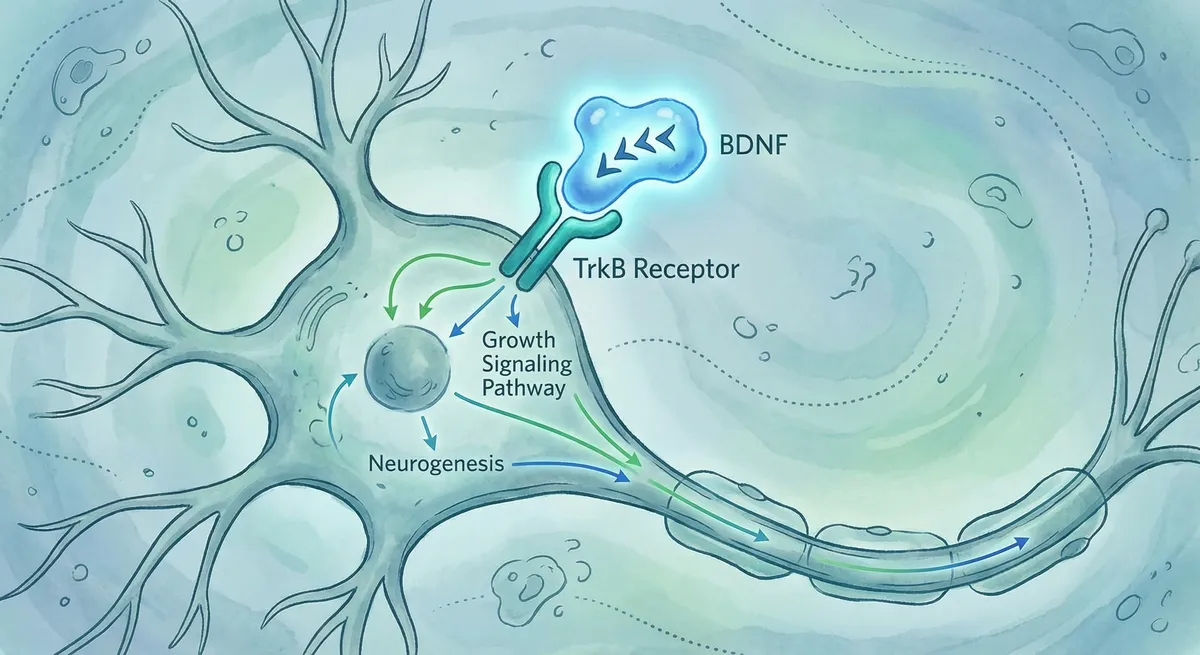
The anti-inflammatory properties of bdellins are mediated through inhibition of trypsin-like proteases involved in tissue degradation at the inflammatory focus. Additionally, both bdellastatin and bdellin B stimulate neurite outgrowth at very low concentrations — an activity attributed to possible interaction with trkA neurotrophin receptors (Fumagalli et al., 1999). This dual anti-inflammatory + neurotrophic profile is shared with eglins, suggesting a conserved evolutionary strategy in Blutegel-SDS.
LDTI — Blutegel-abgeleiteter Tryptase-Inhibitor
4.5 kDa
Molekulargewicht
46 amino acids, non-classical Kazal-type
1.4 nM
Ki (Mast Cell Tryptase)
Einer der wenigen gut charakterisierten natürlichen Tryptase-Inhibitoren.
3
Disulfide Bonds
Compact scaffold allows ring entry
Lösung des Tryptase-Problems
Die vier Monomere der Mastzell-Tryptase bilden eine ringförmige Struktur mit vier aktiven Zentren, die in einen begrenzten, ovalen Innenraum gerichtet sind, wodurch sie für Inhibitoren mit hohem Molekulargewicht unzugänglich werden (Pereira et al., 1998). Diese strukturelle Anordnung erklärt, warum herkömmliche Proteaseinhibitoren die Tryptase nicht blockieren können. LDTI ist einer von nur zwei bekannten natürlichen Tryptaseinhibitoren — der andere ist das Zecken-TdPI. Seine kompakte Struktur von ~4.7 kDa ermöglicht es ihm, in den Tryptase-Ring einzudringen; durch die Besetzung von zwei der vier aktiven Zentren des Enzyms hemmt es etwa die Hälfte der amidolytischen Aktivität der Tryptase und unterdrückt deren mitogene Effekte (Sommerhoff et al., 1994).
| Studie | Design | Population (n=) | Intervention | Primäres Outcome | Ergebnis |
|---|---|---|---|---|---|
| Sommerhoff et al. 1994 | In-vitro-Enzymkinetik | LDTI vs mast cell tryptase, trypsin, chymotrypsin (n=n.v.) | Ki-Bestimmung und substratgrößenabhängiger Inhibitionsassay | Tryptase-Hemmung | Ki = 1,4 nM. Erreicht eine >90%ige Hemmung der Spaltung hochmolekularer Substrate (Kininogen 114 kDa), aber nur eine 50%ige Hemmung niedermolekularer Substrate LDTI ist einer der wenigen gut charakterisierten natürlichen Tryptase-Inhibitoren (ein weiterer ist der Zecken-Inhibitor TdPI). |
| Sommerhoff et al. 1994 | In-vitro-Kinetik | LDTI (n=n.v.) | Ki determination | Trypsin- und Chymotrypsin-Hemmung | Trypsin Ki ~1 nM; Chymotrypsin Ki = 20 nM |
| Various / engineered variants 2000 | Protein-Engineering | LDTI-Varianten 2T und 5T (n=n.v.) | P1 site mutations to introduce thrombin inhibitory activity | Dual tryptase + thrombin inhibition | 5T-Variante: Ki = 2,0 nM für Thrombin bei gleichzeitigem Erhalt der Tryptasehemmung Demonstrates scaffold engineering potential — non-classical Kazal-type → dual-target inhibitor |
Pharmaceutical Engineering Potential
Rekombinantes LDTI (r-LDTI) wurde sowohl in E. coli als auch in Hefe-Expressionssystemen hergestellt. Optimierte Varianten — insbesondere die 5T-Mutante mit Modifikation der P1-Stelle — zeigen, dass das LDTI-Gerüst in einen dualen Tryptase- und Thrombin-Inhibitor umgewandelt werden kann (Ki 2.0 nM für Thrombin). Zusätzlich hemmt LDTI in einer Konzentration von 20 µM die HIV-1-Replikation. Diese Befunde belegen die pharmazeutische Vielseitigkeit des nicht-klassischen Kazal-Typ-Gerüsts im Rahmen des Protein-Engineerings.
C1s-Komplement-Inhibitor — Blockierung des klassischen Wegs
Molecular Profile
- Molecular weight: 67 kDa
- Zielstruktur: C1s-Untereinheit des klassischen Komplementwegs
- Mechanism: Blocks C1s catalytic activity → prevents C4/C2 cleavage → no C3 convertase formation → attenuates MAC formation
- Downstream effects: Reduced opsonization (C3b), reduced chemotaxis (C3a, C5a), reduced membrane attack (C5b-9)
Moderne pharmazeutische Parallelen
- Sutimlimab (Enjaymo): Humanisierter monoklonaler Antikörper, der gegen C1s gerichtet ist. FDA-zugelassen 2022 für die Kälteagglutininerkrankung. Gleiche Zielstruktur wie der SGS-C1s-Inhibitor.
- Eculizumab (Soliris): Anti-C5-Antikörper. Andere Zielstruktur (weiter stromabwärts in der Kaskade), aber derselbe Signalweg. FDA-zugelassen für PNH und aHUS.
- Ravulizumab (Ultomiris): Anti-C5 der nächsten Generation mit verlängerter Halbwertszeit. Derselbe Signalweg.
Der C1s-Inhibitor des Blutegels stellt eine evolutionär optimierte Anti-Komplement-Strategie dar, die den pharmazeutischen Komplement-Therapeutika um Millionen von Jahren vorausgeht.
Drainage & Vaskuläre Komponenten
Hyaluronidase (Spreading Factor)
Depolymerisiert Hyaluronsäure in der Grundsubstanz des Bindegewebes, erhöht die Gewebedurchlässigkeit und erleichtert die Drainage von entzündlichem Ödem, Exsudat und eitrigem Inhalt. Erzeugt einen „spreitenden“ Effekt, der das Eindringen anderer SGS-Komponenten in das umliegende Gewebe verstärkt. Das gleichzeitige Vorhandensein von Proteaseinhibitoren (Egline, Bdelline) schafft ein ausgewogenes proteolytisches Milieu, das den Gewebeumbau ermöglicht, ohne dass es zu einem unkontrollierten Abbau der Matrix kommt — ein Prinzip, das heute als wesentlich in der Biologie der Wundheilung anerkannt ist.
Kininases — Bradykinin Degradation
SGS-Kininasen bauen Bradykinin und andere pro-inflammatorische Kinine an der Bissstelle und im umliegenden Gewebe ab. Da Bradykinin über B1- und B2-Rezeptoren ein Schlüsselmediator der entzündlichen Schmerzsignalübertragung ist, liefert die Kininase-Aktivität die analgetische Komponente der entzündungshemmenden SGS-Antwort. Dieser Mechanismus erklärt die empirisch beobachtete schmerzlindernde Wirkung der Hirudotherapie — abzugrenzen von den gefäßerweiternden und antithrombotischen Mechanismen, die durch andere SGS-Komponenten vermittelt werden.
Histamine-Like Vasodilator
Bewirkt eine lokale Gefäßerweiterung und eine erhöhte Kapillarpermeabilität. Verstärkt den Blutfluss zur Entzündungszone und erleichtert damit die Rekrutierung von Immunzellen sowie den für die Entzündungsauflösung erforderlichen Stoffwechselaustausch. Der um die Bissstelle des Blutegels beobachtete Erythemsaum wird dieser Substanz zugeschrieben. Anders als die pathologische Histaminfreisetzung (die die Entzündung verstärkt) wirkt der histaminähnliche SGS-Vasodilatator im Zusammenspiel mit entzündungshemmenden Inhibitoren und erzeugt so eine kontrollierte Verstärkung der lokalen Durchblutung anstelle einer Entzündungskaskade.
Dreiphasige antiinflammatorische Kaskade
Die entzündungshemmende Wirkung der Hirudotherapie entfaltet sich über eine zeitlich organisierte Kaskade — mit einer sofortigen, einer frühen und einer anhaltenden Phase —, die jeweils durch unterschiedliche Kombinationen von SGS-Komponenten und mechanischen Effekten vermittelt wird.
Phase 1: Immediate (Minutes)
- Histaminähnliche Gefäßerweiterung verstärkt den lokalen Blutfluss zur Bissstelle und zum umliegenden Gewebe
- Hyaluronidase erhöht die Gewebedurchlässigkeit und erleichtert so das Eindringen des SGS sowie die Drainage bestehender Ödeme
- LDTI blockiert die Mastzelltryptase und verhindert dadurch die Verstärkung der entzündlichen Signalkaskade durch degranulierende Mastzellen
- Eglin c inhibits mast cell chymase (Ki 44.5 nM), providing additional mast cell stabilization
Phase 2: Early (Hours)
- Eglin b/c hemmen die neutrophile Elastase (Ki 0.2 nM) und Cathepsin G (Ki 0.25 nM) und blockieren damit die Achse der neutrophilenvermittelten Gewebeschädigung
- Bdelline hemmen trypsinähnliche Proteasen im Entzündungsherd (Ki 0.1 nM für Bdellin B3)
- C1s complement inhibitor attenuates classical complement pathway activation
- Kininases degrade bradykinin — analgesic effect
- Blood extraction + prolonged bleeding provide mechanical drainage of edema, exudate, and purulent contents (5–15 mL feeding + 30–50 mL post-detachment bleeding)
Phase 3: Sustained (Days–Weeks)
- Verbesserte Mikrozirkulation erhöht die O₂-Spannung im Kapillarblut am Entzündungsort
- Verstärkte Lymphdrainage beschleunigt die Beseitigung von Entzündungsmediatoren und Stoffwechselabfallprodukten
- Leukozytose und gesteigerte phagozytäre Aktivität — die Stimulation der angeborenen Immunität fördert die immunvermittelte Abheilung
- Korrektur des Gleichgewichts zwischen Lipidperoxidation und antioxidativer Abwehr (dokumentiert von Gileva, 1997)
Dual Systemic + Local Mechanism
Klinische Evidenz in 8 Fachgebieten
Entzündungshemmende Wirkungen der Hirudotherapie wurden in chirurgischen, gynäkologischen, zahnmedizinisch/kieferchirurgischen, hals-nasen-ohrenärztlichen, ophthalmologischen, rheumatologischen, gefäßmedizinischen und urologischen Anwendungsbereichen dokumentiert. Der Großteil der Evidenz entspricht Level III–IV (Fallserien, Beobachtungsstudien). Kein randomisiert-kontrollierter Versuch (RCT) hat den entzündungshemmenden Endpunkt gezielt untersucht.
| Studie | Design | Population (n=) | Intervention | Primäres Outcome | Ergebnis |
|---|---|---|---|---|---|
| Gileva 1997 | Experimentelles Entzündungsmodell | Mund-Kiefer-Gesicht-Entzündungserkrankungen (n=n.v.) | Hirudotherapie | Antiexsudative Wirkung, angeborene Immunabwehr | Significantly pronounced anti-exudative action; stimulated innate immune defense (phagocytosis, lysozyme activity, CIC levels, lipid peroxidation-antioxidant defense correction) Erster kontrollierter experimenteller Nachweis des entzündungshemmenden Mechanismus der SGS |
| Zidra et al. 1997 | Klinische Fallserie | Chronische Parodontitis, Periostitis, Alveolitis (n=n.v.) | Hirudotherapie — systemische und lokale Anwendung | Antiinflammatorische Auflösung | Sowohl eine systemische als auch eine lokale entzündungshemmende Wirkung wurde dokumentiert. Erfolgreich als Ergänzung zur konventionellen entzündungshemmenden Therapie bei komplizierter Zahnkaries eingesetzt Nachweis eines dualen systemischen + lokalen Wirkmechanismus; die Fallserie umfasste Publikationen aus den Jahren 1995 und 1997 |
| Unkontrollierter Bericht (nicht verifizierbar) 1998 | Fallserie | Eitrige chirurgische Wunden (n=59) | HT in der postoperativen Phase nach chirurgischem Débridement | Postoperative Wundkomplikationen | Deutlich reduzierte Komplikationen. Verbesserte mikrozirkulatorische Sauerstoffspannung, verringerte kompensierte Alkalose im Wundgewebe, vermindertes Suppurationsrisiko Largest surgical anti-inflammatory dataset |
| Platonova 1998 | Fallserie | Postpartale Frauen mit infizierten perinealen und Kaiserschnitt-Nähten (n=n.v.) | Hirudotherapie an infizierten Nahtstellen | Antiinflammatorische Auflösung der Wundinfektion | Dokumentierte antiinflammatorische Wirkung mit beschleunigter Rückbildung postpartaler Wundinfektionen |
| Gromova 2000 | Fallserie | Akute und chronische Salpingo-Oophoritis (n=n.v.) | Hirudotherapie | Antiinflammatorische Wirkung bei entzündlicher Beckenerkrankung | Beschleunigte Rückbildung der Salpingo-Oophoritis bei verminderten Entzündungsmarkern |
| Unkontrollierter Bericht (nicht verifizierbar) 1992 | Fallserie mit mikrobiologischer Bewertung | Otitis-Patienten (n=n.v.) | HT-Sitzungen und SDS-Elektrophorese | Otitis-Auflösung, mikrobielle Zahlen | Beseitigte die Otitis und reduzierte die Keimzahl auf der Oberfläche des äußeren Gehörgangs Kombinierte direkte Applikation und SGS-Elektrophorese |
| Moskalenko 2001 | Fallserie | Akute Sinusitis (n=n.v.) | Hirudotherapie | Antiinflammatorische Auflösung | Anti-inflammatory agent effective in acute sinusitis |
| Magomedov 1998 | Fallserie mit Kontrollen | Thrombophlebitis (n=n.v.) | Hirudotherapie an Thrombophlebitis-Stelle | Antiinflammatorische und antithrombotische Wirkungen | Dokumentierte antiinflammatorische und antithrombotische Wirkung mit kontrolliertem Vergleich Eine der wenigen Studien mit Kontrollgruppe |
| Eldor et al. 1998 | Klinische Studie | Postthrombotisches Syndrom (n=n.v.) | Hirudotherapie | Antiinflammatorische Wirkungen bei chronischer Venenerkrankung | Confirmed anti-inflammatory benefit in post-thrombotic syndrome |
| Savinov & Kuchersky 1998 | Fallserie | Torpide chronische Prostatitis (n=n.v.) | Hirudotherapie — perineale Anwendung | Prostatadrainage und klinische Verbesserungsrate | Verbesserte die Drainagefunktion der Prostata; erhöhte die Rate der klinischen Besserung. Die Wirkung wird der Wiederherstellung der SGS-Mikrozirkulation sowie den bakteriostatischen und antiinflammatorischen Eigenschaften zugeschrieben |
| Antipina 1997 | Fallserie | Gesichtskarbunkel und -furunkel (n=n.v.) | Hirudotherapie — direkte Anwendung an der Läsion | Auflösung eitriger Hautläsionen | Frühere Rückbildung des Weichteilödems, Verringerung der Hyperämie, Sistieren der Wundexsudation, beschleunigte Granulation und Epithelisierung |
| Bondarevsky 1998 | Fallserie | Erysipel, genitaler Papillomvirus, Morbus Reiter, urogenitale Chlamydiose (n=n.v.) | Hirudotherapie | Auflösung entzündlicher Prozesse | Favorable results across all conditions. Inflammatory processes diminished; morphological tissue structure restored Breitestes Spektrum infektiöser/entzündlicher Indikationen in einer einzelnen Publikation |
| Starodubskaya 1998 | Fallserie | Gelenkerkrankungen (rheumatologisch) (n=n.v.) | Hirudotherapie an betroffenen Gelenken | Antiinflammatorische Wirkung | Documented anti-inflammatory action in joint diseases |
| Shpolyansky 1944 | Fallserie | Parametriale und peritoneale Infiltrate (n=n.v.) | Hirudotherapie | Auflösung entzündlicher Infiltrate | Beschleunigte Rückbildung/Resorption parametraner und peritonealer Infiltrate, verhinderte die Abszessbildung Historisch — unter den frühesten dokumentierten gynäkologischen antiinflammatorischen Anwendungen |
| Fachgebiet | Studien | Wichtige Befunde | Stufe |
|---|---|---|---|
| Chirurgisch | Unkontrollierter russischsprachiger Bericht (nicht unabhängig überprüfbar) | Verminderte Wundkomplikationen, verbesserter O₂-Druck, verminderte Eiterung | III |
| Mund-Kiefer-Gesicht | Gileva 1997; Zidra 1995, 1997 | Antiexsudative Wirkung; eingesetzt als Ergänzung zur konventionellen Therapie | III |
| Gynäkologisch | Shpolyansky 1944; Platonova 1998; Gromova 2000; Kurgina 2000 | Auflösung von Infiltraten, postpartaler Infektion, Salpingo-Oophoritis | III–IV |
| Hals-Nasen-Ohren | Unkontrollierte, nicht indexierte russischsprachige Berichte (nicht unabhängig überprüfbar) | Otitis eliminiert; antiinflammatorisch bei Sinusitis/chronischer Otitis | III–IV |
| Vaskulär | Magomedov 1998; Eldor 1998 | Antiinflammatorisch bei Thrombophlebitis und PTS | III |
| Dermatologisch | Fedorova 1946; Antipina 1997 | Beschleunigte Furunkel-/Karbunkel-Auflösung | IV |
| Urologisch | Savinov & Kuchersky 1998 | Verbesserte Prostatadrainage, erhöhte klinische Verbesserungsrate | III |
| Rheumatologisch | Unkontrollierter Bericht (nicht verifizierbar) | Antiinflammatorische Wirkung bei Gelenkerkrankungen | IV |
Empirical Safety Observation
Intrinsischer entzündungshemmender Schutz an der Bissstelle
Über Jahrzehnte klinischer Erfahrung wurde eine konsistente empirische Beobachtung in unkontrollierten russischsprachigen Berichten (nicht unabhängig verifizierbar) festgestellt: eine niedrige Rate lokaler Infektionen selbst unter nicht idealen aseptischen Bedingungen, im Einklang mit den antimikrobiellen Eigenschaften von leech SGS — obwohl die moderne Praxis sterile Technik verwendet, da leechassoziierte (z. B. Aeromonas) Wundinfektion ein bekanntes Risiko darstellt. Diese Beobachtung — bemerkenswert angesichts der Einführung eines biologischen Agens durch die Hautbarriere — unterstützt die intrinsischen antimikrobiellen und antiinflammatorischen Eigenschaften von leech SGS an der Bissstelle.
Hinweis: Die moderne Praxis erfordert eine standardmäßige antiseptische Hautvorbereitung und sterile Verbandtechnik. Die oben genannte historische Beobachtung wird zitiert, um die schützenden Eigenschaften des SGS zu veranschaulichen, nicht um eine gelockerte Infektionskontrolle zu empfehlen.
Moderne pharmazeutische Parallelen
Das entzündungshemmende Profil des SGS überschneidet sich mit mehreren aktiven Bereichen der modernen pharmazeutischen Entwicklung. Diese Parallelen bestätigen den mechanistischen Rahmen, ohne präklinische SGS-Daten mit der klinischen Wirksamkeit von Arzneimitteln gleichzusetzen.
| SDS Component | Ziel | Modern Drug Parallel | Drug Status |
|---|---|---|---|
| Eglins b/c | Neutrophile Elastase | Sivelestat (Elaspol) | In Japan/Korea zugelassen für ARDS |
| C1s complement inhibitor | Classical complement C1s | Sutimlimab (Enjaymo) | FDA-zugelassenen 2022 (Kälteagglutininkrankheit) |
| C1s complement inhibitor | Complement pathway | Eculizumab (Soliris) | FDA-zugelassenen (PNH, aHUS) — Ziel C5 |
| LDTI | Mast cell tryptase | Cromolyn sodium (mast cell stabilizer) | FDA-zugelassenen (Asthma, Mastozytose) |
| LDTI | Mast cell tryptase | APC 366, BMS-262084 (tryptase inhibitors) | Klinische Studien für Asthma/CED |
| Eglins b/c | Cathepsin G | Cathepsin G inhibitors (various) | Präklinisch (COPD, RA, CF) |
Multi-Target Paradigm
Aufkommende präklinische Evidenz: Hirudin bei Organfibrose (2025)
Hinweis zu präklinischer Forschung
Die unten dargestellten Befunde beschreiben präklinische Forschung (Netzwerkpharmakologie, molekulares Docking, in vitro und Tiermodelle). Sie stellen keinen Nachweis therapeutischer Wirksamkeit beim Menschen dar. Es wurden keine klinischen Studien zu Hirudin bei renaler Fibrose durchgeführt. Diese Informationen werden zu Bildungszwecken präsentiert, um neue Forschung zu den antiinflammatorischen Signalweg-Interaktionen von Hirudin zu veranschaulichen.
Zwei unabhängige Publikationen aus dem Jahr 2025 haben neuartige antifibrotische Wirkmechanismen von Hirudin identifiziert, die über Signalwege wirken, welche unmittelbar für die auf dieser Seite beschriebene entzündungshemmende Biologie relevant sind. Diese Erkenntnisse erweitern das bekannte pharmakologische Profil von Hirudin über die Antikoagulation hinaus in den Bereich der Organfibrose — ein Feld, in dem chronische Entzündung fortschreitende Gewebeschädigung antreibt.
Hirudin schwächt die renale interstitielle Fibrose über die Nrf2- und NF-κB-Signalwege ab
Naunyn-Schmiedeberg's Archives of Pharmacology, 2025 (PMID 41617993)
Mithilfe eines integrierten Ansatzes, der Netzwerkpharmakologie, molekulares Docking und In-vitro-Validierung kombiniert, zeigten die Forscher, dass Hirudin die renale interstitielle Fibrose durch koordinierte Modulation zweier zentraler Signalwege abschwächt:
Dual Pathway Mechanism
- •Unterdrückung des NF-κB-Signalwegs: Hirudin regulierte TNF-α, MCP-1, phosphoryliertes P65 (p-P65) und phosphoryliertes IκBα (p-IκBα) herunter — Schlüsselmediatoren der proinflammatorischen NF-κB-Signalkaskade, die das Fortschreiten der Fibrose vorantreibt
- •Aktivierung des Nrf2-Signalwegs: Hirudin regulierte Nrf2, HO-1 und SOD-1 hoch — zentrale Regulatoren des antioxidativen Abwehrsystems, das vor durch oxidativen Stress verursachter Gewebeschädigung schützt
- •Die gleichzeitige Unterdrückung der proinflammatorischen Signalgebung (NF-κB) und die Aktivierung der zytoprotektiven Signalgebung (Nrf2) stellen einen antifibrotischen Wirkmechanismus mit dualer Wirkung dar
Relevance to SDS Anti-Inflammatory Biology
Der NF-κB-Signalweg ist ein zentraler Mediator der entzündlichen Genexpression — derselbe Signalweg, der von mehreren SGS-Komponenten adressiert wird (Egline über die Hemmung neutrophiler Proteasen, C1s-Inhibitor über die Komplementblockade). Dieser Befund liefert eine Validierung auf molekularer Ebene dafür, dass Hirudin, wie andere SGS-Komponenten, die Entzündung über definierte intrazelluläre Signalwege moduliert und nicht ausschließlich über die extrazelluläre Thrombinhemmung.
Hirudin Inhibits Ferroptosis in Renal Fibrosis via STAT3/NLRP3 Signaling
Acta Cirurgica Brasileira, 2025 (PMC12036808)
Eine zweite unabhängige Studie aus dem Jahr 2025 identifizierte einen zusätzlichen antifibrotischen Mechanismus: Hirudin hemmt die <strong>Ferroptose</strong> — eine Form des regulierten Zelltods, der durch eisenabhängige Lipidperoxidation angetrieben wird — durch Modulation der STAT3/NLRP3-Signalachse.
Mechanism: STAT3/NLRP3 Ferroptosis Inhibition
- •Ferroptose wird zunehmend als Treiber der Organfibrose erkannt, bei der eisenkatalysierte Lipidperoxidation einen entzündlichen Zelltod auslöst
- •Das NLRP3-Inflammasom verstärkt die Gewebeschädigung, indem es pro-IL-1β und pro-IL-18 in aktive entzündliche Zytokine umwandelt
- •Hirudin moduliert die STAT3/NLRP3-Achse und hemmt den ferroptotischen Zelltod sowie die nachgeschaltete Inflammasom-Aktivierung
- •Dies stellt einen dritten eigenständigen antifibrotischen Signalweg für Hirudin dar (neben der Nrf2-Aktivierung und der NF-κB-Suppression)
Evidence: Hirudin in Organ Fibrosis
| Studie | Design | Population (n=) | Intervention | Primäres Outcome | Ergebnis |
|---|---|---|---|---|---|
| PMID 41617993 2025 | Netzwerkpharmakologie + molekulares Docking + in vitro | Renal interstitial fibrosis models (n=n.v.) | Hirudin | Fibrosis markers, inflammatory mediators, antioxidant markers | Herunterregulierung von TNF-α, MCP-1, p-P65, p-IκBα; Hochregulierung von Nrf2, HO-1, SOD-1. Abschwächung der renalen interstitiellen Fibrose durch duale Modulation des Nrf2/NF-κB-Signalwegs Tandem-Hirudin: oligomeres Mitglied der Hirudin-Familie, das Thrombin NICHT hemmt — was bewirkt es? |
| PMC12036808 2025 | Präklinisch | Renal fibrosis models (n=n.v.) | Hirudin | Ferroptose-Marker und STAT3/NLRP3-Signalübertragung | Hirudin hemmte die Ferroptose durch Modulation der STAT3/NLRP3-Signalübertragung und reduzierte die eisenabhängige Lipidperoxidation sowie die Inflammasom-Aktivierung bei renaler Fibrose Published in Acta Cirurgica Brasileira. Novel mechanism linking hirudin to regulated cell death inhibition |
Cross-Reference: Hirudin in Cancer Biology
Zusätzlich zu den oben beschriebenen antifibrotischen Mechanismen hat die Forschung 2024–2025 die Aktivität von Hirudin in der Krebsbiologie aufgezeigt — Auflösung von Brustkrebs‑CTC‑Clustern über HIF‑1α–DSG2‑Signalweg (Experimental & Molecular Medicine, 2025) und Hemmung des Fortschreitens von DLBCL‑Lymphomen durch PAR‑1–vermittelte Makrophagen‑Reprogrammierung (BMC Biotechnology, 2024). Siehe die Seite Hämostase und Gerinnung für eine detaillierte Darstellung dieser Ergebnisse. Zusammen zeigen diese Studien ein Molekül, dessen biologische Aktivitäten weit über seine etablierte Rolle als Thrombin‑Inhibitor hinausgehen.
Complete Anti-Inflammatory Component Summary
| Komponente | MG | Primary Target | Ki / Potency | Inflammatory Pathway Blocked | Phase |
|---|---|---|---|---|---|
| Eglins b/c | 8.1 kDa | Neutrophil elastase, cathepsin G | 0.2–0.3 nM | Neutrophil-mediated tissue destruction | Früh |
| LDTI | 4.5 kDa | Mast cell tryptase | 1.4 nM | Mast cell amplification cascade | Sofort |
| C1s inhibitor | 67 kDa | C1s complement subcomponent | Stoichiometric | Classical complement cascade | Früh |
| Bdellins A/B | 5.0–6.3 kDa | Trypsin, Plasmin | 0.1–1 nM | Protease-mediated tissue degradation | Früh |
| Hyaluronidase | ~27 kDa | Hyaluronic acid (ECM) | Enzymatic | Tissue edema, spreading | Sofort |
| Kininases | Variabel | Bradykinin, Kinine | Enzymatic | Pain signaling, vascular permeability | Früh |
| Histamine-like | Low MW | Vascular smooth muscle | — | Local vasodilation (controlled, not inflammatory) | Sofort |
Clinical Applications — Anti-Inflammatory as Primary Rationale
The anti-inflammatory action of hirudotherapy operates through both systemic effects on the body and local effects at the inflammatory focus (Zidra et al., 1997). This dual action makes hirudotherapy applicable across a wide range of inflammatory conditions. The following applications use anti-inflammatory effect as the primary therapeutic rationale (as distinct from anticoagulant or decongestive rationale):
Purulent Surgical Conditions
Postoperative Wundinfektionen, Furunkel und Karbunkel. Die Kombination aus Drainage (Hyaluronidase + Blutung), Proteaseinhibition (Eglins) und Förderung der Mikrozirkulation erfasst mehrere Aspekte der Pathophysiologie von Wundinfektionen.
Gynecologic Inflammatory Diseases
Salpingo-Oophoritis, Parametritis, postpartale Wundinfektionen, bakterielle Vaginose. Die Dokumentation reicht von Shpolyansky (1944) bis Gromova (2000). Entzündungshemmende + Drainage-Mechanismen sind besonders relevant für entzündliche Beckenerkrankungen mit Exsudatbildung.
Orales & Maxillofacial
Parodontitis, Periostitis, Alveolitis. Traditionelle Hirudotherapie-Quellen berichten über die Anwendung von Blutegeltherapie als Ergänzung zu konventioneller antientzündlicher Behandlung bei entzündlichen dentalen Erkrankungen, obwohl dies in indexierten Peer-Review-Vergleichsstudien nicht bestätigt wurde.
Vascular & Joint Inflammation
Naunyn-Schmiedeberg's Archives of Pharmacology, 2025 (PMID 41617993)
Die Hirudotherapie sollte als ergänzende entzündungshemmende Modalität innerhalb umfassender Behandlungspläne betrachtet werden und nicht als eigenständiges entzündungshemmendes Mittel. Ihr Multi-Target-Mechanismus kann einen additiven Nutzen bieten, wenn er mit einer konventionellen entzündungshemmenden Therapie kombiniert wird. Diese Anwendungen sind nicht von der FDA zugelassen.
Evidenzlücken & Forschungsprioritäten
Der entzündungshemmende Mechanismus von SDS ist auf molekularer Ebene gut charakterisiert, wobei kinetische Daten eine subnanomolare Wirksamkeit gegen wichtige entzündliche Zielstrukturen belegen. Die klinische Evidenz bleibt jedoch auf Level III–IV — Fallserien und Beobachtungsstudien ohne randomisierte Kontrollen oder standardisierte entzündungshemmende Endpunkte (CRP, ESR, Zytokin-Panels, validierte Entzündungsscores). Zu den zentralen Forschungsprioritäten gehören:
- Kontrollierte Studien mit Entzündungsbiomarkern: CRP, IL-6, TNF-alpha, Marker der Komplementaktivierung (C3a, C5a, sC5b-9) vor und nach der Hirudotherapie
- Quantitative SDS delivery studies: Wie viel von jeder entzündungshemmenden Komponente erreicht tatsächlich den Entzündungsherd? Daten zur Gewebe-Bioverfügbarkeit werden benötigt
- Vergleich mit modernen entzündungshemmenden Wirkstoffen: Direkter Vergleich der entzündungshemmenden Wirkung von SGS mit NSAR, Kortikosteroiden oder Biologika bei bestimmten entzündlichen Erkrankungen
- Dauer der entzündungshemmenden Wirkung: Die anhaltende Phase (Tage bis Wochen) bedarf einer Dokumentation mit seriellen Biomarker-Messungen
- Mechanism attribution: Welche SGS-Komponenten sind primär für die beobachteten klinischen entzündungshemmenden Wirkungen verantwortlich? Komponentenspezifische Studien (rekombinante Egline, LDTI, C1s-Inhibitor) könnten die Zuordnung klären
ASH unterstützt die Entwicklung kontrollierter klinischer Studien mit standardisierten Entzündungsendpunkten, um die entzündungshemmende Wirksamkeit der Hirudotherapie zu quantifizieren und eine evidenzbasierte Integration in die konventionelle entzündungshemmende Therapie zu ermöglichen.
Verwandte Forschung
Novel CRA Protein from Hirudo medicinalis — Complement Regulation
Identification and characterization of a novel complement-regulatory activity (CRA) protein from Hirudo medicinalis salivary gland secretion. The protein modulates complement cascade activation, adding a new immunomodulatory mechanism to the leech’s multi-compound therapeutic arsenal.
Research team (2025) · Biomolecules
Synthetic Oligodeoxynucleotide CpG Motifs Activate Human Complement through Their Backbone Structure and Induce Complement-Dependent Cytokine Release
Bacterial and mitochondrial DNA, sharing an evolutionary origin, act as danger-associated molecular patterns in infectious and sterile inflammation.
de Boer E et al. · Journal of immunology (Baltimore, Md. : 1950)
Air Bubbles Activate Complement and Trigger Hemostasis and C3-Dependent Cytokine Release Ex Vivo in Human Whole Blood
Lepirudin-anticoagulated whole blood with air bubbles activates complement (C3a, C5a, sC5b9 etc.) and triggers C3-dependent thromboinflammation, with C3 inhibition reducing tissue factor and cytokine response.
Storm BS et al. · Journal of immunology
Phagocytosis of live and dead Escherichia coli and Staphylococcus aureus in human whole blood is markedly reduced by combined inhibition of C5aR1 and CD14
Lepirudin-anticoagulated whole blood model demonstrates combined C5aR1/CD14 inhibition reduces 24/28 phagocytosis-induced inflammatory mediators, supporting clinical anti-inflammatory targeting.
Skjeflo EW et al. · Molecular immunology
The IL-1 cytokine family and its role in inflammation and fibrosis in the lung
The IL-1 cytokine family comprises 11 members (7 ligands with agonist activity, 3 receptor antagonists and 1 anti-inflammatory cytokine) and is recognised as a key mediator of inflammation and fibrosis in multiple tissues including the lung.
Borthwick LA · Seminars in immunopathology
Immunomodulatory effects of medicinal leech saliva extract on in vitro activated macrophages
Leech therapy has been utilized in modern and traditional medicine. Leech saliva contains versatile peptides and molecules that can exert anti-microbial, anti-inflammatory, anti-coagulant, and analgesic activities on the patients.
Ayhan H et al. · Immunologic research
Verwandte Ressourcen
Proteinase-Inhibitoren
Vollständige molekulare Profile aller 14+ SDS-Inhibitoren.
Musculoskeletal Evidence
Klinische Daten zu Arthritis und Tendinopathie (Stufe B).
Speicheldrüsensekret
Vollständige Übersicht der SDS-Zusammensetzung.
Neurotrophe Effekte
Gemeinsame neurotrophe Aktivität von Eglinen und Bdellinen.