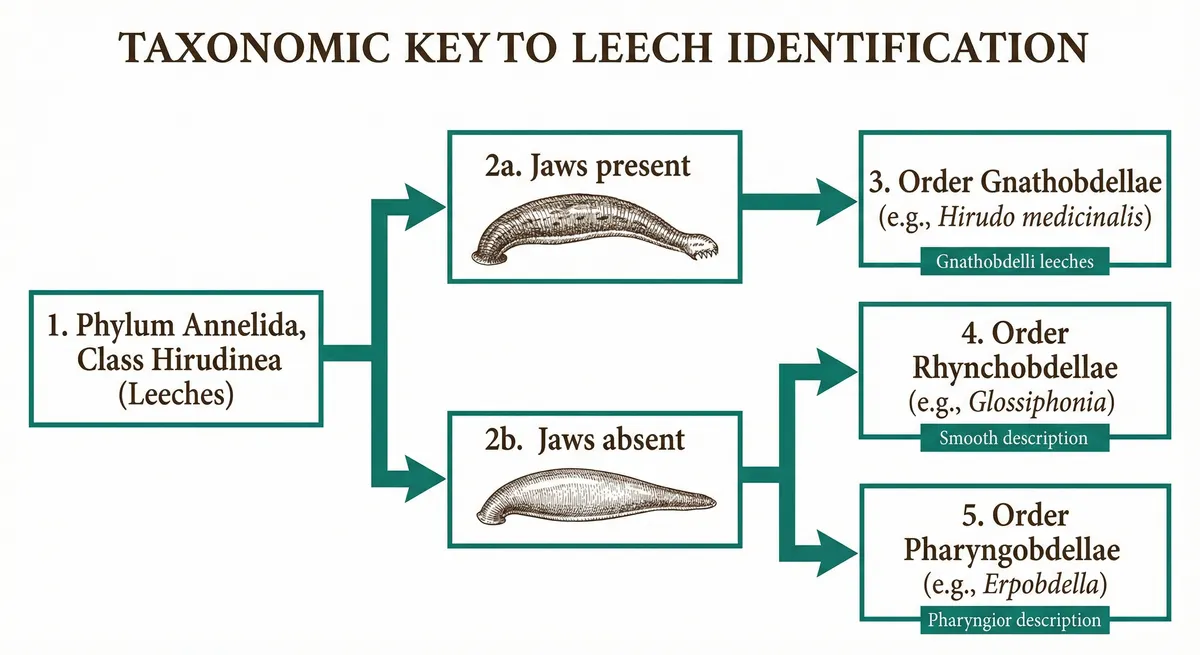
Artenidentifikation für den klinischen Einsatz
Morphologische und molekulare Methoden zur Identifizierung medizinischer Blutegelarten
Identification context: Accurate species ID matters because the 440+ catalogued salivary proteins differ subtly across H. medicinalis/H. verbana/H. orientalis. See the Coverage Map for clinical-evidence coverage, and the Research Roadmap.
18. Juni 2026
Eine genaue Artenidentifikation medizinischer Blutegel ist entscheidend für FDA-Konformität, klinische Standardisierung und Forschungsreproduzierbarkeit. Drei Hauptarten werden in der modernen Hirudotherapie verwendet: H. medicinalis, H. verbana und H. orientalis. Diese Arten teilen ähnliche allgemeine Morphologie, unterscheiden sich aber in dorsalen Mustern, geographischen Verbreitungen und mitochondrialen DNA-Sequenzen.
Why Species Identification Matters
- Unterschiedliche Speichelprofile: Die Hirudin-Isoformen HV1, HV2 und HV3 weisen leicht unterschiedliche Pharmakokinetik auf
- Variable gerinnungshemmende Wirkstärke: Artspezifische Unterschiede bei Calin, Apyrase und anderen Verbindungen
- Immunologisches Risiko: Wiederholte Exposition gegenüber verschiedenen Arten kann das Sensibilisierungsrisiko erhöhen
- FDA-Konformität: Die 510(k)-Freigabe ist an bestimmte Arten von validierten Lieferanten gebunden
- Research reproducibility: Species mislabeling in scientific literature compromises data integrity
Morphologische Identifikationsmethoden
Morphologische Merkmale können eine vorläufige Artbestimmung ermöglichen, sind jedoch nicht eindeutig:
| Merkmal | H. medicinalis | H. verbana | H. orientalis |
|---|---|---|---|
| Dorsale Färbung | Dunkelgrün bis olivbraun | Olivgrün bis braun | Variabel (grün bis braun) |
| Laterale Streifen | Markante rot-braune Bänder | Weniger deutlich, gefleckt | Häufig abwesend oder fragmentiert |
| Ventrale Pigmentierung | Gefleckt (schwarz auf oliv) | Olivgrün, wenige Flecken | Grünlich, variable Fleckung |
| Körpergröße (ausgestreckt) | 15–20 cm | 15–20 cm | 10–15 cm |
Einschränkung: Färbungsmuster sind innerhalb einer Art hochgradig variabel und können sich zwischen Arten überschneiden. Die morphologische Bestimmung allein ist für eine artgerechte Bestätigung in klinischer Qualität unzureichend.
Molekulare Identifikationsmethoden
Molekulare Methoden liefern eine eindeutige Artbestimmung und sind der Goldstandard für die Validierung:
COI-Barcoding (Cytochrom-Oxidase I)
- Mitochondriale Gensequenzierung — Standard-DNA-Barcoding-Locus für Tiere
- ~650 Basenpaar lange Sequenz mit artspezifischer Variation
- Öffentliche Datenbanken (BOLD, GenBank) enthalten Referenzsequenzen
- Kann H. medicinalis, H. verbana, H. orientalis mit >99 % Genauigkeit unterscheiden
ITS2-Marker (Internal Transcribed Spacer 2)
- Region nuklearer ribosomaler DNA
- Höhere intraspezifische Variation — nützlich für Populations-Studien
- Ergänzt COI für eine gründliche Artenvalidierung
Practical Implementation
Lieferanten mit FDA-510(k)-Freigabe sollten mit jeder Charge eine molekulare Validierungsdokumentation (COI-Sequenzdaten) bereitstellen. Institutionelle Apothekenabteilungen können die Lieferantendokumentation überprüfen, ohne selbst eine hausinterne Sequenzierung durchzuführen.
Das Problem der Falschbezeichnung
Mehrere Studien mit molekularer Identifizierung haben gezeigt, dass 30–70 % der kommerziellen medizinischen Blutegel falsch etikettiert sind:
- Die meisten als „H. medicinalis“ verkauften Blutegel sind tatsächlich H. verbana
- Einige Lieferanten verteilen unwissentlich Chargen mit Mischarten
- Historical literature often reports „H. medicinalis“ without molecular confirmation
Diese Falschetikettierung hat erhebliche Auswirkungen auf die Reproduzierbarkeit der Forschung und die klinische Standardisierung.
FDA-Position zur Artenvalidierung
Die FDA-510(k)-Freigabe für medizinische Blutegel ist an bestimmte Lieferanten gebunden, die die Artidentität durch dokumentierte Prozesse validieren. Die FDA schreibt keine molekulare Testung für jede Charge vor, erwartet jedoch:
- Qualitätskontrollsysteme der Lieferanten, die eine Artenvalidierung umfassen
- Rückverfolgbarkeit von der Zuchtanlage bis zur klinischen Versorgung
- Dokumentation morphologischer und/oder molekularer Identifikationsmethoden