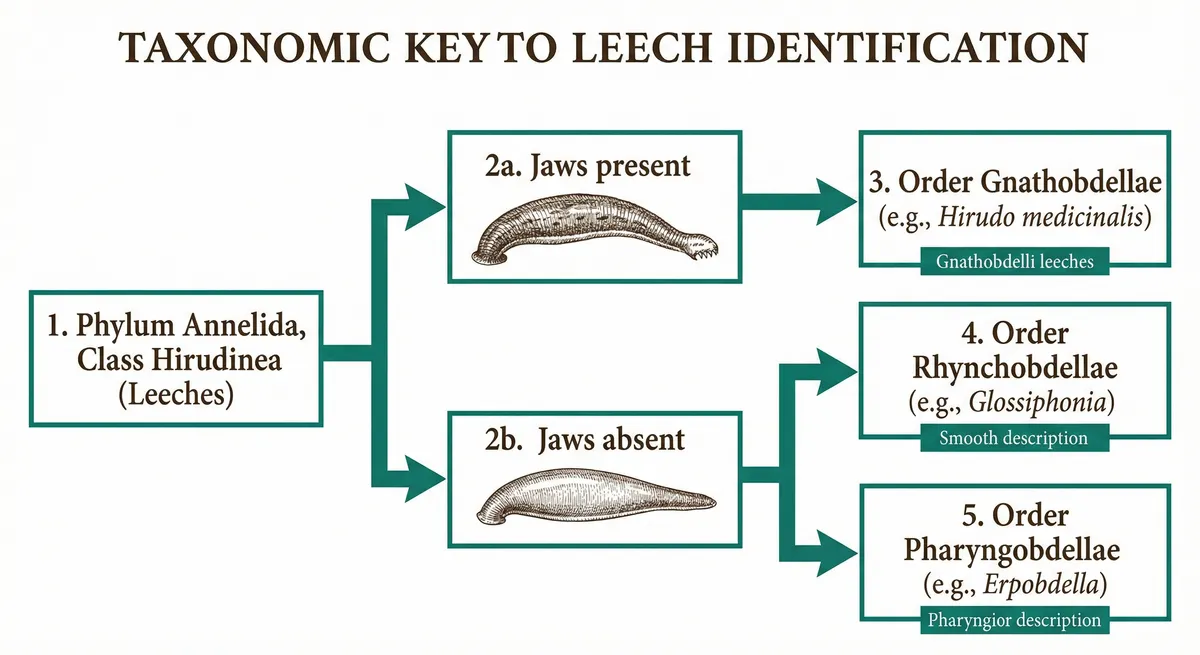
Species Identification for Clinical Use
Morphological and molecular methods for identifying medicinal leech species
Identification context: Accurate species ID matters because salivary protein repertoires differ between species: mass spectrometry identified 189 proteins in H. medicinalis, 344 in H. verbana and 86 in H. orientalis (Babenko et al. 2020). See the Coverage Map for clinical-evidence coverage, and the Research Roadmap.
November 1, 2026
Accurate species identification is critical for clinical standardization because different Hirudo species have distinct salivary profiles, anticoagulant potencies, and potential immunological risks. Unfortunately, morphological identification alone is often unreliable.
Why Species Identification Matters
- Different salivary profiles: HV1, HV2, and HV3 hirudin isoforms have slightly different pharmacokinetics
- Variable anticoagulant potency: Species-specific differences in calin, apyrase, and other compounds
- Immunological risk: Repeated exposure to different species may increase sensitization risk
- FDA compliance: 510(k) clearance is tied to the species named in each sponsor's clearance (H. medicinalis, K040187; H. verbana, K132958)
- Research reproducibility: Species mislabeling in scientific literature compromises data integrity
Morphological Identification Methods
Morphological features can provide preliminary species identification, but they are not definitive:
| Feature | H. medicinalis | H. verbana | H. orientalis |
|---|---|---|---|
| Dorsal coloration | Dark green to olive-brown | Olive-green to brown | Variable (green to brown) |
| Lateral stripes | Prominent red-brown bands | Less distinct, mottled | Often absent or fragmented |
| Ventral pigmentation | Spotted (black on olive) | Olive-green, few spots | Greenish, variable spotting |
| Body size (extended) | 15-20 cm | 15-20 cm | 10-15 cm |
Limitation: Coloration patterns are highly variable within species and can overlap between species. Morphological ID alone is insufficient for clinical-grade species confirmation.
Molecular Identification Methods
Molecular methods provide definitive species identification and are the gold standard for validation:
COI Barcoding (Cytochrome Oxidase I)
- Mitochondrial gene sequencing — standard DNA barcoding locus for animals
- ~650 base-pair sequence with species-specific variation
- Public databases (BOLD, GenBank) contain reference sequences
- Can distinguish H. medicinalis, H. verbana, H. orientalis (mean COI divergence about 8.5–8.6% between species versus under 2% within species; Siddall et al., 2007)
ITS2 Markers (Internal Transcribed Spacer 2)
- Nuclear ribosomal DNA region
- Higher intraspecific variation — useful for population-level studies
- Complements COI for thorough species validation
Practical Implementation
FDA-cleared suppliers should provide molecular validation documentation (COI sequence data) with each batch. Institutional pharmacy departments can verify supplier documentation without conducting in-house sequencing.
The Mislabeling Problem
Molecular identification (Siddall et al., 2007) showed that commercially supplied leeches marketed as H. medicinalis were H. verbana:
- Most leeches sold as “H. medicinalis” are actually H. verbana
- Some suppliers unknowingly distribute mixed-species batches
- Historical literature often reports “H. medicinalis” without molecular confirmation
This mislabeling has significant implications for research reproducibility and clinical standardization.
FDA Position on Species Validation
The FDA 510(k) clearance for medicinal leeches is tied to specific suppliers who name the species of the cleared device in their 510(k) submissions (Hirudo medicinalis for Ricarimpex, Hirudo verbana for Biopharm, and Hirudo verbana, alternatively Hirudo medicinalis, for Carolina Biological). The cleared summaries do not set any molecular-testing or species-validation requirement.
- Supplier quality control systems that include species validation
- Traceability from breeding facility to clinical supply
- Documentation of morphological and/or molecular identification methods