History of Medicinal Leech Therapy
3,500 years from ancient Egypt to modern operating rooms — one of the longest-running therapies in medical history
Last updated: March 14, 2026
Medicinal leech therapy is among the oldest continuously practiced medical interventions in human history, with documented use spanning from ancient Egyptian tomb paintings to present-day microsurgical units in academic medical centers.
Timeline of Key Events
| Date | Event | Significance |
|---|---|---|
| ~1500 BCE | Egyptian tomb frescoes depict leech application | Earliest visual evidence of medicinal leech use |
| ~800 BCE | Sushruta Samhita describes Jalaukavacharana | First systematic medical text on leech therapy |
| 2nd c. BCE | Nicander of Colophon writes on leeches | Greek medical literature integrates leech therapy |
| ~1025 CE | Ibn Sina (Avicenna) Canon of Medicine | Codified leech therapy in Islamic medicine |
| 1820s-1850s | Broussais leech mania — 35-40M/year in France | Peak of leech use, near-extinction of wild populations |
| 1884 | Haycraft discovers anticoagulant in leech extract | First scientific identification of hirudin precursor |
| 1960 | Derganc & Zdravic publish on leech use in flap surgery | Modern clinical rediscovery in microsurgery |
| 1998 | Lepirudin (Refludan) FDA-approved | First recombinant hirudin drug reaches market |
| 2004 | FDA 510(k) clearance K040187 for medicinal leeches | First FDA 510(k) clearance as medical device |
| Present | Standard of care for flap salvage, 7+ investigational uses | Evidence-based integration into modern medicine |
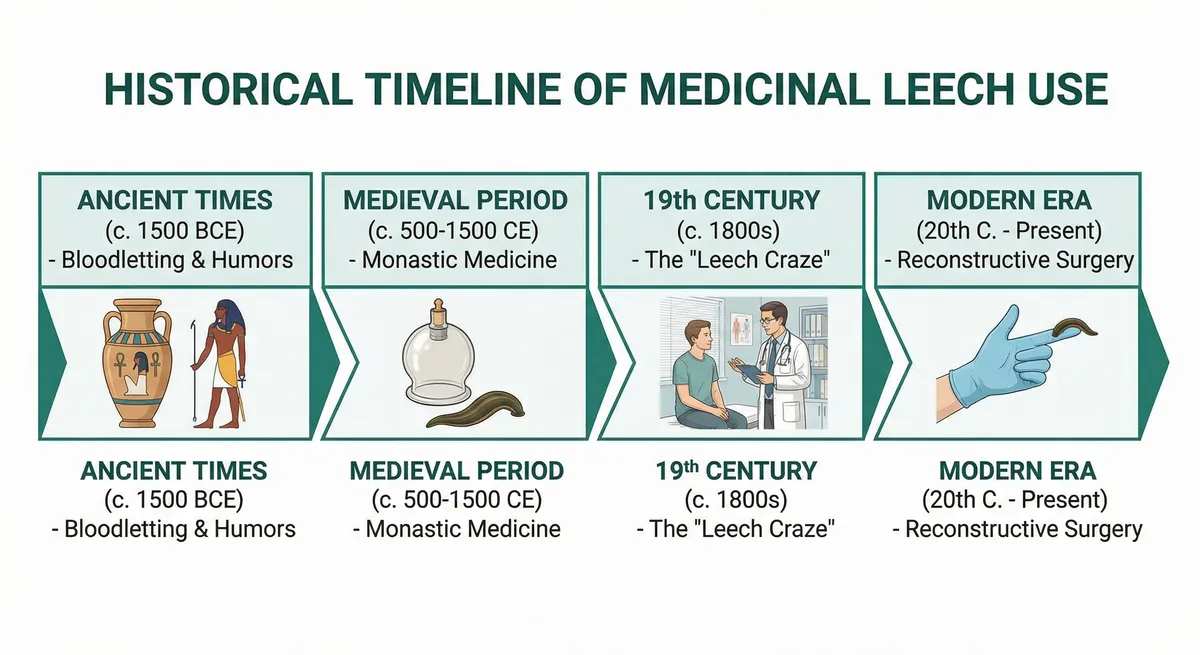
Ancient World (1500 BCE - 500 CE)
The earliest evidence of medicinal leech use appears in Egyptian tomb paintings dating to approximately 1500 BCE. In India, the Sushruta Samhita (~800 BCE) provides the first systematic medical description of leech therapy, known as Jalaukavacharana, describing it as one of the five detoxification procedures (Panchakarma). The Hindu deity Dhanvantari, considered the god of medicine, is often depicted holding a leech.
Greek physicians adopted leech therapy through Hippocratic humoralism. Nicander of Colophon (2nd century BCE) wrote extensively on leeches, and Roman physicians including Pliny the Elder and Galen incorporated leech application into standard medical practice, associating it with bloodletting to restore humoral balance.
Middle Ages (500-1500 CE)
Ibn Sina (Avicenna) codified leech therapy in his Canon of Medicine (~1025 CE), one of the most influential medical texts in history. He described specific conditions for leech application and removal techniques that remained standard for centuries. European monastic medicine preserved and transmitted leech therapy knowledge through the medieval period, with monasteries often maintaining leech ponds.
Peak and Decline (1800-1900)
The early 19th century saw an unprecedented explosion in leech use, driven largely by French physician François-Joseph-Victor Broussais and his theory that all disease stemmed from gastrointestinal inflammation treatable by leeching. France alone consumed 35-40 million leeches per year in the 1830s. England imported approximately 6 million annually. This demand nearly drove Hirudo medicinalis to extinction across Western Europe.
The collapse of humoralism and the rise of germ theory in the mid-19th century led to a dramatic decline in leech therapy. However, in 1884, John Berry Haycraft made a pivotal discovery: leech extracts contained a powerful anticoagulant substance, later isolated and named hirudin — laying the groundwork for modern pharmacological interest.
Modern Revival (1960-2004)
The modern clinical revival began in 1960 when Slovenian surgeons Derganc and Zdravic published the first modern report on using leeches to salvage congested skin flaps. Through the 1970s-1990s, microsurgeons increasingly recognized that venous congestion — a common and devastating complication of free tissue transfer — could be effectively managed with medicinal leeches when surgical revision was not feasible.
This clinical evidence culminated in 2004 when the FDA granted 510(k) clearance (K040187) to medicinal leeches as FDA-cleared medical devices for the relief of venous congestion in grafted or replanted tissue. This was the first time an organism received FDA device clearance.
Present Day (2004+)
Today, medicinal leech therapy is standard of care for flap salvage in reconstructive surgery, with 7+ investigational indications under active clinical study including osteoarthritis, chronic venous insufficiency, and various pain syndromes. The pharmacological legacy continues: leech-derived compounds have produced multiple FDA-approved drugs, including lepirudin (recombinant hirudin, 1998; discontinued 2012), bivalirudin (synthetic analog, 2000), and desirudin (2003).
Living History
Related Resources
Historical Timeline
Key dates in hirudotherapy from antiquity to modern FDA clearance.
Learn more →
Drug Development
From leech to pharmacy - FDA-approved leech-derived drugs.
Learn more →
What Is Hirudotherapy
Overview of medicinal leech therapy.
Learn more →
Clinical Evidence
Systematic reviews and clinical studies.
Learn more →