Ecology, Distribution & Conservation
Habitat requirements, geographic range, behavioral ecology, and conservation status of medicinal leech species
The medicinal leech occupies a paradoxical position in conservation biology: once so abundant that France exported 40+ million specimens annually, now protected under CITES Appendix II and classified as Near Threatened by the IUCN. These organisms require specific freshwater habitats with defined water chemistry (calcium 11–94 mg CaO/L, pH 6.1–9.0; Bennike 1943), regular mammalian host access, freedom from predation pressure, and seasonal temperature cycles governing their behavioral repertoire. The same medical demand that drove 19th-century populations to near-extinction now funds breeding programs that may represent the species’ best hope for survival.
Ecological Overview
Medicinal leeches are free-living ectoparasites (phylum Annelida, subclass Hirudinea) that lead independent aquatic lives punctuated by intermittent blood meals from visiting vertebrates. Three species are recognized in contemporary taxonomy:
| Species | Common Name | Primary Range | Key Ecological Features |
|---|---|---|---|
| Hirudo medicinalis L. | European medicinal leech | Northern/central Europe (UK, Scandinavia, northern France, Germany, Poland) | Lithophilic (prefers rocky substrate); most restricted range; strongest CITES concern |
| Hirudo verbana Carena | Southern European medicinal leech | Southern/southeastern Europe (Italy, Balkans, Turkey, southern France) | Dominant commercial species; historically misidentified as H. medicinalis; muddy substrate preference |
| Hirudo orientalis Utevsky & Trontelj | Eastern medicinal leech | Caucasus, Iran, Central Asia, Near East | More aggressive than congeners (Kamenev 2001); warm-adapted; least studied ecologically |
The taxonomic clarification (Trontelj & Utevsky 2012) has profound implications: for two centuries, all three were traded as H. medicinalis, conflating CITES and Red List data. True H. medicinalis sensu stricto may be the most imperiled.
Ecological Niche Summary
The medicinal leech occupies a narrow ecological niche defined by four essential requirements (Lukin 1976): (1) regular visits by mammalian hosts to the water body — leeches require blood meals for growth and reproduction; (2) absence of many predators, particularly the horse leech (Haemopis sanguisuga); (3) sufficient water warming during spring and summer to support metabolic activity and cocoon development; and (4) suitable shoreline conditions for cocoon deposition above the waterline. The loss of any single requirement renders a habitat unsuitable, explaining the species’ vulnerability to habitat-level changes.
Habitat Requirements
Preferred habitats: shallow marshes with emergent vegetation (reeds, cattails), ponds, quiet backwaters, irrigation ditches, and rice paddies (Livanov 1940; Lukin 1976; Sawyer 1986). The common thread is calm, vegetated freshwater with shoreline access.
Water Chemistry
Bennike (1943) established quantitative water chemistry parameters from Danish habitats. Leeches were absent from calcium-poor acidic waters regardless of other habitat suitability.
| Parameter | Range | Significance |
|---|---|---|
| Calcium (as CaO) | 11–94 mg/L | Essential for hemostatic function, cocoon formation, and cuticular integrity. Populations absent below 11 mg CaO/L. |
| pH | 6.1–9.0 | Tolerates mildly acidic to alkaline conditions. Strongly acidic waters (<6.0) are unsuitable. |
| Dissolved oxygen | Moderate to high | Undulatory body movements indicate O₂ deficiency. May crawl out of water to alleviate hypoxia. |
| Temperature | Thermophilic range | Requires seasonal warming for activity. Cannot survive deep freezing. Poorly adapted to extreme heat. |
Substrate Preferences
H. medicinalis sensu stricto is lithophilic — preferring rocky substrate, spending time near shoreline under stones and submerged vegetation (Lukin 1976). H. verbana shows greater tolerance for muddy bottoms, partly explaining its broader distribution. The shoreline zone is critical for reproduction: cocoons are deposited in moist soil above the waterline. Habitats lacking suitable shoreline (steep banks, concrete channels, trampled margins) cannot support breeding populations regardless of water quality.
Ideal Habitat Characteristics
- Stagnant or slow-moving freshwater with muddy or rocky bottom
- Shallow margins with emergent vegetation (reeds, cattails, sedges)
- Calcium-rich water (11–94 mg CaO/L) with pH 6.1–9.0
- Gentle shoreline gradient for cocoon deposition
- Regular mammalian visitors (livestock watering points historically ideal)
- Low predator density, particularly absence of horse leeches
- Seasonal temperature cycle: warm summers, non-freezing winters
Unsuitable Habitat Features
- Fast-flowing water (rivers, streams with strong current)
- Deep water without vegetated shallow margins
- Calcium-poor, strongly acidic waters (pH <6.0)
- Biotopes subject to deep freezing
- Desiccating water bodies (temporary pools, seasonal streams)
- Steep or artificial banks without moist soil for cocoons
- Polluted waters (agricultural runoff, industrial contaminants)
- No mammalian access (fenced, isolated water bodies)
Geographic Distribution
Natural populations are concentrated in the temperate Palearctic, with three species occupying largely allopatric ranges. The genus is thermophilic but poorly adapted to extreme heat; deep freezing is lethal (Lukin 1976), confining Hirudo to a band from western Europe through the Caucasus to Central Asia.
Distribution by Species
| Region | Dominant Species | Status | Notes |
|---|---|---|---|
| N. Europe (UK, Scandinavia, N. Germany) | H. medicinalis | Rare / endangered | Depleted by 19th-c. harvesting; isolated relicts |
| S. France, Italy, Balkans | H. verbana | More common | Primary historical trade source |
| Turkey, Greece | H. verbana / H. orientalis | Variable | Species overlap zone |
| Caucasus | H. orientalis | Relatively stable | Less affected by commercial harvesting |
| Central Asia | H. orientalis | Poorly documented | Ecological data sparse |
| S. European Russia | H. medicinalis / H. verbana | Depleted | Range contracted (Voskresensky 1859) |
| W. Siberia | H. medicinalis (rare) | Extremely rare | Marginal populations |
| E. Siberia, N/NE Russia | Absent | N/A | Deep freezing precludes establishment |
Historical accounts record harvesting in Siberian and central Russian territories during the 19th-century boom (Voskresensky 1859), suggesting a broader historical range. The complete absence of modern records from these regions implies contraction under combined overharvesting and habitat loss.
Taxonomic Confusion and Conservation Consequences
Until molecular phylogenetics clarified species boundaries (Utevsky et al. 2010; Trontelj & Utevsky 2012), all three species were recorded under H. medicinalis. CITES trade data and Red List assessments cannot be reliably attributed to any single species. The commercially dominant H. verbana was misidentified for two centuries; assessments for true H. medicinalis may underestimate its decline.
Seasonal Activity Cycle
The annual cycle is governed by temperature and photoperiod. Vitet’s observations (1809) — the earliest documented seasonal profile — remain consistent with modern findings.
| Season | Activity Level | Feeding Behavior | Bite Characteristics | Post-Detachment Bleeding |
|---|---|---|---|---|
| Spring | High — post-dormancy energy deficit | Pierces with considerable force and speed; vigorous attachment | Maximum bite force; rapid incision | Heavy and prolonged bleeding (maximal SGS potency) |
| Summer | Peak — reproductive season | High activity; frequent host-seeking | Strong attachment; reduced blood volume per meal | Moderate bleeding |
| Autumn | Declining — pre-dormancy fattening | Less active; slower to attach | Weaker bite; deliberate movements | Scant bleeding; blood coagulates rapidly at bite site |
| Winter | Minimal — dormancy | Sluggish; frequently detaches before completing meal | Weak, incomplete incision | Minimal bleeding; rapid clotting |
Dormancy Cycles
Leeches undergo two dormancy periods annually. In autumn, winter dormancy (hibernation): burrowing into substrate, reducing metabolic rate, ceasing feeding. In summer drought, summer dormancy (aestivation): retreating into moist soil beneath the receding waterline, emerging with rising water. This dual strategy adapts to Mediterranean and continental climates where water availability fluctuates dramatically.
Behavioral Ecology
Behavior alternates between two states: host-seeking (active) and post-feeding (quiescent), each with distinct sensory priorities.
Phototaxis and Shelter-Seeking
Satiated leeches exhibit negative phototaxis, retreating beneath stones and vegetation — reducing predation risk during the months-long digestion period. Hungry leeches show the opposite: they orient toward sunlit, open water where hosts are most likely to enter (Lukin 1976). This state-dependent switch is among the most dramatic behavioral changes in invertebrate biology.
Host-Seeking Behavior
Host detection operates through multiple sensory modalities:
Mechanoreception
Water surface waves and substrate vibrations caused by approaching animals attract leeches from considerable distances (Young et al. 1981). Sensory cells distributed along the body detect minute pressure changes in the water column.
Chemoreception
Mammalian scent — including skin secretions, sweat compounds, and carbon dioxide — orients directional movement. Chemoreceptors concentrated in the anterior sucker and on the lip segments guide final approach to the host.
Thermoreception
Temperature gradients created by warm-blooded hosts in cool water provide a reliable proximity signal. Leeches orient toward heat sources, using thermal sensing to locate optimal attachment sites on the host body.
These three modalities create a hierarchical detection system: mechanical disturbances trigger searching at long range, chemical gradients guide swimming at medium range, and thermal sensing identifies attachment sites at close range — enabling host location even in turbid, vegetated water.
Age-Dependent Aggression & Oxygen-Seeking
Juveniles are consistently more aggressive than adults — higher metabolic demands prevent the 6–18 month fasting intervals that adults tolerate. Under low dissolved oxygen, leeches display undulatory body movements increasing cutaneous gas exchange. In severe hypoxia, they may crawl out of water entirely.
Locomotion
Three distinct modes enable exploitation of microhabitats from mudflats to open water:
1. Crawling
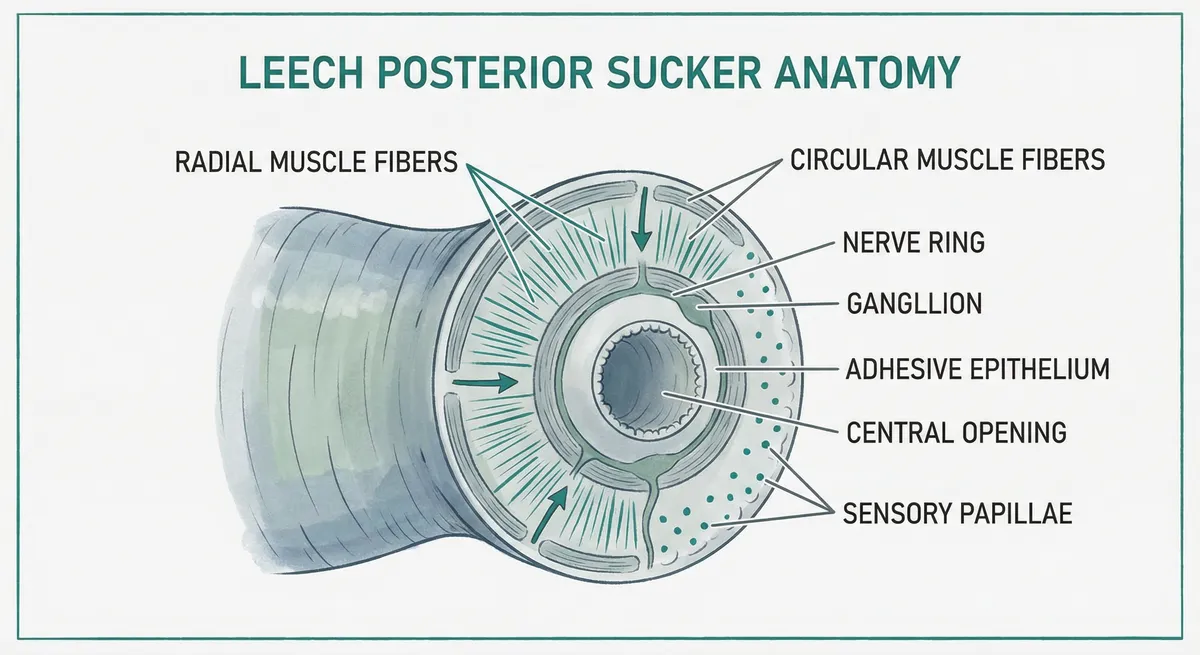
Peristaltic muscular contraction without sucker involvement. Longitudinal and circular muscles contract sequentially, producing elongation-compression cycles. Used on moist substrate and during overland movements. Slowest mode: ~1–3 cm/min.
2. Stepping (Inchworm Gait)
Posterior sucker attaches → body extends → anterior sucker probes and attaches → posterior releases → body arches in loop. Primary mode on solid surfaces (rocks, host skin). Anterior probing incorporates sensory assessment. Speed: ~5–10 cm/min.
3. Swimming
Undulatory dorsoventral movement. Body flattens and propagates sinusoidal waves anterior to posterior, generating thrust. Both suckers retracted. Fastest mode: up to 30 cm/s sustained, higher in escape bursts. Used for long-range host approach and predator escape.
The neural control of these modes involves distinct pattern-generating circuits in the ventral nerve cord. Transitions between modes are discrete, not gradual — the leech switches pattern generators based on substrate availability, water depth, and motivational state (hungry vs. satiated).
Sensory Ecology
Despite lacking image-forming eyes (only ocelli for light/dark discrimination), medicinal leeches detect and localize hosts from meters away via four integrated sensory modalities.
Mechanoreception (long range, >1 m): Young et al. (1981) demonstrated acute response to water surface waves and substrate vibrations. Segmental sensillae detect pressure fluctuations from a wading mammal at several meters. The system discriminates patterns — rhythmic low-frequency waves elicit approach; irregular disturbances trigger avoidance.
Chemoreception (medium range, 10 cm–1 m): Leeches orient toward dissolved mammalian signals — CO₂, ammonia, lactic acid, sebum compounds. Anterior lip segments have highest chemoreceptor density for fine gradient tracking.
Thermoreception (short range, <10 cm): Detects gradients <1°C around warm-blooded hosts. On skin, guides to sites of superficial blood flow — explaining preferential attachment over veins and congested areas.
Photoreception: Five pairs of ocelli mediate state-dependent phototaxis: light avoidance when satiated, light attraction when hungry — positioning for host encounter.
Multimodal Integration Model
Hierarchical by range: (1) Mechanoreception triggers searching; (2) chemoreception guides directional swimming; (3) thermoreception localizes attachment sites; (4) contact assessment before bite. Explains host location in complete darkness and turbid water.
Predator-Prey Relationships
Medicinal leeches occupy a mid-trophic position in freshwater food webs. Predator community composition is one of Lukin’s (1976) four essential habitat requirements — populations cannot persist where predation pressure is high.
Known Predators
| Predator | Taxonomic Group | Predation Mode | Impact |
|---|---|---|---|
| Horse leech (Haemopis sanguisuga) | Hirudinea | Ingests whole or tears apart | Major — habitat exclusion |
| Water vole (Arvicola amphibius) | Rodentia | Opportunistic aquatic foraging | Moderate |
| Desman (Desmana moschata) | Insectivora | Bottom-foraging | Moderate (historical; desman itself endangered) |
| Diving beetles (Dytiscus spp.) | Coleoptera | Larvae attack juveniles | Moderate — juvenile recruitment |
| Water bugs (Nepidae, Notonectidae) | Hemiptera | Piercing-sucking on juveniles | Minor to moderate |
| Dragonfly larvae | Odonata | Ambush predation | Minor — small individuals |
| Waterfowl | Aves | Visual foraging in shallows | Variable |
| Freshwater turtles | Reptilia | Opportunistic (suspected) | Uncertain |
Host Preferences and Attack Success
Leeches can attach to all vertebrate classes but show clear preferences. They are particularly inclined to attack frogs (permeable skin, aquatic habits, reliable encounters; Lukin 1976). Among mammals, ungulates visiting water historically provided primary blood meals; decline of wild mammals and fencing of livestock from water bodies has removed this interaction. Leeches are less successful with fast-swimming fish and largely indifferent to reptiles (protective integument + rare habitat overlap).
The Horse Leech Problem
Haemopis sanguisuga does not feed on blood — it is a macrophagous predator consuming invertebrates including other leeches. Its presence effectively excludes medicinal leech populations. Lukin (1976) listed horse leech absence as one of four essential habitat requirements. Conservation and reintroduction programs must assess horse leech density before selecting sites.
Species Behavioral Differences
Kamenev (2001) established key behavioral distinctions between the three species with direct clinical and aquaculture relevance:
| Behavioral Trait | H. medicinalis | H. orientalis | H. verbana |
|---|---|---|---|
| Aggressiveness | Moderate | High — consistently more aggressive | Moderate to high |
| Attachment speed | Moderate (1–5 min typical) | Fast (<1–3 min typical) | Moderate (1–5 min typical) |
| Substrate preference | Lithophilic (rocky) | Variable | Muddy bottoms |
| Temperature tolerance | Cool-temperate | Warm-adapted | Warm-temperate |
| Geographic range | Most restricted (N. Europe) | Caucasus, Central Asia | Broadest (S/SE Europe) |
| Commercial availability | Rare | Moderate (regional) | Dominant commercial species |
Wild-Caught vs. Captive-Bred Behavior
Kamenev (2001) documented that captive-bred specimens are less mobile and aggressive than wild-caught — accustomed to provisioned feeding, they show reduced host-seeking motivation and slower attachment. Aggressiveness also fluctuates with husbandry: temperature, feeding frequency, stocking density, and water quality all influence behavioral vigor.
The greater aggressiveness of H. orientalis has led some practitioners to prefer it for clinical use. However, the vast majority of leeches in international commerce are H. verbana, reflecting its broader range and established aquaculture infrastructure.
Conservation Status
One of the most extensively protected invertebrates, listed at international, continental, and national levels:
| Framework | Status | Implications |
|---|---|---|
| CITES Appendix II | Listed under Hirudo medicinalis | International trade regulated; export permits required |
| IUCN Red List | Near Threatened (NT) | Global population declining; approaching Vulnerable criteria |
| European Red List | Listed (Utevsky et al. 1999) | Requires conservation action across European range |
| Germany | Endangered / strictly protected | Wild collection prohibited; habitat protection mandated |
| France | Protected species | Wild harvesting prohibited |
| United Kingdom | Wildlife & Countryside Act 1981 | Schedule 5 species; protected from killing, injuring, trade |
| Scandinavia | Various protected listings | Extremely sparse northern populations |
| Russia | Regional Red Lists | Multiple regional Red Data Books |
A critical limitation: the CITES entry covers “Hirudo medicinalis” without distinguishing the three now-recognized species. Whether H. verbana and H. orientalis are automatically covered is legally ambiguous, creating enforcement gaps. Conservation biologists advocate species-level listing.
Historical Population Decline
At the peak of “leech mania” (1830s–1840s), European medicine consumed hundreds of millions annually, driving catastrophic declines across the continent.
Scale of Exploitation
| Country | Period | Volume | Source |
|---|---|---|---|
| France | 1830s | 40–57M exported/yr; 100M+ total consumed | Trade records |
| Russia | 1840s–50s | 30M+ exported to W. Europe annually | Voskresensky 1859 |
| Hungary | 1830s–40s | Major exporter to France, Germany, Britain | Commercial records |
| Ottoman Empire | 1820s–60s | Tens of millions from Anatolian wetlands | Commercial records |
| United Kingdom | 1830s | 7–9M imported/yr (London hospitals) | Hospital records |
Under Broussais (1772–1838), Paris alone consumed 5–6 million/year. When domestic supplies collapsed, France sourced from Russia, Hungary, Turkey, and the Balkans. As theories fell from favor, the trade contracted — but ecological damage was done. Populations reduced by orders of magnitude; Voskresensky’s (1859) Siberian populations are no longer detectable.
The Leech Collectors
Professional “leech gatherers” waded barefoot into marshes, using their legs as bait. Dangerous, poorly compensated labor — chronic blood loss and infections. Wordsworth immortalized the occupation in his 1802 poem “Resolution and Independence,” describing an elderly collector who noted leeches were becoming scarce — an early witness to population decline.
Current Threats
Modern threats are primarily habitat-based. Even populations that survived the harvest era face compounding pressures:
Habitat Destruction
- Wetland drainage: Agricultural conversion has eliminated vast marsh/pond habitat. The EU has lost an estimated 50–90% of original wetland area.
- Channel modification: Straightening, deepening, and concrete-lining eliminates shallow vegetated margins.
- Shoreline development: Urbanization and bank hardening destroy cocoon deposition sites.
- Field fragmentation: Roads and agricultural intensification isolate remaining wetland fragments, preventing genetic exchange.
Pollution & Water Quality
- Agricultural runoff: Pesticides and fertilizer-driven eutrophication cause oxygen depletion.
- Industrial contaminants: Heavy metals accumulate through ingested blood with unknown population effects.
- Pharmaceutical residues: Anticoagulants and endocrine disruptors may affect physiology and reproduction.
- Acidification: Acid rain lowers pH below the 6.1 threshold (Bennike 1943), rendering waters unsuitable.
Climate Change
- Altered precipitation: Increased drought may convert permanent habitats to seasonal ones.
- Temperature extremes: Heat events raise water temperatures above tolerance and reduce dissolved O₂.
- Phenological mismatch: Shifting timing may decouple leech activity from host availability.
- Range shift: Northern expansion theoretically possible but fragmentation prevents colonization of newly suitable areas.
Loss of Mammalian Hosts
- Livestock management: Modern practices fence livestock from water bodies, removing the primary blood meal source.
- Wild mammal decline: Fewer large mammals (wild boar, deer) visiting wetlands reduces feeding.
- Veterinary antiparasitics: Ivermectin in livestock blood may be toxic to leeches.
- Critical threshold: Without regular blood meals, populations cannot sustain reproduction — the most immediate but least visible threat.
The Conservation Paradox
The same medical demand that drove H. medicinalis to near-extinction now funds the breeding programs ensuring its survival. Wild harvesting is neither feasible nor advisable; commercial aquaculture is the sole viable supply chain.
The Paradox in Three Acts
Act 1 — Exploitation (1750–1860): Broussais’s bloodletting doctrine drives consumption to hundreds of millions annually. Wild populations collapse. France imports 40M+/yr; Russia and the Balkans are strip-mined.
Act 2 — Neglect (1860–1970): Demand plummets but populations do not recover — habitats are drained, polluted, fragmented. No economic incentive for conservation.
Act 3 — Redemption (1970–present): Microsurgery rediscovers the leech. FDA clearance (2004). Aquaculture facilities now maintain the largest genetic reservoirs. The market that almost destroyed the species funds its propagation.
The policy implication: sustainable use can be conservation. CITES Appendix II recognizes that economic value, properly managed, incentivizes species preservation. The challenge is ensuring aquaculture genuinely reduces wild pressure rather than laundering wild-caught specimens into the legal market.
Conservation Programs
Conservation operates on three scales: in-situ habitat protection, ex-situ breeding/reintroduction, and regulatory enforcement.
Habitat Protection and Restoration
- Wetland restoration: Returning drained marshes to natural hydrology creates habitat and reconnects fragments. The EU Water Framework Directive and Habitats Directive provide regulatory frameworks that indirectly benefit leech populations.
- Buffer zones: Undeveloped strips around water bodies protect shoreline cocoon deposition sites and reduce agricultural runoff.
- Livestock watering access: Controlled reintroduction of livestock access to natural water bodies restores the critical mammalian blood meal source.
- Predator management: Monitoring horse leech density in conservation areas improves habitat suitability.
Captive Breeding and Reintroduction
Aquaculture facilities in Russia, Turkey, and France maintain large captive populations. The Russian biofactory model preserves genetic diversity lost from wild populations. Reintroduction attempts have had mixed results:
Reintroduction Challenges
- Behavioral attenuation in captive-bred individuals (Kamenev 2001)
- Genetic provenance — matching released stock to local genotype
- Habitat suitability assessment (all four Lukin criteria must be met)
- Horse leech presence at candidate release sites
- Long-term monitoring of reintroduced populations
- Disease and parasite screening of release stock
Success Factors
- Thorough pre-release habitat assessment against all known requirements
- Genetically appropriate source populations (confirmed via molecular analysis)
- Sufficient release numbers to establish viable breeding colony
- Confirmed mammalian host access at release site
- Absence or management of horse leech populations
- Long-term (>10 year) commitment to population monitoring
Research and Monitoring Needs
Population monitoring is inadequate for most of the range. The leech’s cryptic lifestyle makes census difficult — presence may only be apparent during brief host-seeking periods. Environmental DNA (eDNA) sampling has emerged as a promising non-invasive tool, detecting leech presence from water samples without direct observation.
The Role of Commercial Aquaculture in Conservation
Aquaculture facilities maintain the largest single populations of medicinal leeches on Earth, preserving genetic diversity and providing reintroduction stock. The economic value creates financial incentive for preservation that no pure conservation program could match. However, artificial selection pressures (docility, reduced aggressiveness, tolerance of high density) may reduce conservation value. The optimal strategy: maintain both commercial populations and separate conservation breeding lines managed for genetic diversity and wild-type behavior.
Evidence Summary
Key studies informing leech ecology and conservation. The literature is predominantly observational, reflecting difficulty of controlled experiments on protected species.
| Study | Design | Population (n=) | Intervention | Key Outcome | Result |
|---|---|---|---|---|---|
| Sawyer RT 1986 | Monograph / thorough review | All known leech species (Hirudinea) (n=NR) | Systematic review of leech biology, ecology, and taxonomy | Habitat preferences, distribution, ecological requirements | Definitive reference for freshwater habitat requirements, substrate preferences, and global distribution Leech Biology and Behaviour (3 vols). Foundational text |
| Lukin EI 1976 | Monograph / systematic review | Leech fauna of Soviet Union and adjacent territories (n=NR) | Survey of distribution, habitat requirements, ecological relationships | Geographic range, host associations, predator-prey dynamics | Four essential requirements: mammalian host visits, absence of predators, sufficient warming, suitable shoreline for cocoons. Southern/southeastern distribution confirmed. Key Russian-language ecological reference |
| Bennike SAB 1943 | Field survey / observational | H. medicinalis in Danish freshwater habitats (n=NR) | Water chemistry analysis across habitats with/without leech populations | Chemical parameters correlating with leech presence | Calcium requirement: 11-94 mg CaO/L; pH 6.1-9.0. Absent from calcium-poor acidic waters. First quantitative water chemistry study. Cited in all subsequent assessments |
| Livanov NA 1940 | Ecological survey / monograph | Russian freshwater leech populations (n=NR) | Multi-site habitat characterization across European Russia | Habitat classification and distribution mapping | Preference for stagnant freshwater with muddy bottoms, shallow marshes. Can traverse wet substrate but not survive desiccation. Early ecological study establishing habitat classification for Russian populations |
| Vitet JP 1809 | Clinical observation / natural history | Wild and captive medicinal leeches across seasonal cycle (n=NR) | Systematic observation of feeding, bite force, bleeding across seasons | Seasonal activity profile | Spring: maximal force, prolonged bleeding. Summer: high activity, reduced volume. Autumn: reduced activity, rapid coagulation. Winter: sluggish, premature detachment. Earliest systematic seasonal documentation. Still referenced in modern practice |
| Young JO et al. 1981 | Laboratory / behavioral experiment | H. medicinalis and related species (n=NR) | Controlled water disturbance and chemical stimulus experiments | Sensory response patterns and host-detection mechanisms | Acutely responsive to water movements; surface waves attract from distance. Chemical gradients orient directional movement. Experimental basis for leech sensory ecology |
| Kamenev OYu 2001 | Comparative behavioral study | Wild-caught vs captive-bred H. medicinalis and H. orientalis (n=NR) | Standardized aggressiveness and feeding behavior assessment | Species and rearing condition effects on behavior | H. orientalis more aggressive than H. medicinalis. Captive-bred less mobile/aggressive than wild-caught. Aggressiveness fluctuates with husbandry. Species selection and fasting protocols affect therapeutic efficacy |
| Utevsky SY et al. 2010 | Phylogeographic / molecular study | H. medicinalis and H. verbana across Europe (n=NR) | Mitochondrial DNA analysis (COI, 12S) across historic range | Genetic diversity, population structure, species boundaries | Commercial leeches sold as H. medicinalis are predominantly H. verbana. True H. medicinalis genetically distinct with restricted range. Critical finding — species identity affects Red List assessments |
| Trontelj P & Utevsky SY 2012 | Systematic review / molecular phylogenetics | European Hirudo populations (3 species) (n=NR) | Multi-locus molecular analysis and morphological assessment | Species delineation and conservation status revision | Three distinct species confirmed. H. medicinalis: restricted to northern Europe. H. verbana: southern/southeastern Europe. H. orientalis: Caucasus/Near East. Species-level resolution critical for accurate IUCN assessments |
| Voskresensky SM 1859 | Historical survey / administrative records | Commercial leech harvesting across Russian Empire (n=NR) | Documentation of harvest volumes, trade routes, population impacts | Historical exploitation intensity and decline evidence | Massive harvesting in Siberian and central Russian territories during 19th-century boom. Populations contracted from historical range. Primary historical source for Russian leech trade |
Evidence Gaps & Research Priorities
Significant knowledge gaps remain. Climate change, habitat loss, and renewed medical demand make addressing them urgent.
Population Biology
- No reliable global population estimates for any species
- Effective population sizes, gene flow, inbreeding unknown for most wild populations
- Minimum viable population thresholds not established
- Wild reproductive biology (clutch size, juvenile survival) poorly quantified
- eDNA monitoring protocols need standardization
Ecological Requirements
- Water chemistry beyond Bennike (1943) needs modern update
- Cocoon deposition and juvenile habitat features poorly characterized
- Host-density thresholds for population viability unknown
- Predator community effects require quantitative modeling
- Microbiome contributions to environmental adaptation unexplored
Climate Change Vulnerability
- Thermal tolerance limits not precisely measured
- Climate envelope models for range shifts lacking
- Aestivation survival limits unknown
- Climate x stressor interactions unmodeled
- Assisted migration potential unassessed
Conservation Practice
- Reintroduction success rates poorly documented
- Captive-bred vs. wild-caught fitness for release unquantified
- CITES enforcement effectiveness unassessed
- Species-level assessments needed for H. verbana and H. orientalis
- Ecosystem services valuation would strengthen conservation arguments
Addressing these priorities requires collaboration across zoology, conservation biology, molecular ecology, and aquaculture science. ASH supports evidence-based conservation as a foundation for sustainable hirudotherapy practice.
Related Resources
Leech Biology Hub
Overview of medicinal leech biology, anatomy, and physiology.
Salivary Gland Secretion
Complete molecular catalog of SGS bioactive compounds.
Clinical Protocols
Evidence-based treatment protocols for hirudotherapy.
Safety Protocols
Infection prevention, monitoring, and contraindications.
Antimicrobial Properties
SGS bactericidal mechanisms and the Aeromonas symbiosis.
Science Hub
Research field and molecular pharmacology.
Research Roadmap
Open conservation-biology research questions and 2025-2026 priorities.