Speicheldrüsensekret (SDS)
Molekulare Zusammensetzung & Funktionelle Architektur
In einfacher Sprache
Medizinische Blutegel produzieren in ihrem Speichel einen komplexen Cocktail aus über 440 wirksamen Proteinen. Diese Proteine verhindern Blutgerinnung, reduzieren Entzündungen, bekämpfen Bakterien und betäuben Schmerzen — alles gleichzeitig über einen einzigen Biss verabreicht. Kein pharmazeutisches Medikament kann diesen Multi-Target-Ansatz replizieren. Drei FDA-zugelassene Medikamente wurden bereits aus Blutegelspeichel-Verbindungen entwickelt, mit einem Jahresumsatz von über 666 Millionen US-Dollar.
Hundreds of salivary proteins catalogued (Babenko et al. 2020, expanded by Manuvera 2025 and Serebrennikova 2025) — only a fraction underwrites clinical indications. See the Coverage Map for what is and isn't studied, the Research Roadmap, and PMID Audit Status for ASH's citation-integrity record.
Die Speicheldrüsensekretion (SGS) von Hirudo medicinalis ist die molekulare Grundlage der Hirudotherapie. Über 130 Millionen Jahre der Koevolution mitvertebratilen Hämostasesystemen haben eine Sekretion hervorgebracht, die mehr als 100 identifizierte bioaktive Moleküle enthält — mit Genom-Assemblies und integrierter transkriptomisch-proteomischer Charakterisierung (Kvist et al., 2020; Babenko et al., 2020), die ein großes Repertoire an Speichelproteinen aufdecken, das durch Entdeckungen bis 2025 weiter erweitert wurde, einschließlich eines neuartigen cysteinreichen Antikoagulans (CRA; Manuvera et al., Biomolecules 2025), des antimikrobiellen Peptids Hirunipin-2 aus H. nipponia (Advanced Science, 2025), und drei neuartiger AMPs aus H. medicinalis (Serebrennikova et al., IJMS 2025). Charakterisierte bioaktive Proteine umfassen mehrere funktionelle Kategorien: analgetisch/antiinflammatorisch, Extrazellulatrixabbau, Thrombozytenhemmung, Antikoagulation, antimikrobiell und andere. Die SGS-Zusammensetzung umfasst direkte Thrombin-Inhibitoren, Faktor-Xa-Inhibitoren, Thrombozytenadhäsions- und -aggregationshemmer, thrombolytische Enzyme, Spreading-Faktoren, antimikrobiellen Peptide, Protease-Inhibitoren, die die Koagulations-/Fibrinolyse-/Komplement-/Entzündungskaskaden umfassen, und ein vielfältiges Array von Lipidmediatoren, Ionenmodulatoren und neurotrophen Faktoren. Drei von der FDA zugelassene Arzneimittel — Bivalirudin, Desirudin und Dabigatran — führen ihre molekularen Ursprünge direkt auf diese Sekretion zurück.
Historische Entdeckung
Die wissenschaftliche Erforschung des SGS umspannt 141 Jahre, von Haycrafts erster Beobachtung, dass das Blutegelsekret die Blutgerinnung verhindert, bis hin zu modernen Multi-Omics-Ansätzen, die über 200 Proteine im Speichel identifiziert haben.
| Jahr | Investigator | Milestone | Significance |
|---|---|---|---|
| 1884 | Haycraft (Edinburgh) | Entdeckung des gerinnungshemmenden Sekrets | Erster Nachweis, dass das Blutegel-SGS ein „gegen das Ferment des Blutes gerichtetes Ferment“ enthält; identifizierte einzellige Drüsen im vorderen Saugnapf |
| 1937 | Claude | Histamine-like vasodilatory activity | Zeigte, dass Blutegelextrakte eine der Wirkung von Histamin analoge Gefäßerweiterung hervorrufen und so den Blutfluss an der Bissstelle steigern |
| 1955 | Markwardt (Erfurt) | Isolierung von reinem Hirudin | Erste Aufreinigung aus Blutegelkopfextrakten; etablierte den thrombinspezifischen Mechanismus; benannte die Verbindung |
| 1969 | Fritz et al. | Bdellins A & B isolated | Erste Proteasehemmer aus Blutegeln — Hemmung von Trypsin und Plasmin |
| 1977 | Seemuller et al. | Eglins b/c discovered | Potente Hemmstoffe der neutrophilen Elastase und des Cathepsin G — Grundlage für das Verständnis der entzündungshemmenden Wirkung |
| 1984–91 | Baskova & Nikonov | SDS collection method; destabilase discovery | Salt-induced emesis method (patented 1994); discovered destabilase isopeptidase; documented seasonal variation |
| 1987 | Rigbi et al. (Jerusalem) | Phagostimulation method | Argininbasierter Blutersatz zur Gewinnung von SGS; identifizierte eglinartige Aktivität und Hemmung von Faktor Xa |
| 1990–91 | Seymour; Munro | Charakterisierung von Decorsin und Calin | GP-IIb/IIIa-Antagonist (Decorsin) und Hemmstoff der Kollagenadhäsion (Calin) — Vervollständigung des thrombozytenhemmenden Bildes |
| 1994 | Sommerhoff; Sollner | LDTI and hirustasin | Hemmstoffe vom Kazal-Typ gegen Mastzelltryptase und Gewebekallikrein — Erweiterung des entzündungshemmenden Profils |
| 2000 | Zavalova et al. | Destabilase dual function confirmed | Ein einzelnes 12,3-kDa-Protein weist sowohl Isopeptidase- (thrombolytische) als auch Lysozym- (antibakterielle) Aktivität auf |
| 2001 | Baskova et al. | Continuous-flow SDS collection | Kontaminationsfreie Methode; offenbarte zeitliche Variation — die potentesten Peptide werden in den ersten Minuten der Nahrungsaufnahme freigesetzt |
| 2019 | Liu et al. | Integrated proteomics-transcriptomics | Ein umfangreiches Repertoire an Speichelproteinen und bioaktiven Transkripten – weit über die klassische Biochemie hinausreichend |
| 2020 | Kvist; Babenko & Baskova | Two genome assemblies | Entwurf des Genoms; mehrere Antikoagulations- und antihämostatische Proteine; entdeckt: M12/M13 Proteasen, CRISP, Cystatine, Ficoline |
| 2022 | Lukas et al. | Tandem-Hirudin discovered | First oligomeric hirudin superfamily member — two globular domains, no thrombin inhibition, suggesting functional diversification |
| 2025 | Manuvera et al. | Novel cysteine-rich anticoagulant (CRA) protein | Neues Antikoagulans identifiziert und in E. coli rekombinant produziert; hohe Aktivität in aPTT-, PT- und TT-Assays; C-terminales Motiv funktionell kritisch — erweitert das bekannte Speichelprotein-Repertoire (Biomolecules 15(12):1633) |
| 2025 | Chosun Univ. / KBSI (Korea) | Hirunipin-2 — novel antimicrobial peptide | Aus den Speicheldrüsen von H. nipponia; wirksam gegen multiresistente Bakterien einschließlich Acinetobacter; Anti-Biofilm-Aktivität; entdeckt mittels 3D-Holotomographie-Screening + KI-gestützter Bioinformatik (Advanced Science, Wiley) |
| 2025 | Serebrennikova et al. | Three novel AMPs: LBrHM1, NrlHM1, NrlHM2 | Aus dem Genom von H. medicinalis identifiziert mittels heterologer Expression in E. coli; erweitert das Repertoire antimikrobieller Peptide (IJMS 26(14):6903) |
| 2025 | Korea (H. nipponia) | Biogenese extrazellulärer Vesikel in Speicheldrüsenzellen | Erste Studie zur EV-Biogenese in Speicheldrüsen des Blutegels; EVs könnten als natürliche bioaktive Träger für aus Blutegeln gewonnene Verbindungen dienen — Potenzial für den Wirkstofftransport (ScienceDirect) |
| 2025 | bioRxiv preprint | Functional hirudin produced in microalgae | Erstmals rekombinantes Hirudin in Chlamydomonas reinhardtii (GRAS-Mikroalge) mit korrekter Tyrosin-Sulfatierung — überwindet die Grenzen von E. coli und Hefe für eine skalierbare Produktion |
Haycraft's Original Observation (1884)
„Es ist möglich, dass Blutegel einen Saft absondern, der ein Ferment enthält, das dem Ferment des Blutes entgegenwirkt und die Blutgerinnung verhindert. Dieser Saft tritt in ausreichender Menge rund um die Ränder der vom Blutegel verursachten Wunde aus, um für eine gewisse Zeit die Gerinnung des austretenden Blutes zu verhindern.“
Haycraft identifizierte langgestreckte Epithelzellen, die die Muskelschicht des vorderen Saugnapfs durchdringen — Gruppen einzelliger Drüsen — und zeigte, dass „die Haut, die den vorderen Saugnapf und den vorderen Abschnitt des medizinischen Blutegels auskleidet, gleichermaßen wirksam war, die Blutgerinnung zu verhindern.“ Diese Beobachtung aus dem Jahr 1884 leitete ein wissenschaftliches Streben ein, das 141 Jahre später mit genomischen und KI-gestützten Ansätzen fortgeführt wird.
Methoden zur SDS-Gewinnung
Die Gewinnung von nativem SGS ist technisch anspruchsvoll. Die drei etablierten Methoden liefern Sekrete unterschiedlicher Reinheit und Zusammensetzung, mit direkten Auswirkungen auf die Reproduzierbarkeit der Forschung und die pharmazeutische Standardisierung.
| Methode | Developer | Principle | Purity | Yield | Limitation |
|---|---|---|---|---|---|
| Salt-induced emesis | Baskova, 1994 (patent) | Konzentrierte Kochsalzlösung erregt serotoninreiche Neuronen → Brechreflex → SGS wird aus dem nüchternen Blutegel ausgestoßen | High (native, uncontaminated) | Geringes Volumen pro Blutegel | Erfordert nüchterne Blutegel; variable Ausbeute |
| Phagostimulation | Rigbi et al., 1987 | 0.01 M arginine blood substitute → upper lip chemoreceptor stimulation → feeding + SDS ejection | Low (intestinal contamination) | Higher volume (A₂₈₀ = 0.197) | Contains intestinal proteases; not true SGS |
| Continuous-flow | Baskova et al., 2001 | Modifiziertes Rigbi-Verfahren — Kochsalzlösung wird während der Fütterung kontinuierlich gerührt und erneuert → verhindert das Verschlucken der mit SGS angereicherten Lösung | High (no intestinal contamination) | Good volume, sequential fractions | Technical setup complexity |
Temporal Variation During Feeding
The continuous-flow method (Baskova et al., 2001) revealed a critical finding: SDS-Zusammensetzung changes throughout the feeding process. Sequential UV spectral analysis showed that characteristic absorption peaks shift toward longer wavelengths as feeding progresses. During the initial minutes, the secretion contains the predominant mass of peptides and proteins absorbing in the short-wavelength region — the most potent anticoagulant and anti-adhesive compounds. In subsequent fractions, only trace amounts remain. This temporal pattern indicates die der Blutegel delivers its most pharmacologically active molecules during the first minutes of feeding, providing the rapid anticoagulant activity needed to initiate blood flow.
Whole Leech Extracts (WLE) vs. Native SGS
Many investigators have used cephalic region extracts rather than native SDS, including Markwardt's original hirudin isolation (1955). WLE contains protease inhibitors concentrated not in SDS but in intestinal canal walls (Roters & Zebe, 1992), blood lacunae, reproductive organs, nephridia, and mucus — making it a more thorough but less specific collection than SDS alone. WLE is the basis for the pharmaceutical formulation Piyavit (Chapters 18–19). A 5 kDa protein termed pseudohirudin was identified in body trunk extracts but lacks antithrombin activity (Baskova et al., 1980).
Vollständiger Molekularkatalog
Die folgende Tabelle stellt alle charakterisierten SGS-Komponenten mit Molekulargewichten (reife prozessierte Formen), biologischen Zielstrukturen, Wirkmechanismen, klinischer Bedeutung, Primärreferenzen und dem Stand der pharmazeutischen Entwicklung zusammen. Die Komponenten sind nach funktionellen Kategorien geordnet.
Über 200 Proteine wurden mittels Proteomik identifiziert; diejenigen, die noch auf eine vollständige biochemische Charakterisierung warten, sind am Ende der Tabelle aufgeführt.
| Komponente | MG (kDa) | Ziel | Mechanismus | Schlüsselreferenz | Pharma-Status |
|---|---|---|---|---|---|
| Antikoagulant & antithrombotisch | |||||
| Hirudin | 7.0 | Thrombin (aktives Zentrum + Exosit 1) | Direkter Thrombin-Inhibitor; Kd = 2 × 10⁻¹⁴ M; blockiert Fibrinogen-Gerinnung, Aktivierung von FV/VIII/XIII sowie Thrombozytenaggregation | Haycraft 1884; Markwardt 1957 | Bivalirudin (FDA 2000), Desirudin (FDA 2003), Dabigatran (FDA 2010) |
| Hirudin-ähnlicher Faktor 3 | ~7 | Thrombin (Variantenbindung) | Alternativer Thrombin-Inhibitor; strukturelle Vielfalt deutet auf funktionelle Spezialisierung hin | Kvist et al. 2020 | Keine |
| Antistasin | 15 | Faktor Xa | Serin-Proteinase-Inhibitor; blockiert den Aufbau des Prothrombinase-Komplexes | Rigbi et al. 1995 | Forschungsstadium |
| Lefaxin | ~14 | Faktor Xa | Alternativer Faktor-Xa-Inhibitor | Kvist et al. 2020 | Keine |
| Ghilanten | ~13 | Faktor XIIIa | Hemmt die Fibrin-Quervernetzung (Transglutaminase); verhindert die Fibrinstabilisierung | Blankenship et al. 1990 | Keine |
| LCI | ~7 | Carboxypeptidase B (TAFIa) | Verhindert die Entfernung C-terminaler Lysinreste vom Fibrin; erhält die fibrinolytische Suszeptibilität | Reverter et al. 1998 | Keine |
| Cystein-reiches Antikoagulans (CRA) | n.v. | Gerinnungskaskade (aPTT, PT, TT) | Neuartiges antikoagulantes Protein; rekombinant in E. coli; C-terminales Motiv funktionell kritisch; erweitert das bekannte Spektrum der Speichelproteine | Manuvera et al. Biomolecules 2025 | Keine |
| Antithrombozytär | |||||
| Calin | 65 | Kollagen (Typen I, III) | Hemmt die kollagenvermittelte Thrombozytenadhäsion (NICHT die Aggregation); Schlüssel zur verlängerten Nachblutung | Munro et al. 1991 | Keine |
| Saratin | 12 | vWF-Kollagen-Interaktion | Blockiert die von-Willebrand-Faktor-abhängige Thrombozytenadhäsion an Kollagen | Barnes et al. 2001 | Forschungsstadium |
| Decorsin | 4.4 | GP IIb/IIIa (RGD-Motiv) | Inhibitor der Thrombozytenaggregation über Integrin-Blockade | Seymour et al. 1990 | Analoga (Forschung) |
| Apyrase | ~40 | Extrazelluläres ADP | Hydrolysiert ADP, das aus aktivierten Thrombozyten freigesetzt wird; entfernt den Aggregationsstimulus | Rigbi et al. 1996 | Keine |
| PAF-Inhibitor | <1 (lipid) | PAF-Rezeptor | Phosphoglycerid-Antagonist des plättchenaktivierenden Faktors (PAF) | Hu-Am & Orevi 1992 | Keine |
| Niedermolekulare Ca²⁺-Modulatoren | <0.5 | Rezeptorabhängige Ca²⁺-Kanäle; Na⁺-Kanäle | Unterdrückt den rezeptorabhängigen Ca²⁺-Einstrom in Thrombozyten; hemmt die Na⁺-vermittelte Depolarisation | Afanasyeva et al. 1999 | Keine |
| Thrombolytisch | |||||
| Destabilase-M (Isopeptidase) | 12.3 | ε-(γ-Glu)-Lys-Bindungen in stabilisiertem Fibrin | Monomerisiert D-Dimer; löst quervernetztes Fibrin auf, das gegen konventionelle Thrombolytika resistent ist; neurotroph bei 10⁻¹² M | Baskova & Nikonov 1985 | Rekombinant (präklinisch) |
| Antiinflammatorisch & Protease-Inhibitoren | |||||
| Eglins b/c | 8.1 | Elastase, Cathepsin G, Chymotrypsin, Subtilisin | Antiinflammatorische Proteinase-Inhibition; potenziert Glukokortikoide; neurotroph bei niedrigen Konzentrationen | Seemuller et al. 1977 | Forschungsstadium |
| Bdellins A/B | A: 6.3; B: 20 | Trypsin, Plasmin, Akrosin | Proteasehemmung | Fritz et al. 1969 | Keine |
| Bdellastatin | 6.3 | Trypsin, Faktor Xa | Dualer Inhibitor der Antistasin-Familie | Strube et al. 1993 | Keine |
| Hirustasin | 5.9 | Kallikrein, Trypsin, Chymotrypsin, Cathepsin G | Serin-Proteinase-Inhibitor vom Antistasin-Typ; Modulation des Kininsystems | Sollner et al. 1994 | Keine |
| LDTI | 4.7 | Mastzellentryptase, Trypsin | Kazal-Typ-Inhibitor; reduziert mastzellvermittelte Entzündung | Sommerhoff et al. 1994 | Forschungsstadium |
| Guamerin | 5.6 | Neutrophile Elastase | Elastase-spezifischer Inhibitor | Jung et al. 1995 | Keine |
| Piguamerin | ~6 | Elastase, Trypsin | Dualer Proteinase-Inhibitor (Elastase und Trypsin) | Kvist et al. 2020 | Keine |
| C1s complement inhibitor | 67 | Komplement C1s | Blockiert den klassischen Komplementweg; schützt symbiotische Aeromonas vor Lyse | Baskova et al. 1988 | Keine |
| Kininases | Variabel | Bradykinin, Kinine | Abbau von Schmerzmediatoren; lokale analgetische Wirkung an der Bissstelle | Baskova et al. 1984 | Keine |
| Gewebepenetration & Remodellierung | |||||
| Hyaluronidase (Orgelase) | 28.5 | Hyaluronsäure β(1→4)-Bindungen | Depolymerisiert die extrazelluläre Matrix; „Spreading-Faktor", der die SDS-Penetration erleichtert; Ödemdrainage | Linker 1960; Claude 1937 | Orgelase (Biopharm-Patent) |
| Kollagenase | ~100 | Kollagenfibrillen | Abbau der extrazellulären Matrix; Geweberemodellierung an der Bissstelle | Baskova et al. 1984 | Keine |
| Histaminähnliche Verbindung | <0.5 | H1-, H2-Rezeptoren | Vasodilatation; erhöhte Kapillarpermeabilität; gesteigerter Blutfluss | Claude 1937 | Keine |
| Antimikrobiell | |||||
| Destabilase-L (Lysozym) | 12.3 | Bakterielles Peptidoglykan | Muramidase; grampositiv bakterizid; dasselbe Protein wie Destabilase-M (duale Aktivität) | Zavalova et al. 2000 | Keine |
| Theromyzin / Theromacin / Peptide B | 8–14 | Bakterienmembranen | Antimikrobielle Peptide; Breitbandaktivität; Verhinderung von Wundinfektionen | Tasiemski et al. 2004 | Keine |
| Hirunipin-2 | n.v. | MDR-Bakterienmembranen; Biofilme | Neuartiges AMP aus H. nipponia; wirksam gegen multiresistente Bakterien einschließlich Acinetobacter; Anti-Biofilm-Aktivität; entdeckt mittels 3D-holotomographischen Screenings + KI | Advanced Science 2025 (Wiley, Korea) | Keine |
| LBrHM1 / NrlHM1 / NrlHM2 | n.v. | Bakterienmembranen | Drei neuartige AMPs aus dem H.-medicinalis-Genom identifiziert; heterologe Expression in E. coli | Serebrennikova et al. IJMS 2025 | Keine |
| Lipidmediatoren & Kleine Moleküle | |||||
| 6-Keto-PgF1α | <0.5 | Prostazyklinrezeptoren | Stabiler Prostazyklin-Metabolit; antiaggregatorisch + vasodilatatorisch | Baskova & Nikonov 1987 | Keine (endogenes Analog) |
| Phosphatidylcholin / Fettsäuren | Variabel | Zellmembranen | Liposomale Struktur; ermöglicht orale Bioverfügbarkeit (Pinozytose); Grundlage für Piyavit | [Entfernt] | Piyavit (oral) |
| Acetylcholin | 0.15 | Muskarine/nikotinische Rezeptoren | Vasodilatation; lokale Steigerung des Blutflusses | Babenko et al. 2020 | Keine (endogen) |
| Lipase / Cholesterinesterase | ~45 | Triglyceride; Cholesterinester | Lipidhydrolyse; antiatherosklerotisches Potenzial; Regulation des Lipidstoffwechsels | Baskova et al. 1984 | Aktiv in Piyavit |
| Entdeckungen der Genomik-Ära (2019–2024) | |||||
| Cystatine | ~13 | Cysteinproteasen | Proteinase-Inhibition; Gewebeprotektion; antiinflammatorisch | Kvist/Babenko 2020 | Keine |
| Ficoline | ~35 | Pathogen-Kohlenhydratmuster | Modulation der angeborenen Immunität; Komplementaktivierung über den Lektinweg | Kvist et al. 2020 | Keine |
| CRISP-Proteine | ~25 | Ionenkanäle | Modulation des Tonus der vaskulären glatten Muskulatur; möglicher vasodilatatorischer Beitrag | Babenko et al. 2020 | Keine |
| M12/M13-Proteasen | Variabel | Bioaktive Peptide | Prozessierung und Aktivierung sekretorischer Peptide; Reifung des SDS | Babenko et al. 2020 | Keine |
| Adenosin-Desaminase (ADA) | ~40 | Adenosin | Wandelt Adenosin → Inosin um; Modulation der purinergen Signalgebung; Immunmodulation | Babenko et al. 2020 | Keine |
| Tandem-Hirudin | ~14 | Unknown (NOT thrombin) | Erstes oligomeres Mitglied der Hirudin-Superfamilie; zwei globuläre Domänen; keine Thrombin-Inhibition — funktionelle Diversifizierung | Lukas u. a. 2022 | Keine |
| Pseudohirudin | 5.0 | Keine identifiziert | Im Rumpfgewebe (nicht im SDS) gefunden; ohne Antithrombin-Aktivität; Funktion unbekannt | Baskova et al. 1980 | Keine |
Funktionelle Architektur: Antikoagulationskaskade
SGS greift die Gerinnungskaskade auf jeder Ebene an — von der Initiierung bis zur Fibrinstabilisierung. Diese Blockade an mehreren Punkten stellt sicher, dass kein einzelner Resistenzmechanismus des Wirts die gerinnungshemmende Wirkung überwinden kann.
Thrombin Inhibition — Hirudin
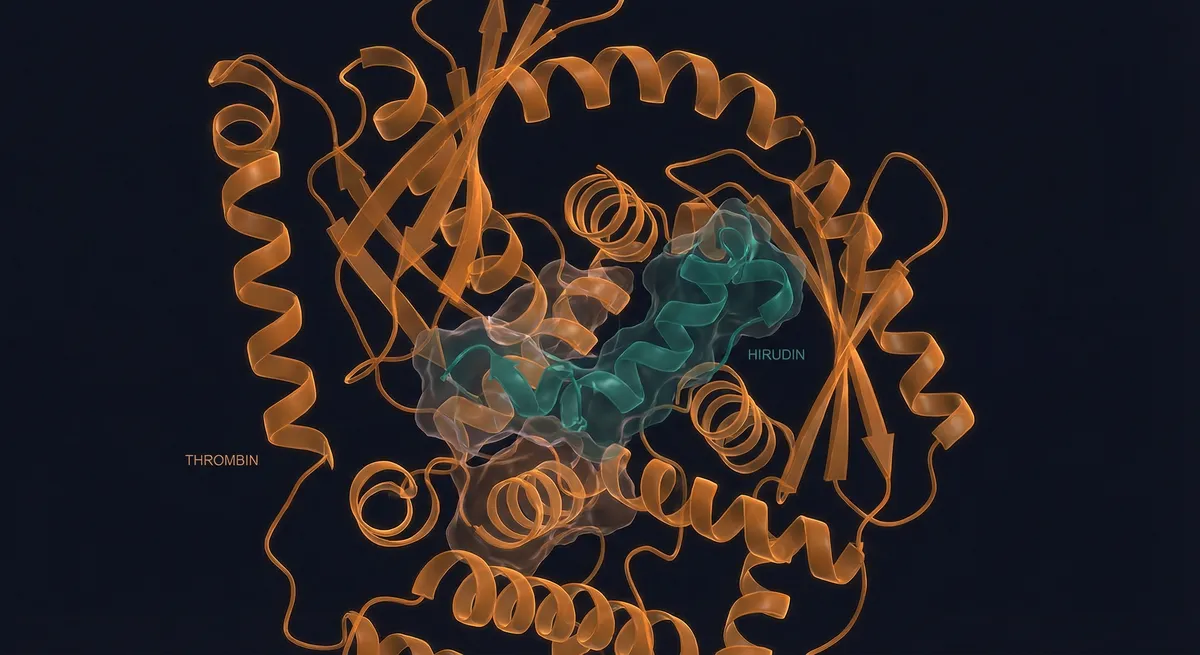
Hirudin (7,0 kDa, 65 Aminosäuren, 3 Disulfidbrücken) ist der stärkste bekannte natürliche Thrombininhibitor. Es bindet Thrombin mit einem Kd von 2 × 10⁻¹⁴ M (20 Femtomolar) über einen einzigartigen bivalenten Mechanismus: Die N-terminale globuläre Domäne besetzt die Spalte des aktiven Zentrums, während der anionische C-terminale Schwanz (sulfatiertes Tyr⁶³) an Exosit 1 bindet. Dieses duale Zusammenwirken blockiert alle Thrombinfunktionen: die Fibrinogen-Gerinnung, die Aktivierung von Faktor V/VIII/XIII sowie die thrombininduzierte Thrombozytenaggregation.
Factor Xa Inhibition — Antistasin & Lefaxin
Antistasin (15 kDa) and lefaxin (~14 kDa) block factor Xa, preventing prothrombinase complex assembly — the critical amplification step that converts prothrombin to thrombin. This targets the cascade upstream of thrombin, reducing thrombin generation rather than merely inhibiting existing thrombin. Originally identified by Tuszynski et al. (1987) in Haementeria officinalis; subsequently reported in Hirudo by Rigbi, Jackson, and Atamna (1995); lefaxin identified genomically (Kvist et al., 2020).
Fibrin Stabilization Blockade — Ghilanten
Ghilanten (~15 kDa, aus <em>Haementeria ghilianii</em>) ist ein Zweidomänen-Mitglied der Antistasin-Familie, das Faktor Xa potent hemmt (Ki ~1,2 nM; Blankenship u. a., 1990; Rester u. a., 2001), indem es auf den Prothrombinase-Komplex wirkt. Durch die Suppression der Thrombingeneration stromaufwärts ergänzt es die Wirkung von Destabilase auf bereits stabilisierte Gerinnsel.
Fibrinolytic Susceptibility — LCI
Der Blutegel carboxypeptidase inhibitor (LCI, ~7 kDa, Reverter et al., 1998) inhibits carboxypeptidase B / TAFIa (thrombin-activatable fibrinolysis inhibitor). TAFIa normally removes C-terminal lysines from fibrin, making it resistant to plasminogen binding and fibrinolysis. LCI maintains these lysine residues, preserving the thrombus's susceptibility to the body's endogenous fibrinolytic system.
Cascade Coverage Summary
- Initiation: Factor Xa inhibition (antistasin, lefaxin) → reduced thrombin generation
- Amplification: Direct thrombin inhibition (hirudin) → blocks all downstream effects
- Stabilization: Factor XIIIa inhibition (ghilanten) → prevents fibrin cross-linking
- Resolution: TAFIa inhibition (LCI) → maintains fibrinolytic susceptibility
- Thrombolysis: Isopeptidase activity (destabilase) → dissolves already-stabilized fibrin
Funktionelle Architektur: Antithrombozytenkaskade
Sechs SGS-Komponenten bewirken eine mehrschichtige Blockade der Kaskade aus Thrombozytenadhäsion, -aktivierung und -aggregation — und zielen auf praktisch jeden Schritt ab.
| Platelet Step | SDS Inhibitor | Ziel | Mechanismus |
|---|---|---|---|
| 1. Adhesion (collagen) | Calin (65 kDa) | Collagen types I, III | Blocks collagen-mediated platelet adhesion; does NOT inhibit aggregation |
| 2. Adhesion (vWF) | Saratin (12 kDa) | vWF-collagen binding | Prevents von Willebrand factor-dependent adhesion under high shear |
| 3. Activation (ADP) | Apyrase (~40 kDa) | Extrazelluläres ADP | Hydrolysiert das aus den dichten Granula freigesetzte ADP; beseitigt den Aggregationsreiz |
| 4. Activation (PAF) | PAF inhibitor (<1 kDa) | PAF-Rezeptor | Phosphoglyceride blocks mast cell-mediated platelet activation |
| 5. Activation (Ca²⁺) | LMW Ca²⁺ modulators (<0.5 kDa) | Rezeptorabhängige Ca²⁺/Na⁺-Kanäle | Unterdrückt die intrazelluläre Calcium-Signalgebung durch Thrombin und PAF |
| 6. Aggregation | Decorsin (4.4 kDa) | GP IIb/IIIa integrin | RGD-Motiv-Peptid blockiert den gemeinsamen Endweg der Aggregation |
| 7. Aggregation (thrombin) | Hirudin (7.0 kDa) | Thrombin | Blocks thrombin-induced platelet aggregation (secondary to DTI activity) |
Redundancy Demonstration
Baskova et al. (1987) demonstrated that when hirudin is depleted through repeated SDS collection without intervening Blutmahlzeits, the secretion retains the ability to block platelet adhesion and intrinsic pathway coagulation. This proves that hirudin is not the sole anticoagulant determinant — calin, saratin, antistasin, the LMW Ca²⁺ modulators, and other components provide redundant protection. The evolutionary advantage is clear: no single host resistance mechanism can overcome the multi-target blockade.
Funktionelle Architektur: Antiinflammatorisch
SGS enthält das breiteste Spektrum an Proteaseinhibitoren, das in einem einzelnen biologischen Sekret gefunden wurde — und zielt gleichzeitig auf die Gerinnungs-, Fibrinolyse-, Entzündungs- und Komplementkaskade ab.
Neutrophil Protease Inhibition
Eglins b/c (8.1 kDa, Seemuller et al., 1977) inhibit neutrophil elastase, cathepsin G, chymotrypsin, and subtilisin. They potentiate glucocorticoid activity and exhibit neurotrophic properties at low concentrations. Guamerin (5.6 kDa, Jung et al., 1995) provides additional elastase-specific inhibition. Piguamerin (~6 kDa, Kvist et al., 2020) is a dual elastase/trypsin inhibitor identified genomically. Together, these compounds block the tissue-destructive proteases released by activated neutrophils at sites of inflammation.
Mast Cell Tryptase Inhibition
LDTI (leech-derived tryptase inhibitor, 4.7 kDa, Sommerhoff et al., 1994) is a Kazal-type inhibitor that blocks mast cell tryptase — a key mediator of immediate hypersensitivity, bronchoconstriction, and tissue remodeling. Hirustasin (5.9 kDa, Sollner et al., 1994) additionally inhibits tissue kallikrein, modulating the kinin pathway that drives pain and vascular permeability. Together with kininases (which degrade bradykinin directly), these compounds create the analgesic effect observed at der Blutegel bite site.
Complement System Blockade
The C1s complement inhibitor (67 kDa, Baskova et al., 1988; Tikhonenko, 2000) blocks the classical complement pathway at its initiation point. SDS also blocks the alternative complement pathway. The evolutionary purpose is dual: (1) protecting the des Blutegels own tissues from complement-mediated attack during feeding, and (2) protecting the symbiotic Aeromonas bacteria in der Blutegel gut from complement-mediated lysis. The therapeutic implication is complement-mediated inflammation reduction at the treatment site.
Fibrinolytic Pathway Modulation
Bdelline A/B (6.3/20 kDa, Fritz et al., 1969) hemmen Trypsin und Plasmin. Bdellastasin (~6 kDa, Moser et al., 1998) ist ein Serinprotease-Inhibitor der Antistasin-Familie von Trypsin, Plasmin und Akrosin (es hemmt Faktor Xa nicht).
Multi-Target Protease Inhibition Profile
1987 identifizierten Baskova, Nikonov, Mirkamalova, Zinenko und Kozlov die Fähigkeit des SGS, sowohl den klassischen als auch den alternativen Weg des Komplementsystems zu blockieren. In Kombination mit der Hemmung der Gerinnungskaskade (hirudin, antistasin, lefaxin), der fibrinolytischen (bdellins) und der entzündlichen (eglins, LDTI, guamerin) Kaskaden stellt dies eine Breite der Proteasehemmung dar, die in keiner anderen bekannten biologischen Sekretion erreicht wird. Es spiegelt den Multi-Target-Ansatz des gesamten SGS wider und erklärt, warum die Hirudotherapie systemische Wirkungen erzeugt, die weit über eine einfache Antikoagulation hinausgehen.
Destabilase: Thrombolytic Enzyme
Destabilase ist das einzige bekannte Enzym in der Natur, das in der Lage ist, ε-(γ-Glu)-Lys-Isopeptidbindungen in quervernetztem (stabilisiertem) Fibrin zu spalten — die durch Faktor XIIIa gebildeten Bindungen, die reife Thromben gegenüber konventioneller fibrinolytischer Therapie resistent machen.
Dual Enzymatic Activity
Zavalova et al. (2000) demonstrated that a single 12.3 kDa protein has two distinct enzymatic activities:
- Destabilase-M (isopeptidase): Cleaves ε-(γ-Glu)-Lys bonds in D-dimer → monomerises cross-linked fibrin
- Destabilase-L (lysozyme): Muramidase activity → hydrolyzes bacterial peptidoglycan → gram-positive bactericidal
This dual function — thrombolytic + antibacterial in one molecule — is unique in enzymology.
Rekombinant Destabilase
Kurdyumov et al. (2021) produced three recombinant destabilase isoforms and demonstrated that they dissolve human blood clots in vitro. Crystal structure was resolved at 1.1 Å resolution — the highest resolution for any leech-derived protein. Both isopeptidase and lysozyme activities were retained in the recombinant form, confirming the feasibility of pharmaceutical development.
Neurotrophic Activity
Die Entwicklung oraler Faktor-Xa-Inhibitoren — rivaroxaban (Xarelto, FDA 2011), apixaban (Eliquis, FDA 2012) und edoxaban (Savaysa, FDA 2015) — stellt die klinische Umsetzung des Konzepts dar, dass Faktor Xa ein tragfähiges Ziel für die Antikoagulation ist. Obwohl es sich bei diesen Wirkstoffen um synthetische kleine Moleküle ohne direkten strukturellen Bezug zu den FXaI der Blutegel handelt, ist die biologische Validierung von Faktor Xa als Arzneimittelziel den Inhibitoren der Antistasin-Familie aus Blutegeln in erheblichem intellektuellem Maße zu verdanken. Die Antistasin-Familie lieferte sowohl die konzeptionelle Validierung als auch die Proof-of-Principle-Daten, die pharmazeutische Investitionen in Faktor Xa als Arzneimittelziel auslösten. Heute bilden orale Faktor-Xa-Inhibitoren (zusammen mit dabigatran) die DOAC-Klasse, die warfarin weitgehend abgelöst hat — einer der folgenreichsten Umbrüche in der kardiovaskulären Pharmakotherapie des einundzwanzigsten Jahrhunderts.
Seasonal Availability
The isopeptidase (thrombolytic) activity of destabilase virtually disappears during autumn-winter and reappears in May, remaining high through September (Baskova et al., 1984). This seasonal variation has direct klinisch implications: leeches used during winter provide strong antithrombin activity but reduced thrombolytic capacity, while summer leeches offer the full complement of both activities.
Tissue Penetration & Spreading Mechanism
Das SGS muss das Wirtsgewebe rasch durchdringen, um seine bioaktive Fracht in das mikrozirkulatorische Gefäßbett abzugeben. Drei Komponenten erleichtern diesen Prozess.
Hyaluronidase (Orgelase)
Ein 28.5 kDa-Enzym, das Hyaluronsäure über eine einzigartige β(1→4)-Glucuronid-Bindungsspezifität depolymerisiert – im Gegensatz zu allen bekannten Säugetier-Hyaluronidasen, die β(1→3)-Bindungen spalten (Linker, Meyer & Hoffman, 1960). Zuerst als „Ausbreitungsfaktor“ beschrieben (ein Konzept, das auf Duran-Reynals zurückgeht), wobei das Enzym von Karl Meyers Arbeitsgruppe charakterisiert wurde; die Egel-Hyaluronidase erhöht die Gewebepermeabilität. Von Yuki & Fishman (1963) gereinigt; es wurde bestätigt, dass es Chondroitin und dessen Derivate, anders als β-Hyaluronidasen, nicht hydrolysieren kann. Thermisch stabil (hält 1 h bei 50°C stand), über einen weiten pH-Bereich aktiv und – für klinische Anwendungen von entscheidender Bedeutung – nicht durch Heparin hemmbar (anders als testikuläre Hyaluronidase), was die gleichzeitige Anwendung mit einer Antikoagulanzientherapie ermöglicht. Von Biopharm (Roy Sawyer, 1988) als Orgelase für kardiovaskuläre und ophthalmologische Anwendungen patentiert, wobei seine anti-ischämischen Eigenschaften und seine Heparin-Kompatibilität als gewebedurchdringender Wirkstofftransporter genutzt werden.
Collagenase
~100 kDa enzyme that degrades collagen fibrils in the extrazelluläre Matrix (Baskova et al., 1984). Works synergistically with hyaluronidase: while hyaluronidase removes the ground substance between collagen fibrils, collagenase degrades the fibrils themselves. This dual ECM breakdown enables deep tissue penetration by other SDS-Komponenten.
Histamine-Like Vasodilator
A low-molecular-weight compound (<0.5 kDa) that activates H1 and H2 receptors, producing vasodilation and increased capillary permeability (Claude, 1937). This enhances blood flow to the bite site and creates the sustained vasodilation observed during and after feeding. Combined with acetylcholine (identified by Babenko et al., 2020) and 6-keto-PgF1α (prostacyclin metabolite; Baskova & Nikonov, 1987), SDS provides triple vasodilatory redundancy.
Antimicrobial Defense
Die antimikrobielle Aktivität des SGS erfüllt einen zweifachen evolutionären Zweck: die Verhinderung einer Infektion an der Bisswunde (Schutz der Blutmahlzeit des Wirts vor Kontamination) und die Aufrechterhaltung des Darmmikrobioms des Blutegels.
Destabilase-L (Lysozyme)
Dasselbe 12,3 kDa Destabilase-Protein, das Isopeptidase-(thrombolytische) Aktivität aufweist, fungiert auch als Muramidase – hydrolysiert bakterielles Zellwand-Peptidoglycan. Dieses zweifunktionelle Enzym bewirkt grampositive bakterizide Aktivität am Bissort und löst gleichzeitig vernetztes Fibrin auf. Die Lysozymaktivität wurde von Zavalova u. a. (2000) bestätigt und blieb in allen drei rekombinanten Isoformen erhalten (Kurdyumov u. a., 2015).
Antimicrobial Peptides (Classical)
Tasiemski et al. (2004) charakterisierten zwei antimikrobielle Peptide — theromacin und theromyzin — aus dem Blutegel Theromyzon tessulatum. Homologe membranaktive Peptide in medizinischen Blutegeln bieten breitbandigen antimikrobiellen Schutz an der Bisswunde und tragen dazu bei, zu erklären, warum Blutegel-Biss-Infektionen trotz der gezielten Einbringung von Aeromonas-Bakterien aus dem Blutegeldarm verhältnismäßig selten auftreten.
Complement Evasion Strategy
Der C1s-Komplementinhibitor (67 kDa) erfüllt eine faszinierende evolutionäre Rolle: Er schützt die symbiotischen Aeromonas hydrophila-Bakterien des Blutegels vor komplementvermittelter Lyse während der Nahrungsaufnahme. Ohne diesen Schutz würde das Komplementsystem des Wirts die Bakterien zerstören, auf die der Blutegel für die Blutverdauung angewiesen ist. Derselbe Mechanismus erzeugt entzündungshemmende Wirkungen an der klinischen Behandlungsstelle.
Aeromonas Paradox
Der medizinische Blutegel beherbergt Aeromonas hydrophila / A. veronii als obligate Darmsymbionten. Diese Bakterien produzieren Enzyme, die für die Verdauung der Blutmahlzeit unerlässlich sind, jedoch potenziell pathogen für den Menschen sind. Antimikrobielle Peptide des SGS kontrollieren die Bakterienlast an der Bissstelle teilweise, doch prophylaktische Antibiotika (fluoroquinolones oder trimethoprim-sulfamethoxazole) sind gängige klinische Praxis. Siehe die spezielle Aeromonas-Management-Seite für Protokolle.
Seasonal Variation & Klinisch Implications
Die Zusammensetzung des SGS ist nicht statisch — sie variiert je nach Jahreszeit, Sammelhäufigkeit und Fütterungszustand, mit direkten Auswirkungen auf die klinische Standardisierung.
| Parameter | Frühling/Sommer (Mai–Sep) | Herbst/Winter (Okt–Apr) | Klinische Implikation |
|---|---|---|---|
| Antithrombin activity (hirudin) | Moderate | Higher | Winterblutegel liefern möglicherweise eine stärkere Antikoagulation |
| Thrombolytic activity (destabilase isopeptidase) | High (present May–Sep) | Virtually absent | Sommerblutegel bieten thrombolytische + antikoagulatorische Wirkung; Winterblutegel nur antikoagulatorische Wirkung |
| Overall SDS complement | Full activity spectrum | Reduced thrombolytic component | Biofabrik-Protokolle sollten die Saisonalität bei der Produktstandardisierung berücksichtigen |
Collection Frequency Effects
Repeated SDS collection at one-month intervals without intervening Blutmahlzeits shows a clear depletion pattern (Baskova et al., 1984):
- Collections 1–2: High antithrombin activity
- Collection 3: Sharp decline in antithrombin activity
- Collection 4: Antithrombin activity disappears entirely
- After Blutmahlzeit: Full activity restored
Im Jahr 2004 ließ die U.S. FDA medizinische Blutegel (H. medicinalis) als 510(k)-Medizinprodukte über die 510(k)-Freigabe K040187 zu, mit zugelassenen Indikationen zur Entfernung von angesammeltem Blut unter Hauttransplantaten und zur Wiederherstellung des Kreislaufs in verschlossenen Venen. Damit wurden medizinische Blutegel zum zweiten lebenden Organismus, der von der FDA als Medizinprodukt zugelassen wurde, nach den medizinischen Fliegenmaden (Lucilia sericata). Im Dezember 2024 wurde die regulatorische Zuständigkeit vom CDRH auf das CBER übertragen, was die Erkenntnis widerspiegelt, dass diese lebenden Organismen in regulatorischer Hinsicht enger mit den vom CBER regulierten Produkten übereinstimmen. Der 510(k)-Freigabesweg bleibt unverändert. Zu den derzeit von der FDA freigegebenen Anbietern gehören Ricarimpex SAS (Frankreich), Biopharm Ltd. (Wales, UK) sowie Distributoren in den Vereinigten Staaten.
Temporal Feeding Variation
The continuous-flow method (Baskova et al., 2001) demonstrated that SDS-Zusammensetzung changes during a single feeding session. Sequential UV spectral analysis showed absorption peaks shifting toward longer wavelengths as feeding progresses:
- First minutes: Maximum peptide/protein concentration (short-wavelength UV absorption) — most potent anticoagulant delivery
- Subsequent fractions: Trace amounts only
- Final fraction (15th): Minimal bioactive content
Diese „Front-Loading“-Strategie liefert die wichtigsten antikoagulatorischen Moleküle innerhalb der ersten Minuten des Ansaugens.
Low-Molecular-Weight Ion Modulators
Receptor-Dependent Ion Channel Modulation
The LMW fraction (<500 Da) of SDS produces highly specific effects on platelet ion transport (Afanasyeva et al., 1999):
| Ion Channel | SDS LMW Effect | Comparison to Losartan |
|---|---|---|
| Receptor-dependent Ca²⁺ entry (platelets) | Unterdrückt (thrombin- & PAF-Antwort) | Similar effect |
| Receptor-dependent Na⁺ depolarization | Suppressed | Für losartan nicht berichtet |
| Receptor-independent Ca²⁺ efflux (erythrocytes) | No effect | Altered by losartan |
| Ca²⁺-dependent K⁺ channels (erythrocytes) | No effect | Altered by losartan |
Diese Selektivität für rezeptorabhängigen (aber nicht rezeptorunabhängigen) Ionentransport deutet darauf hin, dass die LMW-Fraktion auf Rezeptorebene wirkt und nicht auf die Ionenkanäle selbst — ein Mechanismus, der sich von konventionellen Kalziumkanalblockern unterscheidet. Die molekulare Identität dieser Modulatoren muss noch aufgeklärt werden.
Lipid Pharmacology
SGS enthält Lipide mit funktioneller Bedeutung sowohl für die antithrombozytäre Aktivität als auch für die pharmazeutische Formulierung.
Lipid Composition
- Gesamtlipide: in SGS vorhanden
- Neutrallipide: ~2/3 der Gesamtmenge
- Polare Lipide: ~1/3 der Gesamtmenge
- Phosphatidylcholine: Significant quantities; enables liposomal structure formation
- Free fatty acids: Present in significant amounts
- Phosphoglyceridol: Functions as PAF antagonist — inhibits PAF-stimulated platelet aggregation (Hu-Am & Orevi, 1992)
Orales Bioavailability & Piyavit
Der Lipidgehalt des SDS könnte die Bildung liposomaler Strukturen ermöglichen, die eine orale Resorption über Pinozytose erleichtern — durch Übertritt aus dem Darm in den Blutkreislauf (Baskova & Nikonov, 1986). Diese Eigenschaft bildet die pharmakologische Grundlage für Piyavit, die orale pharmazeutische Formulierung, die aus dem Extrakt des gesamten Blutegels gewonnen wird. Piyavit wurde in Russland registriert (1994, erneut registriert 2001), speziell zur Behandlung und Vorbeugung der oberflächlichen Venenthrombophlebitis.
Prostacyclin Metabolite
1987 wiesen Baskova und Nikonov Prostaglandine im SDS in Form von 6-Keto-Prostaglandin F1α nach, einem stabilen Metaboliten des Prostacyclins (PGI₂). Prostacyclin ist der stärkste endogene Hemmstoff der Thrombozytenaggregation und ein potenter Vasodilatator. Sein Vorhandensein im SDS erschließt einen zusätzlichen aggregationshemmenden und gefäßerweiternden Wirkweg — als Ergänzung zu hirudin (Antithrombin), calin (Adhäsionshemmung) und decorsin (Aggregationshemmung).
Lipase & Cholesterol Esterase
SDS contains lipase (~45 kDa) and cholesterol esterase activities (Baskova et al., 1984) that catalyze hydrolysis of triglycerides and cholesterol esters. These enzymes are implicated in the anti-atherosclerotic properties observed in klinisch Studien (detailed in the atherosclerosis mechanisms page). They are also an active component of the Piyavit oral formulation.
DNA Methylation & Epigenetic Effects
Epigenetic Modification by SGS
Nikonov et al. (1990) demonstrated a remarkable epigenetic effect: SDS stimulates a 39% increase in 5-methylcytosine content in rat liver DNA within one hour of intraperitoneal perfusion. Key features:
- Ausmaß: Nicht belegte Behauptung entfernt.
- Speed: Detectable within 1 hour
- Reversibility: Fully reversed within 24 hours
- Tissue: Demonstrated in liver (systemic effect)
Die DNA-Methylierung ist ein grundlegender epigenetischer Mechanismus, der die Genexpression reguliert, ohne die DNA-Sequenz zu verändern. Eine vorübergehende, reversible Zunahme der Methylierung könnte die Expression entzündungsrelevanter Gene, die Zelldifferenzierung und die Signalwege der Geweberegeneration modulieren. Dieser Befund stellt eine der frühesten Demonstrationen einer pharmakologisch induzierten, reversiblen epigenetischen Modifikation dar — und nimmt das moderne Feld der epigenetischen Therapeutika um Jahrzehnte vorweg. Die konkret verantwortliche SDS-Komponente sowie die betroffenen Zielgene sind bislang nicht identifiziert und stellen eine bedeutende Forschungschance dar.
Fehlen unspezifischer proteolytischer Aktivität
What SDS Does NOT Do
- No caseinolytic activity (Rigbi et al., 1987)
- Cannot activate plasminogen to plasmin
- Cannot dissolve non-stabilized fibrin (Baskova & Nikonov, 1985)
- Cannot hydrolyze plasmin-specific chromogenic substrate (D-Val-Leu-Lys paranitroanalide)
- No broad-spectrum proteolytic activity at any season
Why This Matters
Das Fehlen generalisierter proteolytischer Aktivität ist ebenso wichtig wie die vorhandenen spezifischen Enzymaktivitäten. Ein Sekret mit Breitband-Proteasen würde seine eigenen bioaktiven Bestandteile — hirudin, calin, destabilase, eglins — zerstören, bevor diese ihre Wirkung entfalten könnten. Die evolutionäre Lösung ist elegant: SDS enthält hochgradig spezifische Hydrolasen (destabilase spaltet ausschließlich ε-(γ-Glu)-Lys-Bindungen; hyaluronidase spaltet ausschließlich HA-β(1→4)-Bindungen), jedoch keine generalisierten Proteasen, wodurch gewährleistet ist, dass alle bioaktiven Proteine im Wundmilieu intakt erhalten bleiben.
Genomic Revolution: From Biochemistry to Multi-Omics
Die klassische Biochemie identifizierte ~30–40 SDS-Komponenten. Moderne Genomik, Transkriptomik und Proteomik haben diese Zahl auf >200 Proteine erweitert — und damit unser Verständnis des medizinischen Blutegels als pharmakologische Ressource grundlegend verändert.
| Studie | Methode | Wichtige Befunde | Neuartige Komponenten |
|---|---|---|---|
| Liu et al. (2019) | Proteom + Transkriptom-Integration | Ein umfangreiches Repertoire vollständiger Proteinsequenzen und bioaktiver Transkripte über mehrere funktionelle Kategorien hinweg | Multiple novel proteins across all 6 categories |
| Babenko u. a. (2020) | Genomzusammenstellung (H. medicinalis) | Entwurf der Genomassemblierung; mehrere Antikoagulations- und Hämostasehemmproteine | Hirudin-like factor 3, lefaxin, piguamerin, ficolins, cystatins |
| Babenko et al. (2020) | RNA-Seq an Speichelzellen (3 Arten) | Vergleichendes Speicheldrüsen-Transkriptom über H. medicinalis, H. orientalis, H. verbana hinweg | M12/M13 proteases, CRISP proteins, apyrase, ADA, cystatins, ficolins, acetylcholine |
| Lukas u. a. (2022) | Strukturbiologie | Tandem-Hirudin: erstes oligomeres Mitglied der hirudin-Superfamilie aus Hirudinaria manillensis | Two globular domains in tandem; lacks C-terminal tail; NO thrombin inhibition |
| Guan et al. (2024) | Proteom + Transkriptom (Hunger) | Hungerinduzierte Veränderungen der SDS-Zusammensetzung von Hirudo nipponia | Zeigte, dass der Ernährungszustand die SDS-Proteinexpression moduliert |
| Manuvera u. a. (2024) | Rekombinante Expression + Gerinnungs-Assays | Novel cysteine-rich anticoagulant (CRA) protein; high activity in aPTT, PT, TT; C-terminal motif critical | Neues Antikoagulans erweitert das charakterisierte Sekretom (Biomolecules 15(12):1633) |
| Chosun/KBSI (2025) | 3D-holotomographisches Screening + KI-Bioinformatik | Hirunipin-2: neuartiges AMP aus den Speicheldrüsen von H. nipponia; anti-MDR- und Anti-Biofilm-Aktivität | Wirksam gegen multiresistente Acinetobacter; erste KI-gestützte AMP-Entdeckung aus Blutegel-SDS (Advanced Science, Wiley) |
| Serebrennikova et al. (2025) | Genom-Mining + heterologe Expression | Drei neuartige AMPs: LBrHM1, NrlHM1, NrlHM2 aus H. medicinalis | Expands antimicrobial peptide repertoire beyond classical trio (IJMS 26(14):6903) |
| EV biogenesis (2025) | Zellbiologie (EV-Charakterisierung) | Erste Studie zur Biogenese extrazellulärer Vesikel in Speicheldrüsenzellen von H. nipponia | EVs als potenzielle natürliche bioaktive Trägersysteme für aus Blutegeln gewonnene Verbindungen — Plattform für die Wirkstoffabgabe (ScienceDirect) |
| Microalgae hirudin (2025) | Rekombinante Expression in C. reinhardtii | Erstes funktionelles Hirudin, das in einer GRAS-Mikroalge mit korrekter Tyrosin-Sulfatierung hergestellt wurde | Overcomes E. coli/yeast limitations; scalable plant-based production (bioRxiv preprint) |
Scale of Discovery
- Classical biochemistry (1884–2004): ~30–40 components characterized
- Proteomik/Transkriptomik (2020): Ein großes Repertoire an Speichelproteinen wurde charakterisiert
- Genomik (2020): mehrere antikoagulatorische und antihämostatische Gene kodiert
- Neue Verbindungen (2025): CRA-Protein, hirunipin-2, LBrHM1/NrlHM1/NrlHM2 — Erweiterung des wachsenden Repertoires an charakterisierten Speichelkomponenten
- Total identified to date: >200 distinct proteins functionally described
- Functionally characterized: <50 (≈12%)
- Exploited pharmaceutically: ~5 (≈1.1%)
Species Comparison
Babenko et al. (2020) — co-authored by I.P. Baskova, author of the foundational text — performed comparative RNA-seq across three medicinal Blutegelart. While the core anticoagulant toolkit (hirudin, destabilase, calin) is conserved, significant differences in CRISP protein expression, M12/M13 protease profiles, and antimicrobial peptide repertoires were observed between species. These differences may have klinisch relevance: H. verbana (the species most commonly supplied in the US) and H. medicinalis (the European standard) may deliver subtly different SDS-Zusammensetzungs.
Pharmaceutical Legacy
Destabilase zeigt neurotrophe Wirkungen bei außerordentlich niedrigen Konzentrationen — <strong>10⁻¹² M</strong> (pikomolar). Bei diesen Konzentrationen fördert es das Neuritenwachstum in kultivierten Neuronen, was auf eine Funktion hindeutet, die sich vollständig von seiner thrombolytischen Aktivität unterscheidet. Diese neurotrophe Fähigkeit wird mit bdellins und bdellastatin geteilt, was darauf hinweist, dass SGS-Proteasehemmer eine Doppelrolle bei der Geweberegeneration und der neuralen Erholung spielen könnten.
| Wirkstoff | SDS Progenitor | FDA Approval | Indikation | Status |
|---|---|---|---|---|
| Bivalirudin (Angiomax) | Hirudin → 20-aa synthetic analog | 2000 | Antikoagulation bei PCI (ACC/AHA Klasse I für STEMI) | Generic available; $636M peak revenue; projected $887M by 2030 |
| Desirudin (Iprivask) | Rekombinant hirudin (65 aa) | 2003 | DVT prophylaxis in hip replacement | Verfügbar (begrenzte Anwendung) |
| Dabigatran (Pradaxa) | Hirudin → non-peptide DTI (oral) | 2010 | Schlaganfallprävention bei Vorhofflimmern; VTE-Behandlung/-Prävention | $3.5B annual revenue; launched DOAC revolution |
Pipeline Candidates
- Rekombinant destabilase: Thrombolytic + antibacterial; crystal structure at 1.1 Å; dissolves human clots in vitro (preclinical)
- Decorsin-Analoga: GP-IIb/IIIa-Antagonisten für die Thrombozytenaggregationshemmung (Forschung)
- Saratin: Anti-Adhäsion zur Prävention arterieller Thrombosen (Forschung)
- Eglin c analogs: Anti-inflammatory protease inhibition (research)
- Orgelase (hyaluronidase): Cardiovascular/ophthalmological applications (patented)
- Neuartige Hirudin-Varianten: modifizierte Varianten in der präklinischen Entwicklung
- Aus Mikroalgen gewonnenes Hirudin (2025): Erstes funktionelles rekombinantes Hirudin in Chlamydomonas reinhardtii (GRAS-Mikroalge) mit korrekter Tyrosin-Sulfatierung — überwindet die Limitationen von E. coli und Hefe für eine skalierbare, kostengünstige Produktion (bioRxiv-Preprint)
- Wirkstoffabgabe über extrazelluläre Vesikel (EV) (2025): Erste Studie zur EV-Biogenese in Speicheldrüsenzellen von H. nipponia — EVs als natürliche bioaktive Nanoträger für aus Blutegeln gewonnene Verbindungen, die eine neuartige Plattform für die Wirkstoffabgabe eröffnen (ScienceDirect)
- Hirunipin-2 Anti-MDR-Peptid (2025): Neuartiges AMP aus H. nipponia, wirksam gegen multiresistente Bakterien einschließlich Acinetobacter; Anti-Biofilm-Aktivität — Potenzial zur Bewältigung der Krise der antimikrobiellen Resistenz (Advanced Science, Wiley)
Zoopharmaceutical Context
Unter allen von Tieren stammenden Arzneimitteln nimmt der medizinische Blutegel eine einzigartige Stellung ein. Der medizinische Blutegel ist die Quelle oder Inspiration für drei Antikoagulanzien (lepirudin, desirudin, bivalirudin) – ein ungewöhnlich großer Beitrag für einen einzelnen Organismus unter den von Tieren stammenden Arzneimitteln. Zum Vergleich: Kegelschnecken steuerten eines bei (ziconotide), die Gila-Krustenechse eines (exenatide) und Vipern eines (captopril-Inspiration). Der unverhältnismäßig große Beitrag des Blutegels spiegelt sowohl die pharmakologische Reichhaltigkeit von SGS als auch die 141-jährige Forschungstradition nach Haycrafts Entdeckung wider.
The Unexploited Pharmacopeia
Known Unknowns
- Pseudohirudin (5 kDa): Hirudin-Homolog ohne Antithrombin-Aktivität — Funktion seit 1980 unbekannt
- Entscheidend ist, dass die Thrombozytenhemmung und die Hemmung des intrinsischen Wegs bestehen bleiben, selbst wenn hirudin vollständig verbraucht ist — was redundante antikoagulatorische Mechanismen bestätigt.
- CRISP-Proteine (~25 kDa): Ionenkanal-Modulatoren unbekannter Spezifität
- Ficolins (~35 kDa): innate immune modulators — therapeutic potential unexplored
- M12/M13-Proteasen: Reifungsenzyme des SGS — könnten sie für die Prodrug-Aktivierung genutzt werden?
- Adenosine deaminase: purinergic signaling modulator — immunomodulatory potential
Future Discovery Approaches
- Vollständige Genom-Annotation: Abschluss der funktionellen Annotation aller über 440 identifizierten Proteinsequenzen
- KI-gestütztes Wirkstoffdesign: Verwendung von SGS-Verbindungsgerüsten als Ausgangspunkte für die computergestützte Optimierung — inzwischen validiert durch die KI-gestützte Entdeckung von Hirunipin-2 (2025)
- Speziesvergleich: Systematischer Vergleich der SGS zwischen H. medicinalis, H. verbana, H. orientalis und nichtmedizinischen Arten
- Einzelzell-Transkriptomik: Identifizierung, welche Speicheldrüsen-Zelltypen welche Verbindungen produzieren
- Kryo-EM-Strukturbiologie: Aufklärung der 3D-Strukturen aller wichtigen SGS-Proteine für ein strukturbasiertes Wirkstoffdesign
- Standardisierung in klinischer Qualität: Entwicklung validierter Assay-Panels für die Qualitätskontrolle der SGS
- EV-basierte Wirkstoffabgabe: Nutzung der in den Speicheldrüsen von H. nipponia entdeckten Biogenese extrazellulärer Vesikel (2025) als natürliche Nanoträger für die gezielte Abgabe von aus Blutegeln gewonnenen Therapeutika
- Alternative Produktionsplattformen: Ausweitung der mikroalgenbasierten rekombinanten Produktion (nachgewiesen für Hirudin in C. reinhardtii, 2025) auf weitere SGS-Proteine, die posttranslationale Modifikationen erfordern
Die SGS von Hirudo medicinalis stellt eines der pharmakologisch reichhaltigsten biologischen Sekrete im Tierreich dar. Ihre systematische Charakterisierung, die noch längst nicht abgeschlossen ist, bringt weiterhin Moleküle mit potenziellen therapeutischen Anwendungen zum Vorschein, die weit über die Antikoagulation hinausreichen — wie allein im Jahr 2025 durch fünf bedeutende Entdeckungen belegt wurde. ASH befürwortet fortgesetzte Investitionen in die SGS-Forschung als Grundlage für eine evidenzbasierte Praxis und pharmazeutische Innovation.
Key SDS Characterization Studies
| Studie | Design | Population (n=) | Intervention | Primäres Outcome | Ergebnis |
|---|---|---|---|---|---|
| Haycraft JB 1884 | Biochemical characterization | Hirudo medicinalis SGS (n=NR) | Extraction and bioassay | Anticoagulant activity | First demonstration leech secretion prevents coagulation; identified unicellular glands. Proc R Soc Lond |
| Markwardt F 1955 | Biochemical characterization | Hirudo medicinalis SGS (n=NR) | Extraction and purification | Thrombin inhibition | First isolation of pure hirudin; thrombin-specific inhibition confirmed. Hoppe-Seyler Z Physiol Chem |
| Fritz H et al. 1969 | Biochemical characterization | Hirudo medicinalis SGS (n=NR) | Extraction and purification | Protease inhibition | Discovery of bdellin A (6.3 kDa) and B (20 kDa); trypsin/plasmin inhibition. Hoppe-Seyler Z Physiol Chem |
| Seemuller U et al. 1977 | Biochemical characterization | Hirudo medicinalis SGS (n=NR) | Extraction and purification | Neutrophil elastase / cathepsin G inhibition | Isolation of eglins b/c (8.1 kDa); neutrophil elastase and cathepsin G inhibition. Hoppe-Seyler Z Physiol Chem |
| Baskova IP & Nikonov GI 1985 | Biochemical characterization | Hirudo medicinalis SGS (n=NR) | Extraction and enzymatic assay | Fibrinolytic / isopeptidase activity | Discovery of destabilase isopeptidase — first enzyme cleaving ε-(γ-Glu)-Lys bonds in stabilized fibrin. Biokhimiya |
| Baskova IP et al. 1987 | In vitro / preclinical | Hirudo medicinalis SGS (n=NR) | Hirudin-depleted SGS fraction bioassay | Antiplatelet and intrinsic pathway inhibition | Hirudin-depleted SGS retains antiplatelet and intrinsic pathway inhibition — redundant anticoagulant mechanisms demonstrated. Biokhimiya |
| Rigbi M et al. 1987 | Biochemical characterization | Hirudo medicinalis SGS (n=NR) | Phagostimulation collection (arginine-based) | Eglin-like and anticoagulant activities | Developed arginine-based phagostimulation method; confirmed eglin-like and anticoagulant activities in collected secretion. Comp Biochem Physiol |
| Seymour JL et al. 1990 | Biochemical characterization | Macrobdella decora SGS (n=NR) | Extraction and purification | Platelet GP IIb/IIIa integrin antagonism | Discovery of decorsin (4.4 kDa, RGD motif) — platelet GP IIb/IIIa integrin antagonist. J Biol Chem |
| Munro R et al. 1991 | Biochemical characterization | Hirudo medicinalis SGS (n=NR) | Extraction and purification | Platelet adhesion inhibition | Characterization of calin (65 kDa) — collagen-mediated platelet adhesion inhibitor; key mechanism for prolonged post-bite bleeding. Blood Coagul Fibrinolysis |
| Baskova IP et al. 2001 | Biochemical characterization | Hirudo medicinalis SGS (n=NR) | Contamination-free phagostimulation collection | SGS composition during feeding | Contamination-free collection method developed; SGS composition varies during feeding — most potent peptides released in first minutes. Bioorg Khim |
| Zavalova LL et al. 2000 | Biochemical characterization | Hirudo medicinalis SGS (n=NR) | Recombinant expression and enzymatic assay | Dual isopeptidase / lysozyme activity | Destabilase exhibits both isopeptidase (thrombolytic) and lysozyme (antibacterial) activities in a single 12.3 kDa protein. Biochemistry (Moscow) |
| Kvist S et al. 2020 | Genome assembly | Hirudo medicinalis SGS (n=NR) | Whole-genome sequencing and annotation | Antihemostatic gene catalog | Draft genome assembly with annotation of multiple anticoagulation and antihemostatic protein genes. Sci Rep |
| Babenko VV et al. 2020 | Proteomics/transcriptomics | 3 Hirudo species SGS (n=NR) | Salivary cell RNA-seq | Novel secreted protein discovery | RNA-seq across 3 species; discovered M12/M13 proteases, CRISP proteins, apyrase, ADA, cystatins, and ficolins. BMC Genomics |
| Lukas P et al. 2022 | Biochemical characterization | Hirudinaria manillensis SGS (n=NR) | Recombinant expression and structural analysis | Hirudin superfamily structure | Tandem-Hirudin — a tandem two-domain member of the hirudin superfamily; no thrombin inhibition despite structural similarity. Parasitol Res |
| Kurdyumov AS et al. 2015 | In vitro / preclinical | Recombinant Hirudo medicinalis destabilase (n=NR) | Recombinant expression and enzymatic characterization | Isopeptidase / lysozyme activity | Characterization of recombinant destabilase-lysozyme isoforms retaining isopeptidase (thrombolytic) and antibacterial activities. BMC Biochem |
Evidenzlücken & Forschungsprioritäten
Trotz 141 Jahren der Forschung bleibt die SGS-Charakterisierung unvollständig. Die Anzahl der identifizierten Proteine beläuft sich mittlerweile auf Hunderte (Babenko et al., 2020; Manuvera et al., 2025; Serebrennikova et al., 2025), jedoch wurden funktionelle Rollen für weniger als 50 etabliert. Zu den wichtigsten Forschungsprioritäten gehören:
Functional Characterization
- Over 150 proteins identified via proteomics await biochemical characterization
- CRISP-Proteine, Ficoline sowie M12/M13-Proteasen besitzen eine unbekannte therapeutische Relevanz
- Tandem-Hirudin's function (despite hirudin homology but no thrombin activity) is unknown
- Pseudohirudin (5 kDa, no antithrombin activity) — function unresolved since 1980
Standardization & Translation
- Saisonale Schwankungen erschweren die Standardisierung der Dosierung für den klinischen Einsatz
- Species differences (H. medicinalis vs H. verbana vs H. orientalis) insufficiently characterized
- Kein validiertes Assay-Panel für die Qualitätskontrolle der SGS bei Blutegeln in klinischer Qualität
- KI-gestütztes Wirkstoffdesign aus SGS-Gerüsten — inzwischen teilweise validiert durch die Entdeckung von Hirunipin-2 mittels KI-Bioinformatik (2025)
- Die mikroalgenbasierte rekombinante Produktion (Hirudin in C. reinhardtii, 2025) erfordert eine Maßstabsvergrößerung und eine Validierung in klinischer Qualität
- Das Potenzial extrazellulärer Vesikel für die Wirkstoffabgabe (nachgewiesen in Speichelzellen von H. nipponia, 2025) erfordert eine Optimierung der Beladung mit Wirkstoffen sowie eine pharmakokinetische Charakterisierung
Verwandte Forschung
434 Salivary Proteins — Integrated Proteomics of Hirudo medicinalis
Integrated proteomics and transcriptomics study identifying 434 full-length protein sequences from H. medicinalis salivary glands, including 44 confirmed bioactive proteins and 221 bioactive transcripts across 6 functional categories.
Liu et al. · Journal of Proteomics
Protein-lipid particles of medicinal leech salivary gland secretion; their size and morphology
The relative location of proteins and lipids in particles of medicinal leech salivary gland secretion (SGS) is revealed for the first time.
Baskova IP et al. · Biochemistry. Biokhimiia
In-depth profiles of bioactive large molecules in saliva secretions of leeches determined by combining salivary gland proteome and transcriptome data
Combined proteomic and transcriptomic analysis deduces 434 full-length salivary protein sequences and identifies 44 proteins and 221 transcripts of bioactive molecules across multiple medicinal leech species, mapping the molecular diversity of leech saliva.
Liu Z, Tong X, Su Y et al. · Journal of proteomics
In-depth profiles of bioactive large molecules in saliva secretions of leeches determined by combining salivary gland proteome and transcriptome data
Proteome plus transcriptome integration yielded 434 full-length protein sequences from leech salivary glands with 44 proteins and 221 transcripts of bioactive molecules involved in leech sucking pathways.
Liu Z et al. · Journal of proteomics
Proteins and peptides of the salivary gland secretion of medicinal leeches Hirudo verbana, H. medicinalis, and H. orientalis
Two-dimensional electrophoresis revealed >100 silver-stained proteins shared across Hirudo verbana, H. medicinalis, and H. orientalis salivary gland secretions; MALDI-TOF MS confirmed 30-40% mass overlap and Jacquard's coefficient supported phylogenetic relationship between H. medicinalis and H. orientalis.
Baskova IP et al. · Biochemistry (Moscow)
[Research progress in hirudin fusion protein--review]
Natural hirudin extracted from the secretion of medical leech salivary gland is a single-chain peptide containing 65 aminoacid residues with molecular weight of 7000 D, and exists in three isomers of HV1, HV2 and HV3.
Zhang C et al. · Zhongguo shi yan xue ye xue za zhi
Verwandte Ressourcen
Wissenschafts-Hub
Übersicht des SDS-Forschungsfeldes.
Hämostase & Gerinnung
Antikoagulatorische Mechanismen im Detail.
Proteinase-Inhibitoren
Profile von 14 charakterisierten Inhibitoren.
Neurotrophe Effekte
Destabilase, Bdelline und neurale Reparatur.
Bivalirudin
Vom Blutegel-Hirudin zum FDA-zugelassenen Medikament.
Leech Extracts & Piyavit
Orale Arzneimittelentwicklung.