Salivary Gland Secretion (SGS)
Molecular Composition & Functional Architecture
In Plain Language
Medicinal leeches produce a complex cocktail of over 440 beneficial proteins in their saliva. These proteins prevent blood clotting, reduce inflammation, fight bacteria, and numb pain — all delivered simultaneously through a single bite. No pharmaceutical drug can replicate this multi-target approach. Three FDA-approved medications have already been developed from leech saliva compounds, generating over $666 million in annual sales.
Hundreds of salivary proteins catalogued (Babenko et al. 2020, expanded by Manuvera 2025 and Serebrennikova 2025) — only a fraction underwrites clinical indications. See the Coverage Map for what is and isn't studied, the Research Roadmap, and PMID Audit Status for ASH's citation-integrity record.
The salivary gland secretion (SGS) of Hirudo medicinalis is the molecular foundation of hirudotherapy. Over 130 million years of coevolution with vertebrate hemostatic systems have produced a secretion containing more than 100 identified bioactive molecules — with draft genome assemblies and integrated transcriptomic-proteomic characterization (Kvist et al., 2020; Babenko et al., 2020) revealing a large repertoire of salivary proteins, further expanded by 2025 discoveries including a novel cysteine-rich anticoagulant (CRA; Manuvera et al., Biomolecules 2025), the antimicrobial peptide hirunipin-2 from H. nipponia (Advanced Science, 2025), and three novel AMPs from H. medicinalis (Serebrennikova et al., IJMS 2025). Characterized bioactive proteins span several functional categories: analgesic/anti-inflammatory, extracellular matrix degradation, platelet inhibition, anticoagulant, antimicrobial, and others. SGS composition includes direct thrombin inhibitors, factor Xa inhibitors, platelet adhesion and aggregation inhibitors, thrombolytic enzymes, spreading factors, antimicrobial peptides, protease inhibitors spanning the coagulation/fibrinolytic/complement/inflammatory cascades, and a diverse array of lipid mediators, ion modulators, and neurotrophic factors. Three FDA-approved pharmaceuticals — bivalirudin, desirudin, and dabigatran — trace their molecular origins directly to this secretion.
Historical Discovery
The scientific investigation of SGS spans 141 years, from Haycraft's first observation that leech secretion prevents blood coagulation to modern multi-omics approaches that have identified over 200 proteins in the saliva.
| Year | Investigator | Milestone | Significance |
|---|---|---|---|
| 1884 | Haycraft (Edinburgh) | Discovery of anticoagulant secretion | First proof that leech SGS contains a “ferment antagonistic to the ferment of the blood”; identified unicellular glands in anterior sucker |
| 1937 | Claude | Histamine-like vasodilatory activity | Demonstrated that leech extracts produce vasodilation analogous to histamine, enhancing bite-site blood flow |
| 1955 | Markwardt (Erfurt) | Isolation of pure hirudin | First purification from leech head extracts; established thrombin-specific mechanism; named the compound |
| 1969 | Fritz et al. | Bdellins A & B isolated | First protease inhibitors from leeches — trypsin and plasmin inhibition |
| 1977 | Seemuller et al. | Eglins b/c discovered | Potent neutrophil elastase and cathepsin G inhibitors — foundation for anti-inflammatory understanding |
| 1984–91 | Baskova & Nikonov | SGS collection method; destabilase discovery | Salt-induced emesis method (patented 1994); discovered destabilase isopeptidase; documented seasonal variation |
| 1987 | Rigbi et al. (Jerusalem) | Phagostimulation method | Arginine-based blood substitute for SGS collection; identified eglin-like activity and factor Xa inhibition |
| 1990–91 | Seymour; Munro | Decorsin and calin characterized | GP IIb/IIIa antagonist (decorsin) and collagen adhesion inhibitor (calin) — completing the antiplatelet picture |
| 1994 | Sommerhoff; Sollner | LDTI and hirustasin | Kazal-type inhibitors of mast cell tryptase and tissue kallikrein — broadened anti-inflammatory profile |
| 2000 | Zavalova et al. | Destabilase dual function confirmed | Single 12.3 kDa protein exhibits both isopeptidase (thrombolytic) and lysozyme (antibacterial) activities |
| 2001 | Baskova et al. | Continuous-flow SGS collection | Contamination-free method; revealed temporal variation — most potent peptides released in first minutes of feeding |
| 2019 | Liu et al. | Integrated proteomics-transcriptomics | A large repertoire of salivary proteins and bioactive transcripts — vastly exceeding classical biochemistry |
| 2020 | Kvist; Babenko & Baskova | Two genome assemblies | Draft genome; multiple anticoagulation and antihemostatic proteins; discovered M12/M13 proteases, CRISP, cystatins, ficolins |
| 2022 | Lukas et al. | Tandem-Hirudin discovered | First oligomeric hirudin superfamily member — two globular domains, no thrombin inhibition, suggesting functional diversification |
| 2025 | Manuvera et al. | Novel cysteine-rich anticoagulant (CRA) protein | New anticoagulant identified and recombinantly produced in E. coli; high activity in aPTT, PT, TT assays; C-terminal motif functionally critical — expands the known salivary protein set (Biomolecules 15(12):1633) |
| 2025 | Chosun Univ. / KBSI (Korea) | Hirunipin-2 — novel antimicrobial peptide | From H. nipponia salivary glands; active against multidrug-resistant bacteria including Acinetobacter; anti-biofilm activity; discovered via 3D holotomographic screening + AI bioinformatics (Advanced Science, Wiley) |
| 2025 | Serebrennikova et al. | Three novel AMPs: LBrHM1, NrlHM1, NrlHM2 | Identified from H. medicinalis genome via heterologous expression in E. coli; expanding the antimicrobial peptide repertoire (IJMS 26(14):6903) |
| 2025 | Korea (H. nipponia) | Extracellular vesicle biogenesis in salivary gland cells | First study on EV biogenesis in leech salivary glands; EVs may serve as natural bioactive carriers for leech-derived compounds — potential for drug delivery (ScienceDirect) |
| 2025 | bioRxiv preprint | Functional hirudin produced in microalgae | First-ever recombinant hirudin in Chlamydomonas reinhardtii (GRAS microalga) with proper tyrosine sulfation — overcomes E. coli and yeast limitations for scalable production |
Haycraft's Original Observation (1884)
“It is possible that leeches secrete a juice containing a ferment antagonistic to the ferment of the blood, preventing blood coagulation. This juice appears in sufficient quantity around the edges of the wound made by the leech to prevent for a time the coagulation of the issuing blood.”
Haycraft identified elongated epithelial cells penetrating the muscular layer of the anterior sucker — groups of unicellular glands — and demonstrated that “the skin lining the anterior sucker and the anterior portion of the medicinal leech was equally active in preventing blood coagulation.” This 1884 observation launched a scientific pursuit that continues 141 years later with genomic and AI-driven approaches.
SGS Collection Methods
Native SGS collection is technically demanding. The three established methods produce secretions of differing purity and composition, with direct implications for research reproducibility and pharmaceutical standardization.
| Method | Developer | Principle | Purity | Yield | Limitation |
|---|---|---|---|---|---|
| Salt-induced emesis | Baskova, 1994 (patent) | Concentrated saline excites serotonin-rich neurons → emetic reflex → SGS expelled from fasting leech | High (native, uncontaminated) | Low volume per leech | Requires fasting leeches; variable yield |
| Phagostimulation | Rigbi et al., 1987 | 0.01 M arginine blood substitute → upper lip chemoreceptor stimulation → feeding + SGS ejection | Low (intestinal contamination) | Higher volume (A₂₈₀ = 0.197) | Contains intestinal proteases; not true SGS |
| Continuous-flow | Baskova et al., 2001 | Modified Rigbi — saline continuously stirred and renewed during feeding → prevents swallowing SGS-enriched solution | High (no intestinal contamination) | Good volume, sequential fractions | Technical setup complexity |
Temporal Variation During Feeding
The continuous-flow method (Baskova et al., 2001) revealed a critical finding: SGS composition changes throughout the feeding process. Sequential UV spectral analysis showed that characteristic absorption peaks shift toward longer wavelengths as feeding progresses. During the initial minutes, the secretion contains the predominant mass of peptides and proteins absorbing in the short-wavelength region — the most potent anticoagulant and anti-adhesive compounds. In subsequent fractions, only trace amounts remain. This temporal pattern indicates that the leech delivers its most pharmacologically active molecules during the first minutes of feeding, providing the rapid anticoagulant activity needed to initiate blood flow.
Whole Leech Extracts (WLE) vs. Native SGS
Many investigators have used cephalic region extracts rather than native SGS, including Markwardt's original hirudin isolation (1955). WLE contains protease inhibitors concentrated not in SGS but in intestinal canal walls (Roters & Zebe, 1992), blood lacunae, reproductive organs, nephridia, and mucus — making it a more thorough but less specific collection than SGS alone. WLE is the basis for the pharmaceutical formulation Piyavit (Chapters 18–19). A 5 kDa protein termed pseudohirudin was identified in body trunk extracts but lacks antithrombin activity (Baskova et al., 1980).
Complete Molecular Catalog
The following table compiles all characterized SGS components with molecular weights (mature processed forms), biological targets, mechanisms, clinical significance, primary references, and pharmaceutical development status. Components are organized by functional category.
Over 200 proteins have been identified via proteomics; those awaiting full biochemical characterization are listed at the end of the table.
| Component | MW (kDa) | Target | Mechanism | Key Reference | Pharma Status |
|---|---|---|---|---|---|
| Anticoagulant & Antithrombotic | |||||
| Hirudin | 7.0 | Thrombin (active site + exosite 1) | Direct thrombin inhibitor; Kd = 2 × 10⁻¹⁴ M; blocks fibrinogen clotting, FV/VIII/XIII activation, platelet aggregation | Haycraft 1884; Markwardt 1957 | Bivalirudin (FDA 2000), Desirudin (FDA 2003), Dabigatran (FDA 2010) |
| Hirudin-like factor 3 | ~7 | Thrombin (variant binding) | Alternative thrombin inhibitor; structural diversity suggests functional specialization | Kvist et al. 2020 | None |
| Antistasin | 15 | Factor Xa | Serine protease inhibitor; blocks prothrombinase assembly | Rigbi et al. 1995 | Research stage |
| Lefaxin | ~14 | Factor Xa | Alternative FXa inhibitor | Kvist et al. 2020 | None |
| Ghilanten | ~13 | Factor XIIIa | Inhibits fibrin cross-linking (transglutaminase); prevents fibrin stabilization | Blankenship et al. 1990 | None |
| LCI | ~7 | Carboxypeptidase B (TAFIa) | Prevents C-terminal lysine removal from fibrin; maintains fibrinolytic susceptibility | Reverter et al. 1998 | None |
| Cysteine-Rich Anticoagulant (CRA) | NR | Coagulation cascade (aPTT, PT, TT) | Novel anticoagulant protein; recombinant in E. coli; C-terminal motif functionally critical; expands the known salivary protein set | Manuvera et al. Biomolecules 2025 | None |
| Antiplatelet | |||||
| Calin | 65 | Collagen (types I, III) | Inhibits collagen-mediated platelet adhesion (NOT aggregation); key to prolonged post-bite bleeding | Munro et al. 1991 | None |
| Saratin | 12 | vWF-collagen interaction | Blocks von Willebrand factor-dependent platelet adhesion to collagen | Barnes et al. 2001 | Research stage |
| Decorsin | 4.4 | GP IIb/IIIa (RGD motif) | Platelet aggregation inhibitor via integrin blockade | Seymour et al. 1990 | Analogs (research) |
| Apyrase | ~40 | Extracellular ADP | Hydrolyzes ADP released from activated platelets; removes aggregation stimulus | Rigbi et al. 1996 | None |
| PAF inhibitor | <1 (lipid) | PAF receptor | Phosphoglyceride antagonist of platelet-activating factor | Hu-Am & Orevi 1992 | None |
| LMW Ca²⁺ modulators | <0.5 | Receptor-dependent Ca²⁺ channels; Na⁺ channels | Suppresses receptor-dependent Ca²⁺ entry into platelets; inhibits Na⁺-mediated depolarization | Afanasyeva et al. 1999 | None |
| Thrombolytic | |||||
| Destabilase-M (isopeptidase) | 12.3 | ε-(γ-Glu)-Lys bonds in stabilized fibrin | Monomerises D-dimer; dissolves cross-linked fibrin resistant to conventional thrombolytics; neurotrophic at 10⁻¹² M | Baskova & Nikonov 1985 | Recombinant (preclinical) |
| Anti-Inflammatory & Protease Inhibitors | |||||
| Eglins b/c | 8.1 | Elastase, cathepsin G, chymotrypsin, subtilisin | Anti-inflammatory protease inhibition; potentiates glucocorticoids; neurotrophic at low concentrations | Seemuller et al. 1977 | Research stage |
| Bdellins A/B | A: 6.3; B: 20 | Trypsin, plasmin, acrosin | Protease inhibition | Fritz et al. 1969 | None |
| Bdellastatin | 6.3 | Trypsin, Factor Xa | Antistasin-family dual inhibitor | Strube et al. 1993 | None |
| Hirustasin | 5.9 | Kallikrein, trypsin, chymotrypsin, cathepsin G | Antistasin-type serine protease inhibitor; kinin pathway modulation | Sollner et al. 1994 | None |
| LDTI | 4.7 | Mast cell tryptase, trypsin | Kazal-type inhibitor; reduces mast cell-mediated inflammation | Sommerhoff et al. 1994 | Research stage |
| Guamerin | 5.6 | Neutrophil elastase | Elastase-specific inhibitor | Jung et al. 1995 | None |
| Piguamerin | ~6 | Elastase, trypsin | Dual protease inhibitor | Kvist et al. 2020 | None |
| C1s complement inhibitor | 67 | Complement C1s | Blocks classical complement pathway; protects symbiotic Aeromonas from lysis | Baskova et al. 1988 | None |
| Kininases | Variable | Bradykinin, kinins | Degradation of pain mediators; local analgesic effect at bite site | Baskova et al. 1984 | None |
| Tissue Penetration & Remodeling | |||||
| Hyaluronidase (orgelase) | 28.5 | Hyaluronic acid β(1→4) bonds | Depolymerises extracellular matrix; “spreading factor” facilitating SGS penetration; edema drainage | Linker 1960; Claude 1937 | Orgelase (Biopharm patent) |
| Collagenase | ~100 | Collagen fibrils | ECM degradation; tissue remodeling at bite site | Baskova et al. 1984 | None |
| Histamine-like compound | <0.5 | H1, H2 receptors | Vasodilation; increased capillary permeability; enhanced blood flow | Claude 1937 | None |
| Antimicrobial | |||||
| Destabilase-L (lysozyme) | 12.3 | Bacterial peptidoglycan | Muramidase; gram-positive bactericidal; same protein as destabilase-M (dual activity) | Zavalova et al. 2000 | None |
| Theromyzin / Theromacin / Peptide B | 8–14 | Bacterial membranes | Antimicrobial peptides; broad-spectrum activity; wound infection prevention | Tasiemski et al. 2004 | None |
| Hirunipin-2 | NR | MDR bacterial membranes; biofilms | Novel AMP from H. nipponia; active against multidrug-resistant bacteria including Acinetobacter; anti-biofilm activity; discovered via 3D holotomographic screening + AI | Advanced Science 2025 (Wiley, Korea) | None |
| LBrHM1 / NrlHM1 / NrlHM2 | NR | Bacterial membranes | Three novel AMPs identified from H. medicinalis genome; heterologous expression in E. coli | Serebrennikova et al. IJMS 2025 | None |
| Lipid Mediators & Small Molecules | |||||
| 6-Keto-PgF1α | <0.5 | Prostacyclin receptors | Stable prostacyclin metabolite; antiaggregant + vasodilator | Baskova & Nikonov 1987 | None (endogenous analog) |
| Phosphatidylcholine / fatty acids | Variable | Cell membranes | Liposomal structure; enables oral bioavailability (pinocytosis); basis for Piyavit | [Removed] | Piyavit (oral) |
| Acetylcholine | 0.15 | Muscarinic/nicotinic receptors | Vasodilation; local blood flow enhancement | Babenko et al. 2020 | None (endogenous) |
| Lipase / cholesterol esterase | ~45 | Triglycerides; cholesterol esters | Lipid hydrolysis; anti-atherosclerotic potential; lipid metabolism regulation | Baskova et al. 1984 | Active in Piyavit |
| Genomics-Era Discoveries (2019–2024) | |||||
| Cystatins | ~13 | Cysteine proteases | Protease inhibition; tissue protection; anti-inflammatory | Kvist/Babenko 2020 | None |
| Ficolins | ~35 | Pathogen carbohydrate patterns | Innate immune modulation; lectin pathway complement activation | Kvist et al. 2020 | None |
| CRISP proteins | ~25 | Ion channels | Vascular smooth muscle tone modulation; possible vasodilatory contribution | Babenko et al. 2020 | None |
| M12/M13 proteases | Variable | Bioactive peptides | Processing and activation of secretory peptides; SGS maturation | Babenko et al. 2020 | None |
| Adenosine deaminase (ADA) | ~40 | Adenosine | Converts adenosine → inosine; purinergic signaling modulation; immunomodulation | Babenko et al. 2020 | None |
| Tandem-Hirudin | ~14 | Unknown (NOT thrombin) | First oligomeric hirudin superfamily member; two globular domains; no thrombin inhibition — functional diversification | Lukas et al. 2022 | None |
| Pseudohirudin | 5.0 | None identified | Found in body trunk (not SGS); lacks antithrombin activity; function unknown | Baskova et al. 1980 | None |
Functional Architecture: Anticoagulant Cascade
SGS targets the coagulation cascade at every level — from initiation through fibrin stabilization. This multi-point blockade ensures that no single resistance mechanism in the host can overcome the anticoagulant effect.
Thrombin Inhibition — Hirudin
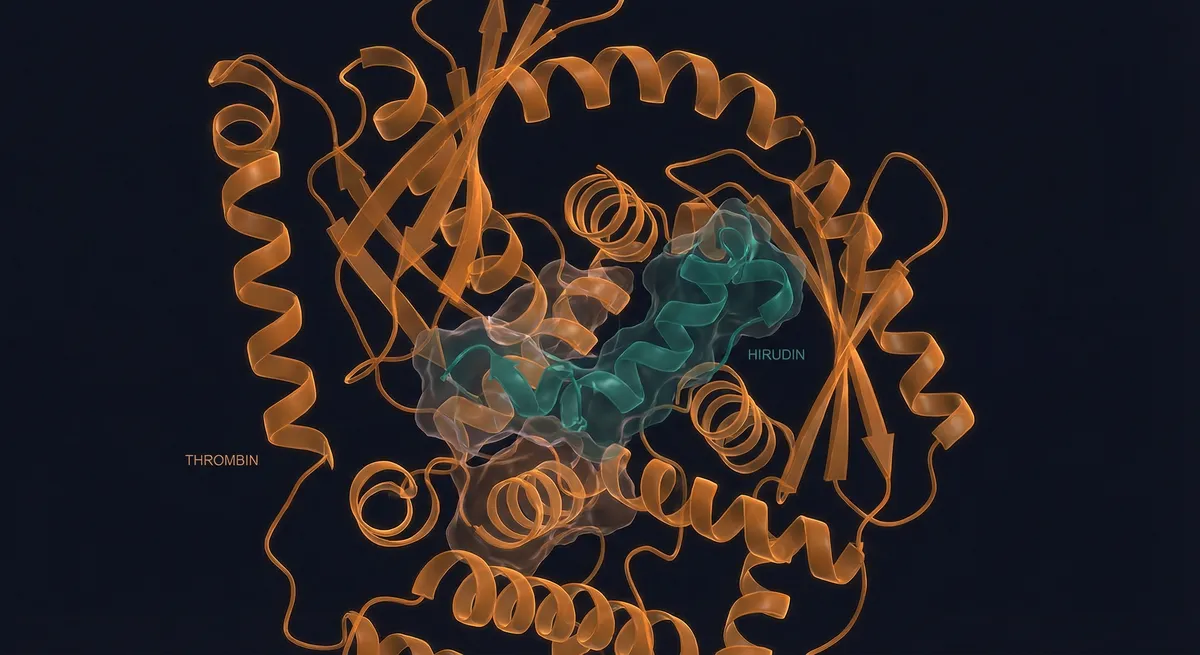
Hirudin (7.0 kDa, 65 amino acids, 3 disulfide bonds) is the most potent natural thrombin inhibitor known. It binds thrombin with a Kd of 2 × 10⁻¹⁴ M (20 femtomolar) through a unique bivalent mechanism: the N-terminal globular domain occupies the active-site cleft while the anionic C-terminal tail (sulfated Tyr⁶³) binds exosite 1. This dual engagement blocks all thrombin functions: fibrinogen clotting, factor V/VIII/XIII activation, and thrombin-induced platelet aggregation.
Factor Xa Inhibition — Antistasin & Lefaxin
Antistasin (15 kDa) and lefaxin (~14 kDa) block factor Xa, preventing prothrombinase complex assembly — the critical amplification step that converts prothrombin to thrombin. This targets the cascade upstream of thrombin, reducing thrombin generation rather than merely inhibiting existing thrombin. Originally identified by Tuszynski et al. (1987) in Haementeria officinalis; subsequently reported in Hirudo by Rigbi, Jackson, and Atamna (1995); lefaxin identified genomically (Kvist et al., 2020).
Fibrin Stabilization Blockade — Ghilanten
Ghilanten (~15 kDa, from <em>Haementeria ghilianii</em>) is a two-domain member of the antistasin family that potently inhibits factor Xa (Ki ~1.2 nM; Blankenship et al., 1990; Rester et al., 2001), acting on the prothrombinase complex. By suppressing thrombin generation upstream, it complements destabilase's action on already-stabilized clots.
Fibrinolytic Susceptibility — LCI
The leech carboxypeptidase inhibitor (LCI, ~7 kDa, Reverter et al., 1998) inhibits carboxypeptidase B / TAFIa (thrombin-activatable fibrinolysis inhibitor). TAFIa normally removes C-terminal lysines from fibrin, making it resistant to plasminogen binding and fibrinolysis. LCI maintains these lysine residues, preserving the thrombus's susceptibility to the body's endogenous fibrinolytic system.
Cascade Coverage Summary
- Initiation: Factor Xa inhibition (antistasin, lefaxin) → reduced thrombin generation
- Amplification: Direct thrombin inhibition (hirudin) → blocks all downstream effects
- Stabilization: Factor XIIIa inhibition (ghilanten) → prevents fibrin cross-linking
- Resolution: TAFIa inhibition (LCI) → maintains fibrinolytic susceptibility
- Thrombolysis: Isopeptidase activity (destabilase) → dissolves already-stabilized fibrin
Functional Architecture: Antiplatelet Cascade
Six SGS components create multi-layered blockade of the platelet adhesion-activation-aggregation cascade — targeting virtually every step.
| Platelet Step | SGS Inhibitor | Target | Mechanism |
|---|---|---|---|
| 1. Adhesion (collagen) | Calin (65 kDa) | Collagen types I, III | Blocks collagen-mediated platelet adhesion; does NOT inhibit aggregation |
| 2. Adhesion (vWF) | Saratin (12 kDa) | vWF-collagen binding | Prevents von Willebrand factor-dependent adhesion under high shear |
| 3. Activation (ADP) | Apyrase (~40 kDa) | Extracellular ADP | Hydrolyzes ADP released from dense granules; removes aggregation stimulus |
| 4. Activation (PAF) | PAF inhibitor (<1 kDa) | PAF receptor | Phosphoglyceride blocks mast cell-mediated platelet activation |
| 5. Activation (Ca²⁺) | LMW Ca²⁺ modulators (<0.5 kDa) | Receptor-dependent Ca²⁺/Na⁺ channels | Suppresses intracellular calcium signaling from thrombin and PAF |
| 6. Aggregation | Decorsin (4.4 kDa) | GP IIb/IIIa integrin | RGD-motif peptide blocks the final common pathway of aggregation |
| 7. Aggregation (thrombin) | Hirudin (7.0 kDa) | Thrombin | Blocks thrombin-induced platelet aggregation (secondary to DTI activity) |
Redundancy Demonstration
Baskova et al. (1987) demonstrated that when hirudin is depleted through repeated SGS collection without intervening blood meals, the secretion retains the ability to block platelet adhesion and intrinsic pathway coagulation. This proves that hirudin is not the sole anticoagulant determinant — calin, saratin, antistasin, the LMW Ca²⁺ modulators, and other components provide redundant protection. The evolutionary advantage is clear: no single host resistance mechanism can overcome the multi-target blockade.
Functional Architecture: Anti-Inflammatory
SGS contains the broadest spectrum of protease inhibitors found in any single biological secretion — targeting the coagulation, fibrinolytic, inflammatory, and complement cascades simultaneously.
Neutrophil Protease Inhibition
Eglins b/c (8.1 kDa, Seemuller et al., 1977) inhibit neutrophil elastase, cathepsin G, chymotrypsin, and subtilisin. They potentiate glucocorticoid activity and exhibit neurotrophic properties at low concentrations. Guamerin (5.6 kDa, Jung et al., 1995) provides additional elastase-specific inhibition. Piguamerin (~6 kDa, Kvist et al., 2020) is a dual elastase/trypsin inhibitor identified genomically. Together, these compounds block the tissue-destructive proteases released by activated neutrophils at sites of inflammation.
Mast Cell Tryptase Inhibition
LDTI (leech-derived tryptase inhibitor, 4.7 kDa, Sommerhoff et al., 1994) is a Kazal-type inhibitor that blocks mast cell tryptase — a key mediator of immediate hypersensitivity, bronchoconstriction, and tissue remodeling. Hirustasin (5.9 kDa, Sollner et al., 1994) additionally inhibits tissue kallikrein, modulating the kinin pathway that drives pain and vascular permeability. Together with kininases (which degrade bradykinin directly), these compounds create the analgesic effect observed at the leech bite site.
Complement System Blockade
The C1s complement inhibitor (67 kDa, Baskova et al., 1988; Tikhonenko, 2000) blocks the classical complement pathway at its initiation point. SGS also blocks the alternative complement pathway. The evolutionary purpose is dual: (1) protecting the leech's own tissues from complement-mediated attack during feeding, and (2) protecting the symbiotic Aeromonas bacteria in the leech gut from complement-mediated lysis. The therapeutic implication is complement-mediated inflammation reduction at the treatment site.
Fibrinolytic Pathway Modulation
Bdellins A/B (6.3/20 kDa, Fritz et al., 1969) inhibit trypsin and plasmin. Bdellastasin (~6 kDa, Moser et al., 1998) is an antistasin-family serine-protease inhibitor of trypsin, plasmin and acrosin (it does not inhibit factor Xa).
Multi-Target Protease Inhibition Profile
In 1987, Baskova, Nikonov, Mirkamalova, Zinenko, and Kozlov identified the capacity of SGS to block both classical and alternative complement pathways. Combined with inhibition of the coagulation (hirudin, antistasin, lefaxin), fibrinolytic (bdellins), and inflammatory (eglins, LDTI, guamerin) cascades, this represents a protease inhibition breadth unmatched in any other known biological secretion. It mirrors the multi-target approach of the entire SGS and explains why hirudotherapy produces systemic effects extending far beyond simple anticoagulation.
Destabilase: Thrombolytic Enzyme
Destabilase is the only known enzyme in nature capable of cleaving ε-(γ-Glu)-Lys isopeptide bonds in cross-linked (stabilized) fibrin — the bonds created by factor XIIIa that make mature thrombi resistant to conventional fibrinolytic therapy.
Dual Enzymatic Activity
Zavalova et al. (2000) demonstrated that a single 12.3 kDa protein has two distinct enzymatic activities:
- Destabilase-M (isopeptidase): Cleaves ε-(γ-Glu)-Lys bonds in D-dimer → monomerises cross-linked fibrin
- Destabilase-L (lysozyme): Muramidase activity → hydrolyzes bacterial peptidoglycan → gram-positive bactericidal
This dual function — thrombolytic + antibacterial in one molecule — is unique in enzymology.
Recombinant Destabilase
Kurdyumov et al. (2021) produced three recombinant destabilase isoforms and demonstrated that they dissolve human blood clots in vitro. Crystal structure was resolved at 1.1 Å resolution — the highest resolution for any leech-derived protein. Both isopeptidase and lysozyme activities were retained in the recombinant form, confirming the feasibility of pharmaceutical development.
Neurotrophic Activity
Destabilase exhibits neurotrophic effects at extraordinarily low concentrations — 10⁻¹² M (picomolar). At these concentrations, it promotes neurite outgrowth in cultured neurons, suggesting a function entirely distinct from its thrombolytic activity. This neurotrophic capacity is shared with bdellins and bdellastatin, indicating that SGS protease inhibitors may have dual roles in tissue repair and neural recovery.
Seasonal Availability
The isopeptidase (thrombolytic) activity of destabilase virtually disappears during autumn-winter and reappears in May, remaining high through September (Baskova et al., 1984). This seasonal variation has direct clinical implications: leeches used during winter provide strong antithrombin activity but reduced thrombolytic capacity, while summer leeches offer the full complement of both activities.
Tissue Penetration & Spreading Mechanism
SGS must penetrate host tissues rapidly to deliver its bioactive payload into the microcirculatory bed. Three components facilitate this process.
Hyaluronidase (Orgelase)
28.5 kDa enzyme that depolymerises hyaluronic acid via a unique β(1→4) glucuronidic bond specificity — in contrast to all known mammalian hyaluronidases, which cleave β(1→3) bonds (Linker, Meyer & Hoffman, 1960). First described as a “spreading factor” (a concept originating with Duran-Reynals), with the enzyme characterized by Karl Meyer's group; leech hyaluronidase enhances tissue permeability. Purified by Yuki & Fishman (1963); confirmed unable to hydrolyze chondroitin and its derivatives, unlike β-hyaluronidases. Thermally stable (withstands 1 h at 50°C), active across a wide pH range, and — critically for clinical applications — not inhibited by heparin (unlike testicular hyaluronidase), enabling concurrent use with anticoagulant therapy. Patented by Biopharm (Roy Sawyer, 1988) as Orgelase for cardiovascular and ophthalmological applications, using its anti-ischaemic properties and heparin compatibility as a tissue-penetrating drug delivery agent.
Collagenase
~100 kDa enzyme that degrades collagen fibrils in the extracellular matrix (Baskova et al., 1984). Works synergistically with hyaluronidase: while hyaluronidase removes the ground substance between collagen fibrils, collagenase degrades the fibrils themselves. This dual ECM breakdown enables deep tissue penetration by other SGS components.
Histamine-Like Vasodilator
A low-molecular-weight compound (<0.5 kDa) that activates H1 and H2 receptors, producing vasodilation and increased capillary permeability (Claude, 1937). This enhances blood flow to the bite site and creates the sustained vasodilation observed during and after feeding. Combined with acetylcholine (identified by Babenko et al., 2020) and 6-keto-PgF1α (prostacyclin metabolite; Baskova & Nikonov, 1987), SGS provides triple vasodilatory redundancy.
Antimicrobial Defense
SGS antimicrobial activity serves a dual evolutionary purpose: preventing infection at the bite wound (protecting the host's blood meal from contamination) and maintaining the leech's gut microbiome.
Destabilase-L (Lysozyme)
The same 12.3 kDa destabilase protein that exhibits isopeptidase (thrombolytic) activity also functions as a muramidase — hydrolyzing bacterial cell wall peptidoglycan. This dual-function enzyme provides gram-positive bactericidal activity at the bite site while simultaneously dissolving cross-linked fibrin. The lysozyme activity was confirmed by Zavalova et al. (2000) and retained in all three recombinant isoforms (Kurdyumov et al., 2015).
Antimicrobial Peptides (Classical)
Tasiemski et al. (2004) characterized two antimicrobial peptides — theromacin and theromyzin — from the leech Theromyzon tessulatum. Homologous membrane-active peptides in medicinal leeches provide broad-spectrum antimicrobial protection at the bite wound, helping to explain why leech-bite infections are relatively rare despite the deliberate introduction of Aeromonas bacteria from the leech gut.
Complement Evasion Strategy
The C1s complement inhibitor (67 kDa) serves a fascinating evolutionary role: it protects the leech's symbiotic Aeromonas hydrophila bacteria from complement-mediated lysis during feeding. Without this protection, the host's complement system would destroy the bacteria that the leech depends on for blood digestion. This same mechanism produces anti-inflammatory effects at the clinical treatment site.
Aeromonas Paradox
The medicinal leech harbors Aeromonas hydrophila / A. veronii as obligate gut symbionts. These bacteria produce enzymes essential for blood meal digestion but are potentially pathogenic to humans. SGS antimicrobial peptides partially control bacterial load at the bite site, but prophylactic antibiotics (fluoroquinolones or trimethoprim-sulfamethoxazole) are standard clinical practice. See the dedicated Aeromonas management page for protocols.
Seasonal Variation & Clinical Implications
SGS composition is not static — it varies by season, collection frequency, and feeding state, with direct implications for clinical standardization.
| Parameter | Spring/Summer (May–Sep) | Autumn/Winter (Oct–Apr) | Clinical Implication |
|---|---|---|---|
| Antithrombin activity (hirudin) | Moderate | Higher | Winter leeches may provide stronger anticoagulation |
| Thrombolytic activity (destabilase isopeptidase) | High (present May–Sep) | Virtually absent | Summer leeches offer thrombolytic + anticoagulant; winter leeches anticoagulant only |
| Overall SGS complement | Full activity spectrum | Reduced thrombolytic component | Biofactory protocols should account for seasonality in product standardization |
Collection Frequency Effects
Repeated SGS collection at one-month intervals without intervening blood meals shows a clear depletion pattern (Baskova et al., 1984):
- Collections 1–2: High antithrombin activity
- Collection 3: Sharp decline in antithrombin activity
- Collection 4: Antithrombin activity disappears entirely
- After blood meal: Full activity restored
Critically, antiplatelet and intrinsic pathway inhibition persist even when hirudin is fully depleted — confirming redundant anticoagulant mechanisms.
Temporal Feeding Variation
The continuous-flow method (Baskova et al., 2001) demonstrated that SGS composition changes during a single feeding session. Sequential UV spectral analysis showed absorption peaks shifting toward longer wavelengths as feeding progresses:
- First minutes: Maximum peptide/protein concentration (short-wavelength UV absorption) — most potent anticoagulant delivery
- Subsequent fractions: Trace amounts only
- Final fraction (15th): Minimal bioactive content
This “front-loading” strategy delivers the most critical anticoagulant molecules within the first minutes of attachment.
Low-Molecular-Weight Ion Modulators
Receptor-Dependent Ion Channel Modulation
The LMW fraction (<500 Da) of SGS produces highly specific effects on platelet ion transport (Afanasyeva et al., 1999):
| Ion Channel | SGS LMW Effect | Comparison to Losartan |
|---|---|---|
| Receptor-dependent Ca²⁺ entry (platelets) | Suppressed (thrombin & PAF response) | Similar effect |
| Receptor-dependent Na⁺ depolarization | Suppressed | Not reported for losartan |
| Receptor-independent Ca²⁺ efflux (erythrocytes) | No effect | Altered by losartan |
| Ca²⁺-dependent K⁺ channels (erythrocytes) | No effect | Altered by losartan |
This selectivity for receptor-dependent (but not receptor-independent) ion transport suggests that the LMW fraction acts at the receptor level rather than on the ion channels themselves — a mechanism distinct from conventional calcium channel blockers. The molecular identity of these modulators remains to be elucidated.
Lipid Pharmacology
SGS contains lipids, with functional significance for both antiplatelet activity and pharmaceutical formulation.
Lipid Composition
- Total lipids: present in SGS
- Neutral lipids: ~2/3 of total
- Polar lipids: ~1/3 of total
- Phosphatidylcholine: Significant quantities; enables liposomal structure formation
- Free fatty acids: Present in significant amounts
- Phosphoglyceridol: Functions as PAF antagonist — inhibits PAF-stimulated platelet aggregation (Hu-Am & Orevi, 1992)
Oral Bioavailability & Piyavit
The lipid content of SGS may enable formation of liposomal structures that facilitate oral absorption via pinocytosis — penetrating from the intestine into the bloodstream (Baskova & Nikonov, 1986). This property is the pharmacological foundation for Piyavit, the oral pharmaceutical formulation derived from whole leech extract. Piyavit was registered in Russia (1994, re-registered 2001) specifically for treatment and prevention of superficial vein thrombophlebitis.
Prostacyclin Metabolite
In 1987, Baskova and Nikonov detected prostaglandins in SGS in the form of 6-keto-prostaglandin F1α, a stable metabolite of prostacyclin (PGI₂). Prostacyclin is the most potent endogenous inhibitor of platelet aggregation and a powerful vasodilator. Its presence in SGS adds an additional antiaggregant and vasodilatory pathway — complementing hirudin (anti-thrombin), calin (anti-adhesion), and decorsin (anti-aggregation).
Lipase & Cholesterol Esterase
SGS contains lipase (~45 kDa) and cholesterol esterase activities (Baskova et al., 1984) that catalyze hydrolysis of triglycerides and cholesterol esters. These enzymes are implicated in the anti-atherosclerotic properties observed in clinical studies (detailed in the atherosclerosis mechanisms page). They are also an active component of the Piyavit oral formulation.
DNA Methylation & Epigenetic Effects
Epigenetic Modification by SGS
Nikonov et al. (1990) demonstrated a remarkable epigenetic effect: SGS stimulates a 39% increase in 5-methylcytosine content in rat liver DNA within one hour of intraperitoneal perfusion. Key features:
- Magnitude: Unsupported claim removed.
- Speed: Detectable within 1 hour
- Reversibility: Fully reversed within 24 hours
- Tissue: Demonstrated in liver (systemic effect)
DNA methylation is a fundamental epigenetic mechanism that regulates gene expression without altering the DNA sequence. A transient, reversible increase in methylation could modulate inflammatory gene expression, cellular differentiation, and tissue repair pathways. This finding represents one of the earliest demonstrations of a pharmacologically induced, reversible epigenetic modification — predating the modern field of epigenetic therapeutics by decades. The specific SGS component responsible and the gene targets affected remain unidentified, representing a significant research opportunity.
Absence of Nonspecific Proteolytic Activity
What SGS Does NOT Do
- No caseinolytic activity (Rigbi et al., 1987)
- Cannot activate plasminogen to plasmin
- Cannot dissolve non-stabilized fibrin (Baskova & Nikonov, 1985)
- Cannot hydrolyze plasmin-specific chromogenic substrate (D-Val-Leu-Lys paranitroanalide)
- No broad-spectrum proteolytic activity at any season
Why This Matters
The absence of generalized proteolytic activity is as important as the specific enzyme activities present. A secretion containing broad-spectrum proteases would destroy its own bioactive components — hirudin, calin, destabilase, eglins — before they could exert their effects. The evolutionary solution is elegant: SGS contains highly specific hydrolases (destabilase targets only ε-(γ-Glu)-Lys bonds; hyaluronidase targets only HA β(1→4) bonds) but no generalized proteases, ensuring that all bioactive proteins survive intact in the wound microenvironment.
Genomic Revolution: From Biochemistry to Multi-Omics
Classical biochemistry identified ~30–40 SGS components. Modern genomics, transcriptomics, and proteomics have expanded this to >200 proteins — transforming our understanding of the medicinal leech as a pharmacological resource.
| Study | Method | Key Findings | Novel Components |
|---|---|---|---|
| Liu et al. (2019) | Proteome + transcriptome integration | A large repertoire of full-length protein sequences and bioactive transcripts across multiple functional categories | Multiple novel proteins across all 6 categories |
| Babenko et al. (2020) | Genome assembly (H. medicinalis) | Draft genome assembly; multiple anticoagulation and antihemostatic proteins | Hirudin-like factor 3, lefaxin, piguamerin, ficolins, cystatins |
| Babenko et al. (2020) | RNA-seq on salivary cells (3 species) | Comparative salivary transcriptome across H. medicinalis, H. orientalis, H. verbana | M12/M13 proteases, CRISP proteins, apyrase, ADA, cystatins, ficolins, acetylcholine |
| Lukas et al. (2022) | Structural biology | Tandem-Hirudin: first oligomeric hirudin superfamily member from Hirudinaria manillensis | Two globular domains in tandem; lacks C-terminal tail; NO thrombin inhibition |
| Guan et al. (2024) | Proteome + transcriptome (starvation) | Starvation-induced changes in SGS composition of Hirudo nipponia | Demonstrated that nutritional state modulates SGS protein expression |
| Manuvera et al. (2024) | Recombinant expression + coagulation assays | Novel cysteine-rich anticoagulant (CRA) protein; high activity in aPTT, PT, TT; C-terminal motif critical | New anticoagulant expanding the characterized secretome (Biomolecules 15(12):1633) |
| Chosun/KBSI (2025) | 3D holotomographic screening + AI bioinformatics | Hirunipin-2: novel AMP from H. nipponia salivary glands; anti-MDR and anti-biofilm activity | Active against multidrug-resistant Acinetobacter; first AI-assisted AMP discovery from leech SGS (Advanced Science, Wiley) |
| Serebrennikova et al. (2025) | Genome mining + heterologous expression | Three novel AMPs: LBrHM1, NrlHM1, NrlHM2 from H. medicinalis | Expands antimicrobial peptide repertoire beyond classical trio (IJMS 26(14):6903) |
| EV biogenesis (2025) | Cell biology (EV characterization) | First study on extracellular vesicle biogenesis in H. nipponia salivary gland cells | EVs as potential natural bioactive carriers for leech-derived compounds — drug delivery platform (ScienceDirect) |
| Microalgae hirudin (2025) | Recombinant expression in C. reinhardtii | First functional hirudin produced in GRAS microalga with proper tyrosine sulfation | Overcomes E. coli/yeast limitations; scalable plant-based production (bioRxiv preprint) |
Scale of Discovery
- Classical biochemistry (1884–2004): ~30–40 components characterized
- Proteomics/transcriptomics (2020): a large repertoire of salivary proteins characterized
- Genomics (2020): multiple anticoagulation and antihemostatic genes encoded
- Novel compounds (2025): CRA protein, hirunipin-2, LBrHM1/NrlHM1/NrlHM2 — expanding the growing repertoire of characterized salivary components
- Total identified to date: >200 distinct proteins functionally described
- Functionally characterized: <50 (≈12%)
- Exploited pharmaceutically: ~5 (≈1.1%)
Species Comparison
Babenko et al. (2020) — co-authored by I.P. Baskova, author of the foundational text — performed comparative RNA-seq across three medicinal leech species. While the core anticoagulant toolkit (hirudin, destabilase, calin) is conserved, significant differences in CRISP protein expression, M12/M13 protease profiles, and antimicrobial peptide repertoires were observed between species. These differences may have clinical relevance: H. verbana (the species most commonly supplied in the US) and H. medicinalis (the European standard) may deliver subtly different SGS compositions.
Pharmaceutical Legacy
The medicinal leech is the source organism for three FDA-approved pharmaceuticals — making it one of the most successful examples of zoopharmaceutical drug discovery in modern medicine.
| Drug | SGS Progenitor | FDA Approval | Indication | Status |
|---|---|---|---|---|
| Bivalirudin (Angiomax) | Hirudin → 20-aa synthetic analog | 2000 | PCI anticoagulation (ACC/AHA Class I for STEMI) | Generic available; $636M peak revenue; projected $887M by 2030 |
| Desirudin (Iprivask) | Recombinant hirudin (65 aa) | 2003 | DVT prophylaxis in hip replacement | Available (limited use) |
| Dabigatran (Pradaxa) | Hirudin → non-peptide DTI (oral) | 2010 | AF stroke prevention; VTE treatment/prevention | $3.5B annual revenue; launched DOAC revolution |
Pipeline Candidates
- Recombinant destabilase: Thrombolytic + antibacterial; crystal structure at 1.1 Å; dissolves human clots in vitro (preclinical)
- Decorsin analogs: GP IIb/IIIa antagonists for antiplatelet therapy (research)
- Saratin: Anti-adhesion for arterial thrombosis prevention (research)
- Eglin c analogs: Anti-inflammatory protease inhibition (research)
- Orgelase (hyaluronidase): Cardiovascular/ophthalmological applications (patented)
- Novel hirudin variants: engineered variants in preclinical development
- Microalgae-produced hirudin (2025): First functional recombinant hirudin in Chlamydomonas reinhardtii (GRAS microalga) with proper tyrosine sulfation — overcoming E. coli and yeast limitations for scalable, cost-effective production (bioRxiv preprint)
- Extracellular vesicle (EV) delivery (2025): First study of EV biogenesis in H. nipponia salivary gland cells — EVs as natural bioactive nanocarriers for leech-derived compounds, opening a novel drug delivery platform (ScienceDirect)
- Hirunipin-2 anti-MDR peptide (2025): Novel AMP from H. nipponia active against multidrug-resistant bacteria including Acinetobacter; anti-biofilm activity — potential for addressing antimicrobial resistance crisis (Advanced Science, Wiley)
Zoopharmaceutical Context
Among all animal-derived pharmaceuticals, the medicinal leech holds a unique position. The medicinal leech is the source or inspiration for three anticoagulant drugs (lepirudin, desirudin, bivalirudin) — an unusually large contribution for a single organism among animal-derived pharmaceuticals. For comparison: cone snails contributed one (ziconotide), Gila monster one (exenatide), and pit vipers one (captopril inspiration). The leech's disproportionate contribution reflects both the pharmacological richness of SGS and the 141-year research tradition following Haycraft's discovery.
The Unexploited Pharmacopeia
Known Unknowns
- Pseudohirudin (5 kDa): hirudin homologue with no antithrombin activity — function unknown since 1980
- Tandem-Hirudin: oligomeric hirudin family member that does NOT inhibit thrombin — what does it do?
- CRISP proteins (~25 kDa): ion channel modulators of unknown specificity
- Ficolins (~35 kDa): innate immune modulators — therapeutic potential unexplored
- M12/M13 proteases: SGS maturation enzymes — could they be exploited for pro-drug activation?
- Adenosine deaminase: purinergic signaling modulator — immunomodulatory potential
Future Discovery Approaches
- Complete genome annotation: Finish functional annotation of all 440+ identified protein sequences
- AI-driven drug design: Use SGS compound scaffolds as starting points for computational optimization — now validated by AI-assisted discovery of hirunipin-2 (2025)
- Species comparison: Systematically compare SGS across H. medicinalis, H. verbana, H. orientalis, and non-medicinal species
- Single-cell transcriptomics: Identify which salivary gland cell types produce which compounds
- Cryo-EM structural biology: Resolve 3D structures of all major SGS proteins for structure-based drug design
- Clinical-grade standardization: Develop validated assay panels for SGS quality control
- EV-based drug delivery: Use extracellular vesicle biogenesis discovered in H. nipponia salivary glands (2025) as natural nanocarriers for targeted delivery of leech-derived therapeutics
- Alternative production platforms: Expand microalgae-based recombinant production (demonstrated for hirudin in C. reinhardtii, 2025) to other SGS proteins requiring post-translational modifications
The SGS of Hirudo medicinalis represents one of the most pharmacologically rich biological secretions in the animal kingdom. Its systematic characterization, still far from complete, continues to reveal molecules with potential therapeutic applications extending well beyond anticoagulation — as demonstrated by five major discoveries in 2025 alone. ASH supports continued investment in SGS research as a foundation for evidence-based practice and pharmaceutical innovation.
Key SGS Characterization Studies
| Study | Design | Population (n=) | Intervention | Key Outcome | Result |
|---|---|---|---|---|---|
| Haycraft JB 1884 | Biochemical characterization | Hirudo medicinalis SGS (n=NR) | Extraction and bioassay | Anticoagulant activity | First demonstration leech secretion prevents coagulation; identified unicellular glands. Proc R Soc Lond |
| Markwardt F 1955 | Biochemical characterization | Hirudo medicinalis SGS (n=NR) | Extraction and purification | Thrombin inhibition | First isolation of pure hirudin; thrombin-specific inhibition confirmed. Hoppe-Seyler Z Physiol Chem |
| Fritz H et al. 1969 | Biochemical characterization | Hirudo medicinalis SGS (n=NR) | Extraction and purification | Protease inhibition | Discovery of bdellin A (6.3 kDa) and B (20 kDa); trypsin/plasmin inhibition. Hoppe-Seyler Z Physiol Chem |
| Seemuller U et al. 1977 | Biochemical characterization | Hirudo medicinalis SGS (n=NR) | Extraction and purification | Neutrophil elastase / cathepsin G inhibition | Isolation of eglins b/c (8.1 kDa); neutrophil elastase and cathepsin G inhibition. Hoppe-Seyler Z Physiol Chem |
| Baskova IP & Nikonov GI 1985 | Biochemical characterization | Hirudo medicinalis SGS (n=NR) | Extraction and enzymatic assay | Fibrinolytic / isopeptidase activity | Discovery of destabilase isopeptidase — first enzyme cleaving ε-(γ-Glu)-Lys bonds in stabilized fibrin. Biokhimiya |
| Baskova IP et al. 1987 | In vitro / preclinical | Hirudo medicinalis SGS (n=NR) | Hirudin-depleted SGS fraction bioassay | Antiplatelet and intrinsic pathway inhibition | Hirudin-depleted SGS retains antiplatelet and intrinsic pathway inhibition — redundant anticoagulant mechanisms demonstrated. Biokhimiya |
| Rigbi M et al. 1987 | Biochemical characterization | Hirudo medicinalis SGS (n=NR) | Phagostimulation collection (arginine-based) | Eglin-like and anticoagulant activities | Developed arginine-based phagostimulation method; confirmed eglin-like and anticoagulant activities in collected secretion. Comp Biochem Physiol |
| Seymour JL et al. 1990 | Biochemical characterization | Macrobdella decora SGS (n=NR) | Extraction and purification | Platelet GP IIb/IIIa integrin antagonism | Discovery of decorsin (4.4 kDa, RGD motif) — platelet GP IIb/IIIa integrin antagonist. J Biol Chem |
| Munro R et al. 1991 | Biochemical characterization | Hirudo medicinalis SGS (n=NR) | Extraction and purification | Platelet adhesion inhibition | Characterization of calin (65 kDa) — collagen-mediated platelet adhesion inhibitor; key mechanism for prolonged post-bite bleeding. Blood Coagul Fibrinolysis |
| Baskova IP et al. 2001 | Biochemical characterization | Hirudo medicinalis SGS (n=NR) | Contamination-free phagostimulation collection | SGS composition during feeding | Contamination-free collection method developed; SGS composition varies during feeding — most potent peptides released in first minutes. Bioorg Khim |
| Zavalova LL et al. 2000 | Biochemical characterization | Hirudo medicinalis SGS (n=NR) | Recombinant expression and enzymatic assay | Dual isopeptidase / lysozyme activity | Destabilase exhibits both isopeptidase (thrombolytic) and lysozyme (antibacterial) activities in a single 12.3 kDa protein. Biochemistry (Moscow) |
| Kvist S et al. 2020 | Genome assembly | Hirudo medicinalis SGS (n=NR) | Whole-genome sequencing and annotation | Antihemostatic gene catalog | Draft genome assembly with annotation of multiple anticoagulation and antihemostatic protein genes. Sci Rep |
| Babenko VV et al. 2020 | Proteomics/transcriptomics | 3 Hirudo species SGS (n=NR) | Salivary cell RNA-seq | Novel secreted protein discovery | RNA-seq across 3 species; discovered M12/M13 proteases, CRISP proteins, apyrase, ADA, cystatins, and ficolins. BMC Genomics |
| Lukas P et al. 2022 | Biochemical characterization | Hirudinaria manillensis SGS (n=NR) | Recombinant expression and structural analysis | Hirudin superfamily structure | Tandem-Hirudin — a tandem two-domain member of the hirudin superfamily; no thrombin inhibition despite structural similarity. Parasitol Res |
| Kurdyumov AS et al. 2015 | In vitro / preclinical | Recombinant Hirudo medicinalis destabilase (n=NR) | Recombinant expression and enzymatic characterization | Isopeptidase / lysozyme activity | Characterization of recombinant destabilase-lysozyme isoforms retaining isopeptidase (thrombolytic) and antibacterial activities. BMC Biochem |
Evidence Gaps & Research Priorities
Despite 141 years of investigation, SGS characterization remains incomplete. The number of identified proteins now numbers in the hundreds (Babenko et al., 2020; Manuvera et al., 2025; Serebrennikova et al., 2025), but functional roles have been established for fewer than 50. Key research priorities include:
Functional Characterization
- Over 150 proteins identified via proteomics await biochemical characterization
- CRISP proteins, ficolins, and M12/M13 proteases have unknown therapeutic relevance
- Tandem-Hirudin's function (despite hirudin homology but no thrombin activity) is unknown
- Pseudohirudin (5 kDa, no antithrombin activity) — function unresolved since 1980
Standardization & Translation
- Seasonal variation complicates dosing standardization for clinical use
- Species differences (H. medicinalis vs H. verbana vs H. orientalis) insufficiently characterized
- No validated assay panel for SGS quality control in clinical-grade leeches
- AI-driven drug design from SGS scaffolds — now partially validated by hirunipin-2 discovery using AI bioinformatics (2025)
- Microalgae recombinant production (hirudin in C. reinhardtii, 2025) needs scale-up and clinical-grade validation
- Extracellular vesicle drug delivery potential (demonstrated in H. nipponia salivary cells, 2025) requires cargo-loading optimization and pharmacokinetic characterization
Related Research
434 Salivary Proteins — Integrated Proteomics of Hirudo medicinalis
Integrated proteomics and transcriptomics study identifying 434 full-length protein sequences from H. medicinalis salivary glands, including 44 confirmed bioactive proteins and 221 bioactive transcripts across 6 functional categories.
Liu et al. · Journal of Proteomics
Protein-lipid particles of medicinal leech salivary gland secretion; their size and morphology
The relative location of proteins and lipids in particles of medicinal leech salivary gland secretion (SGS) is revealed for the first time.
Baskova IP et al. · Biochemistry. Biokhimiia
In-depth profiles of bioactive large molecules in saliva secretions of leeches determined by combining salivary gland proteome and transcriptome data
Combined proteomic and transcriptomic analysis deduces 434 full-length salivary protein sequences and identifies 44 proteins and 221 transcripts of bioactive molecules across multiple medicinal leech species, mapping the molecular diversity of leech saliva.
Liu Z, Tong X, Su Y et al. · Journal of proteomics
In-depth profiles of bioactive large molecules in saliva secretions of leeches determined by combining salivary gland proteome and transcriptome data
Proteome plus transcriptome integration yielded 434 full-length protein sequences from leech salivary glands with 44 proteins and 221 transcripts of bioactive molecules involved in leech sucking pathways.
Liu Z et al. · Journal of proteomics
Proteins and peptides of the salivary gland secretion of medicinal leeches Hirudo verbana, H. medicinalis, and H. orientalis
Two-dimensional electrophoresis revealed >100 silver-stained proteins shared across Hirudo verbana, H. medicinalis, and H. orientalis salivary gland secretions; MALDI-TOF MS confirmed 30-40% mass overlap and Jacquard's coefficient supported phylogenetic relationship between H. medicinalis and H. orientalis.
Baskova IP et al. · Biochemistry (Moscow)
[Research progress in hirudin fusion protein--review]
Natural hirudin extracted from the secretion of medical leech salivary gland is a single-chain peptide containing 65 aminoacid residues with molecular weight of 7000 D, and exists in three isomers of HV1, HV2 and HV3.
Zhang C et al. · Zhongguo shi yan xue ye xue za zhi
Related Resources
Science Hub
Overview of SGS research field.
Hemostasis & Coagulation
Anticoagulant mechanisms in depth.
Proteinase Inhibitors
14 characterized inhibitor profiles.
Neurotrophic Effects
Destabilase, bdellins, and neural repair.
Bivalirudin
From leech hirudin to FDA-approved drug.
Leech Extracts & Piyavit
Oral pharmaceutical development.