Nursing Protocols
Nursing-specific assessment, monitoring, and documentation for leech therapy
FDA-aligned clinical protocolsTraining & operational reference
Practice Context
Registered nurses are the primary applicators of medicinal leeches in hospital settings. All nursing care proceeds under physician orders.
Nurses play a central role in hirudotherapy — from pre-procedure patient assessment through post-discharge follow-up. These protocols provide nursing-specific guidance for safe, effective leech therapy implementation.
Pre-Procedure Assessment
Patient Assessment Checklist
- Verify physician orders (number of leeches, application sites, frequency)
- Confirm signed informed consent in medical record
- Review baseline labs: CBC, PT/INR, aPTT, type and screen
- Verify antibiotic prophylaxis initiated (ciprofloxacin or TMP-SMX)
- Check allergy history: antibiotics, latex, prior leech reactions
- Assess current medications: anticoagulants, antiplatelets, NSAIDs
- Obtain baseline vital signs (BP, HR, O2 sat, temperature)
- For surgical patients: assess tissue color, capillary refill, Doppler signal
Contraindication Screen
Absolute:
- Arterial insufficiency at application site
- Hemophilia or hemorrhagic diathesis
- Severe anemia (Hgb <8 g/dL without transfusion)
- Active sepsis
- Decompensated hepatobiliary disease
Relative:
- Pregnancy, immunosuppression
- Anticoagulant therapy (coordinate with surgeon)
- Platelets <50,000/µL
- INR >3.0
Application Protocol
Step-by-Step Application
- Prepare environment: Post "No Fragrances" notice. Ensure room temperature 72-77°F. Position patient comfortably.
- Don PPE: Nitrile gloves (mandatory), gown if splash risk, eye protection for head/neck applications.
- Prepare site: Cleanse with warm water only — no alcohol, betadine, chlorhexidine, or scented soaps.
- Select leeches: Active, mobile, strong contraction reflex, smooth body, 6-10 cm extended.
- Apply: Transfer leech to small clean container. Invert over prepared site. Once feeding begins, cover loosely with gauze.
- Alternative (syringe guide): Remove plunger from 5-10 mL syringe. Place leech inside barrel. Press tip to skin at exact target.
- If leech refuses: Ensure warm, chemical-free skin. Prick with sterile needle for blood droplet. Try a different leech.
NEVER leave patient unattended with applied leeches. NEVER forcibly remove a feeding leech.
Monitoring Parameters
| Parameter | Frequency | Action Threshold |
|---|---|---|
| Vital signs | Every 30 min | SBP <90 or HR >120: evaluate for hypovolemia |
| Tissue assessment | Every 30 min | Document color, turgor, capillary refill, Doppler |
| Hematocrit | Every 4-8 hours | Hgb <7: transfuse. Hgb 7-8: clinical judgment |
| Leech feeding status | Continuous | Document attachment time, duration, detachment |
| Post-detachment bleeding | Every 1-2 hours x 6 hours | See excessive bleeding protocol |
| Pain (NRS 0-10) | Every 2 hours | >5: acetaminophen; avoid NSAIDs |
Post-Detachment Care
Wound Dressing
- Apply clean, dry gauze (4x4) over bite — no pressure
- Layer additional absorbent pads
- Secure with tape or light wrap — no compression
- When saturated, add layers on top — DO NOT remove underlying dressing for 24 hours
- Place absorbent underpads beneath treatment area
Expected: Oozing 4–24 hours. Prolonged oozing is expected and therapeutic.
Leech Disposal
- Place detached leech in 70% ethyl alcohol
- Confirm death (no movement for 5 min)
- Transfer to red biohazard waste container
- Seal and label per OSHA standards
NEVER reuse a leech. NEVER return fed leech to storage.
Documentation Requirements
Per-Session Nursing Documentation
During Session:
- Date, time, and duration of session
- Number of leeches applied
- Anatomic location(s)
- Duration of each leech attachment
- Post-detachment bleeding: duration, estimated volume
- Vital signs before and after
Assessment Notes:
- Tissue assessment (surgical): color, capillary refill, Doppler, temp
- Patient tolerance and any adverse reactions
- Leech disposal confirmed (biohazard waste)
- Antibiotic prophylaxis administered per orders
- Pain assessment scores
- Patient/family education provided
Complication Recognition
Infection Signs (Notify MD)
- Expanding erythema disproportionate to expected inflammation
- Purulent discharge from bite wound
- Increased warmth, tenderness, induration
- Fever, leukocytosis, elevated CRP
- Tissue color change, turgor loss
- Maintain vigilance for 26 days post-last application
Emergency Situations
- Anaphylaxis: Epinephrine IM, activate emergency response
- Leech migration: Into mouth/nose/ear — immediate retrieval, assess airway
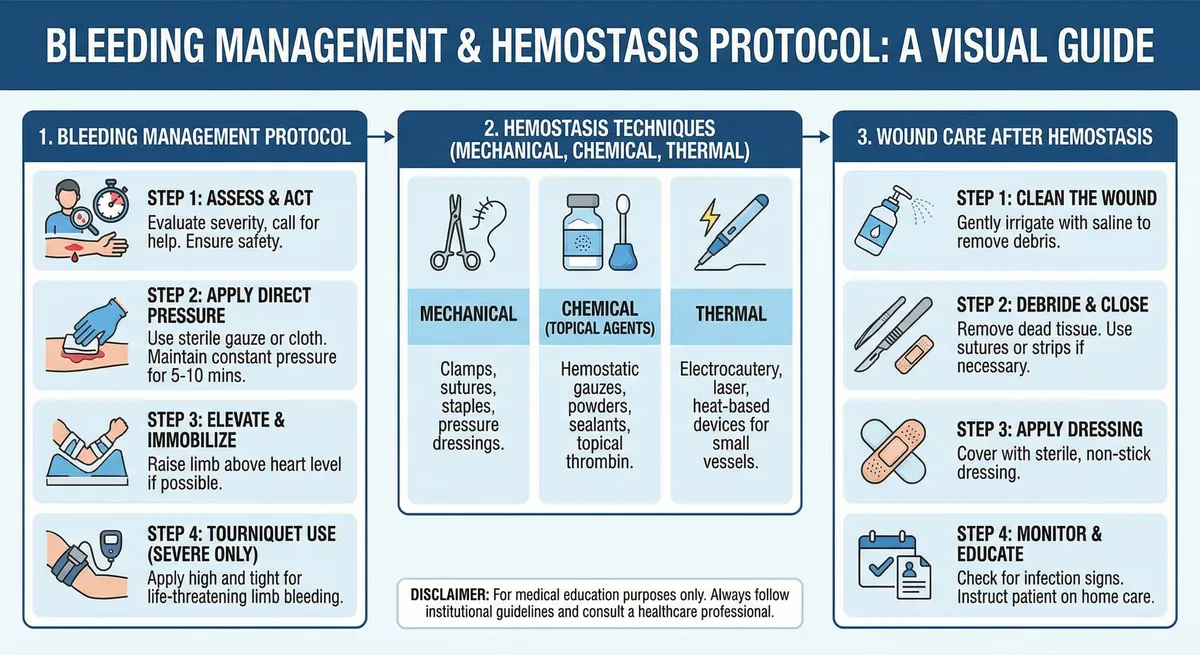
- Excessive bleeding: Pressure, silver nitrate, topical thrombin, suture if refractory
- Vasovagal syncope: Trendelenburg position, monitor vital signs